Discovering Xinomavro
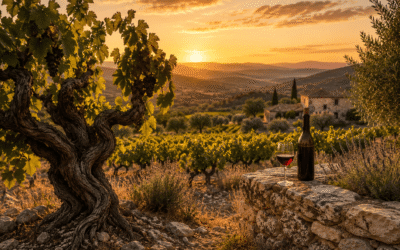
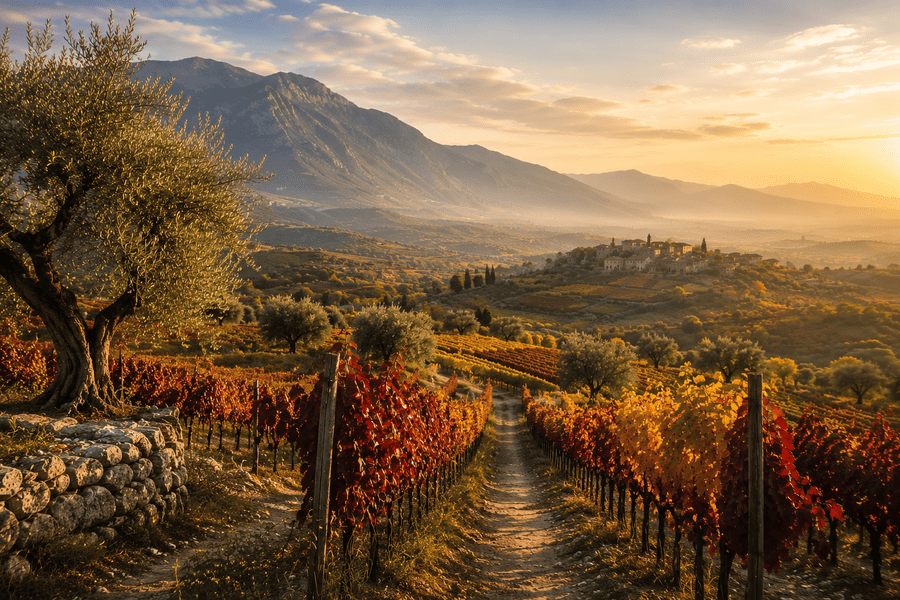
Autumn arrives quietly in northern Greece.
The summer heat softens as cool mountain air drifts through the vineyards, turning the landscape into a patchwork of golden vines, crimson leaves, and ancient olive groves. Stone villages perch along rolling hillsides where generations of families have cultivated the land, and long lunches unfold at an unhurried pace beneath shaded terraces.
The table is simple but abundant. Fresh bread still warm from the oven, olives glistening with local olive oil, roasted vegetables seasoned with fragrant herbs, and slow-roasted lamb prepared with recipes passed down through generations. Conversation flows effortlessly, punctuated by laughter, shared stories, and the occasional pause to appreciate another sip of wine.
Then, a bottle is uncorked.
Deep ruby wine catches the afternoon light as it fills each glass, revealing aromas of ripe red fruit, wild herbs, dried tomato, earthy spice, and a subtle hint of roses. With every swirl, another layer reveals itself. Bright acidity brings the wine to life, while firm tannins promise that this bottle still has many years ahead of it.
The wine is Xinomavro.
Outside of Greece, many wine lovers have never heard its name. Yet among sommeliers, collectors, and adventurous enthusiasts, Xinomavro has quietly earned a reputation as one of Europe’s most captivating red wines. Revered for its remarkable ability to age gracefully and its distinctive character, it has become one of the country’s greatest expressions of place, tradition, and craftsmanship.
It isn’t a wine that demands attention through bold marketing or worldwide fame. Instead, it rewards curiosity. Those willing to venture beyond familiar grapes like Cabernet Sauvignon, Pinot Noir, or Sangiovese often discover a wine that is both unmistakably Greek and surprisingly familiar in its elegance, complexity, and structure.
Sometimes the world’s most memorable wines aren’t the ones everyone already knows.
They’re the ones waiting patiently to be discovered.
So, what exactly is Xinomavro—and why do so many sommeliers believe it deserves a place on every wine lover’s radar?
What Is Xinomavro?
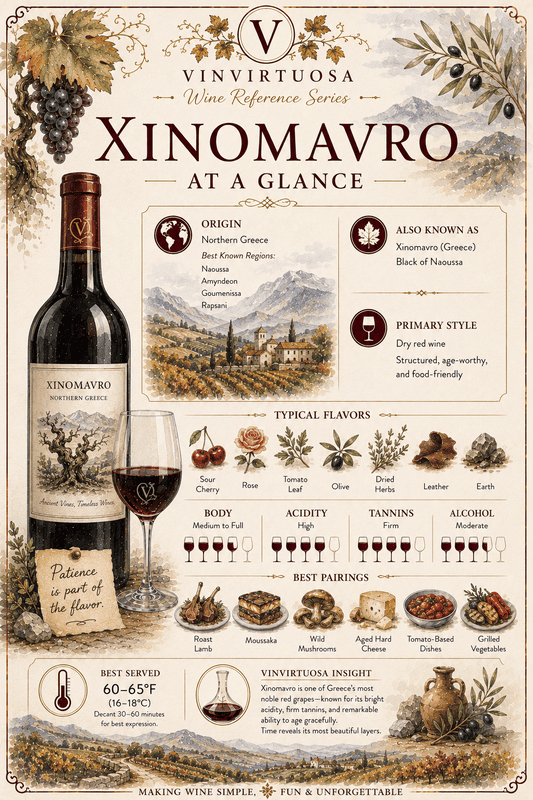
Pronounced KSEE-noh-MAH-vroh, Xinomavro (Ξινόμαυρο) is Greece’s most celebrated indigenous red grape variety and one of Europe’s most compelling wines for those who appreciate structure, complexity, and age-worthiness.
Its name translates literally to “acid black”—a fitting description that hints at two of the grape’s defining characteristics. “Xino” refers to its naturally vibrant acidity, while “mavro” means black, reflecting the grape’s deep color and bold personality. Together, the name offers an early clue to the style of wine waiting inside the bottle: energetic, structured, and built to evolve beautifully over time.
Unlike internationally planted varieties such as Cabernet Sauvignon or Merlot, Xinomavro is deeply rooted in Greece’s winemaking heritage. It has been cultivated for centuries, particularly throughout the mountainous vineyards of northern Greece, where the region’s varied elevations, continental climate, and limestone-rich soils allow the grape to express remarkable complexity.
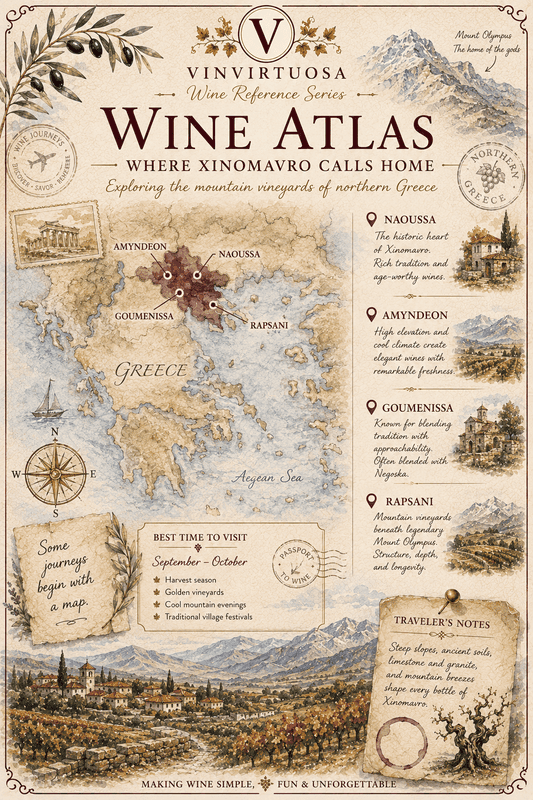
Today, Xinomavro is most closely associated with the prestigious wine region of Naoussa, though exceptional examples are also produced in Amyndeon, Goumenissa, and Rapsani, each offering its own interpretation of the grape. Some wines are elegant and floral, others are richer and more savory, but all share the vibrant acidity and firm tannic structure that have become Xinomavro’s signature.
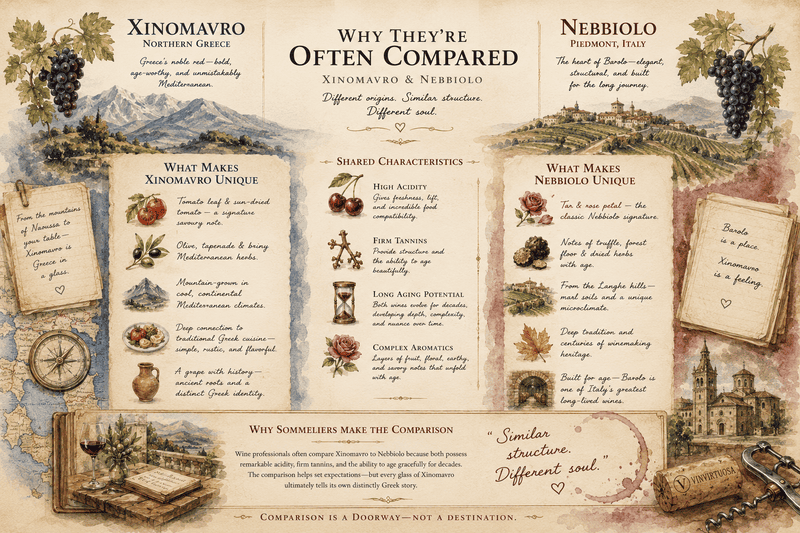
Wine professionals often compare Xinomavro to Italy’s Nebbiolo—not because the two grapes taste identical, but because they share an uncommon ability to balance powerful tannins, bright acidity, and extraordinary aging potential. Like Nebbiolo, Xinomavro rewards patience. While enjoyable in its youth, the finest examples continue to develop for many years, revealing increasingly complex aromas of dried cherry, sun-dried tomato, rose petals, leather, spice, and forest floor.
More than simply Greece’s flagship red wine, Xinomavro represents the remarkable diversity of the country’s modern wine culture. It reflects centuries of tradition while demonstrating the confidence and craftsmanship of today’s Greek winemakers, many of whom are producing wines that are earning international acclaim.
For curious wine lovers, discovering Xinomavro is more than tasting a new grape.
It’s discovering an entirely new chapter in the story of wine.
Why Xinomavro Is Called the “Barolo of Greece”
If you’ve spent any time exploring the world of fine wine, you’ve probably heard Xinomavro described as the “Barolo of Greece.” It’s an intriguing comparison—and one that has helped introduce this remarkable grape to wine lovers around the world.
Like many comparisons in wine, however, it tells only part of the story.
The nickname doesn’t suggest that Xinomavro tastes like Barolo, nor does it imply that the two wines are interchangeable. Instead, it offers a familiar reference point for understanding the grape’s structure, aging potential, and remarkable complexity.
Much like Italy’s Nebbiolo—the grape behind Barolo and Barbaresco—Xinomavro is naturally high in acidity and firm in tannins. In its youth, it can seem tightly wound, vibrant, and even a little reserved, revealing only glimpses of the complexity waiting beneath the surface. Yet with patience, whether through time in the cellar or a thoughtful decant, the wine gradually begins to unfold.
That transformation is one of Xinomavro’s greatest strengths.
Bright notes of sour cherry, raspberry, and cranberry slowly evolve into aromas of dried rose petals, sun-dried tomato, black olive, leather, sweet spices, tobacco, and forest floor. What begins as a vibrant, energetic wine becomes increasingly layered, savory, and nuanced with age, rewarding those willing to wait.
Its naturally high acidity is equally important. While acidity often makes a wine feel fresh and lively on the palate, it also serves as one of the key building blocks of longevity. Combined with Xinomavro’s firm tannic structure, it creates wines capable of developing beautifully for ten, twenty, or even thirty years in exceptional vintages and from top producers.
Yet despite these similarities, Xinomavro remains unmistakably itself.
Where Nebbiolo often expresses delicate floral perfumes alongside notes of tar and truffle, Xinomavro frequently leans into a more savory Mediterranean personality. Its distinctive aromas of tomato leaf, olive, dried herbs, and sun-warmed earth reflect both its Greek heritage and the landscapes where it has been cultivated for centuries.
The grape also possesses an incredible versatility. Depending on the producer, vineyard site, and winemaking style, Xinomavro can be refined and elegant, rustic and earthy, or bold and structured. Some examples showcase vibrant red fruit and floral aromatics, while others reveal deeper layers of spice, smoke, leather, and mineral complexity.
Ultimately, comparing Xinomavro to Barolo isn’t meant to define it.
It’s simply an invitation.
For wine lovers who appreciate structured, age-worthy reds with vibrant acidity and remarkable complexity, Xinomavro offers a fascinating new discovery—one that speaks with its own unmistakable Greek accent.
Where Xinomavro Calls Home
To truly understand Xinomavro, it’s impossible to separate the grape from the landscape that shaped it.
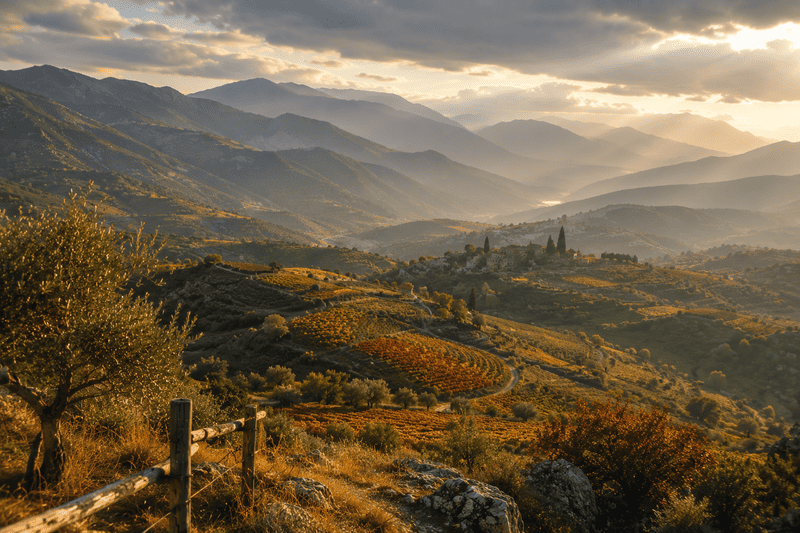
Northern Greece is a region of dramatic contrasts. Rugged mountain ranges rise above rolling vineyards, cool breezes drift through elevated valleys, and ancient villages overlook hillsides that have been cultivated for generations. Here, the rhythm of life often follows the changing seasons, and winemaking remains deeply connected to both tradition and place.
Unlike Greece’s sun-drenched islands, where warm Mediterranean breezes dominate the climate, Xinomavro thrives in the country’s cooler northern interior. The combination of higher elevations, continental weather patterns, and significant day-to-night temperature swings allows the grapes to ripen slowly, preserving the bright acidity that has become one of the variety’s defining characteristics.
These conditions also encourage the gradual development of flavor, tannin, and aromatic complexity, giving Xinomavro the balance needed to produce wines capable of aging gracefully for decades.
While the grape is cultivated in several parts of northern Greece, four regions have become especially important to its story.
Naoussa
Often considered the spiritual home of Xinomavro, Naoussa is the region most closely associated with the grape’s international reputation.
Located on the eastern slopes of Mount Vermio, its vineyards benefit from elevations ranging between approximately 150 and 400 meters (500–1,300 feet). Warm, sunny days encourage ripeness, while cool evenings help preserve freshness and acidity.
The wines of Naoussa are typically the most structured and age-worthy expressions of Xinomavro. Firm tannins, bright acidity, and layered aromas of red fruit, dried herbs, tomato leaf, olive, and spice make these wines ideal candidates for long-term cellaring.
For many wine lovers, Naoussa represents Xinomavro in its purest and most classic form.
Amyndeon
Travel northwest into the higher-altitude vineyards of Amyndeon, and the personality of Xinomavro begins to change.
Situated on a broad plateau surrounded by lakes and mountains, Amyndeon enjoys one of Greece’s coolest wine-growing climates. Elevations often exceed 600 meters (nearly 2,000 feet), while nearby lakes help moderate temperatures throughout the growing season.
The resulting wines are often lighter in body, brighter in acidity, and more floral in character than those from Naoussa. Delicate aromas of cherry, raspberry, rose petals, and fresh herbs are complemented by exceptional freshness and elegance.
Amyndeon has also become one of Greece’s leading regions for sparkling wines made from Xinomavro, demonstrating the grape’s remarkable versatility.
Goumenissa
To the west lies Goumenissa, where Xinomavro is traditionally blended with the local Negoska grape.
This partnership creates wines that retain Xinomavro’s vibrant acidity and structure while gaining additional richness, darker fruit, and softer tannins from Negoska. The result is often a wine that feels slightly more approachable in its youth without sacrificing complexity.
Rolling hills, varied elevations, and well-drained soils contribute to wines that beautifully balance power with generosity.
Rapsani
Further south, on the slopes of legendary Mount Olympus, lies Rapsani—one of Greece’s most historic wine regions.
Here, Xinomavro is blended with Krassato and Stavroto, producing wines that reflect both the mountain’s diverse elevations and its varied soils.
The vineyards stretch across steep hillsides where cooler temperatures and excellent drainage encourage slow, even ripening. The resulting wines often combine vibrant fruit, savory complexity, and graceful structure with an unmistakable sense of place.
It is a fitting home for a grape so deeply connected to history and landscape.
A Landscape Written Into Every Glass
Every bottle of Xinomavro tells the story of where it was grown.
The mountains, changing elevations, cool autumn nights, limestone and clay soils, and centuries of winemaking tradition all leave their mark on the finished wine. While the grape’s naturally bright acidity and firm tannins provide a recognizable foundation, terroir shapes the finer details—its aromas, texture, elegance, and personality.
Perhaps that’s what makes Xinomavro so endlessly fascinating.
No matter where it is grown, it always reflects Greece.
Yet each region offers its own unique interpretation, inviting wine lovers to discover not just one expression of the grape, but an entire landscape waiting to be explored.
What Does Xinomavro Taste Like?
Every great wine tells its story one sip at a time, and Xinomavro is no exception.
From the moment the wine is poured into the glass, it invites curiosity rather than instant understanding. It is a wine that reveals itself gradually, rewarding those willing to slow down, swirl, smell, and taste with intention. Like many of the world’s most respected wines, Xinomavro isn’t about immediate power—it’s about discovery.
Visually, Xinomavro often displays a brilliant ruby color in its youth, sometimes surprisingly pale compared to fuller-bodied reds such as Cabernet Sauvignon or Syrah. As the wine matures, those vibrant ruby hues gradually soften into garnet and brick-red tones, offering a visual clue that time has begun shaping its personality.
Bring the glass to your nose, and the first impression is often one of bright red fruit. Aromas of sour cherry, cranberry, raspberry, and red currant are common, accompanied by delicate floral notes that may remind you of dried roses or violets. Depending on the producer and vineyard, subtle hints of Mediterranean herbs, crushed spices, and fresh tomato leaf often emerge, adding a distinctly savory dimension that sets Xinomavro apart from many other red varieties.
Take your first sip, and the wine immediately comes alive.
Its naturally high acidity creates an energetic, mouthwatering sensation that lifts every flavor across the palate. Rather than feeling heavy, Xinomavro feels vibrant and focused, making it exceptionally food-friendly and wonderfully refreshing despite its impressive structure.
That freshness is balanced by firm, fine-grained tannins that gently coat the palate. In younger wines, these tannins can feel assertive, providing the framework that allows Xinomavro to develop so gracefully over time. With age, they gradually soften and integrate, creating a texture that becomes increasingly elegant and harmonious.
Most examples are medium to full-bodied, offering excellent concentration without excessive weight. Alcohol levels are generally moderate, allowing the grape’s acidity, fruit, and savory complexity to remain beautifully balanced. Nothing feels out of place. Instead, each element works together to create a wine that is refined rather than overpowering.
The finish is often one of Xinomavro’s most memorable qualities.
Long after the wine leaves the palate, lingering notes of cherry, herbs, earthy spice, and mineral freshness continue to unfold, inviting another sip and another moment of reflection.
Yet perhaps the greatest pleasure of Xinomavro is watching how it changes with time.
In its youth, the wine is driven by vibrant fruit—bright cherry, cranberry, raspberry, and fresh herbs. As the years pass, those youthful characteristics gradually evolve into something altogether more complex. Fresh cherries become dried cherry and preserved fruit. Herbal notes deepen into tomato leaf, black olive, and Mediterranean herbs. Hints of rose petals develop alongside leather, sweet baking spices, tobacco, forest floor, and earthy undertones that add remarkable depth without overwhelming the wine’s freshness.
Every bottle tells a slightly different story depending on its origin, producer, and age, but this graceful evolution is one of the reasons Xinomavro has earned such admiration among wine lovers around the world.
It is a wine that rewards patience—not because it hides its beauty, but because it reveals new layers every time you return to the glass.
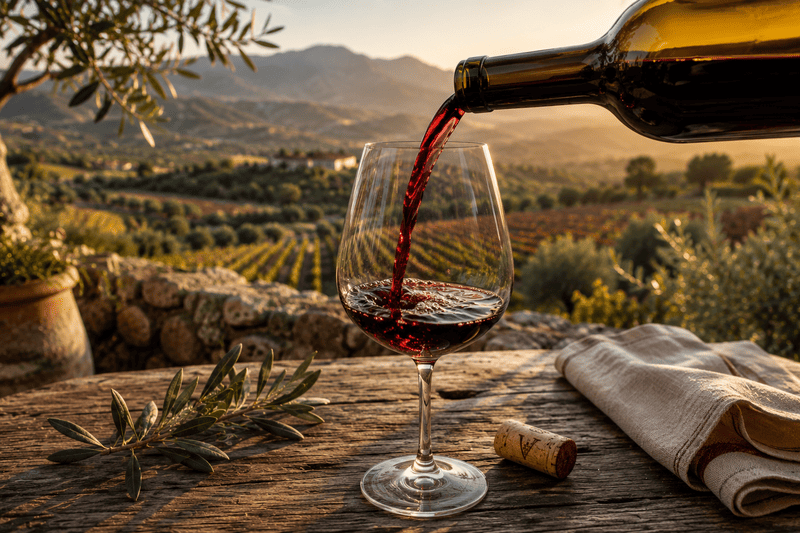
Why Xinomavro Ages So Beautifully
Not every wine is made to age.
Many wines are crafted to be enjoyed within a few years of release, celebrating their fresh fruit and youthful vibrancy before those characteristics begin to fade. Xinomavro, however, belongs to a smaller and more fascinating group of wines that seem to become even more compelling with time.
Its remarkable longevity begins with balance.
Wine professionals often describe acidity, tannins, fruit, and alcohol as the four structural pillars of a wine. When these elements exist in harmony, they create the foundation necessary for graceful bottle aging. Xinomavro possesses this balance naturally, making it one of Greece’s most age-worthy red wines.
The grape’s naturally high acidity acts as a preservative, helping the wine maintain freshness and energy as it matures. Even after many years in the cellar, well-made examples continue to feel vibrant rather than tired, allowing their evolving aromas to remain focused and expressive.
Equally important are Xinomavro’s firm tannins.
In young wines, these tannins provide grip and structure, giving the wine a sense of strength and purpose. While they can seem bold in their youth, time gradually softens their edges. As the tannins become more integrated, the wine develops a silkier texture while retaining the backbone that makes mature Xinomavro so captivating.
Bottle aging is not simply about making a wine older—it’s about transformation.
Over the years, bright primary fruit slowly gives way to increasingly complex secondary and tertiary aromas. Fresh cherries become dried fruit. Floral notes evolve into dried rose petals. Tomato leaf, olive, leather, tobacco, sweet spices, truffle, and forest floor emerge with remarkable subtlety, creating layers of flavor that simply cannot be rushed.
This slow evolution is one of the reasons collectors treasure Xinomavro.
Opening a well-cellared bottle becomes more than enjoying a glass of wine—it becomes an opportunity to witness time itself. Every year spent resting in the bottle allows the wine to reveal another chapter of its story.
Exactly how long a bottle can age depends on the producer, vineyard, vintage, and storage conditions, but many quality examples comfortably develop for ten to fifteen years, while outstanding wines from exceptional producers and vintages can continue evolving beautifully for twenty years or more.
That aging potential also makes Xinomavro surprisingly versatile.
A younger bottle offers vibrant fruit, energetic acidity, and firm structure that pair beautifully with roasted meats and Mediterranean cuisine. An older bottle, by contrast, becomes softer, more savory, and wonderfully nuanced, making it an unforgettable companion for slow dinners, meaningful celebrations, and moments when the wine itself becomes part of the conversation.
Perhaps that’s the true beauty of Xinomavro.
It reminds us that some of life’s greatest pleasures aren’t hurried.
They unfold slowly, revealing their full character only to those willing to give them time.
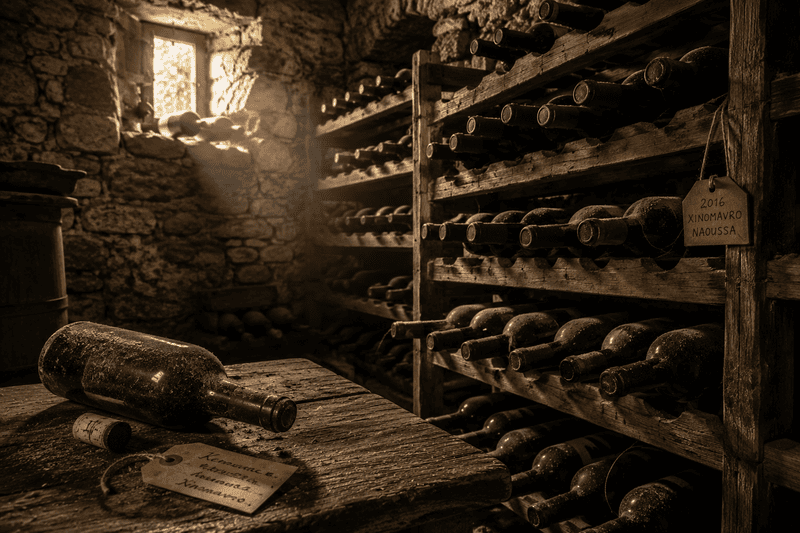
Wine Curiosities
Every wine has a few fascinating details that make it memorable, and Xinomavro is full of surprises. The more you learn about this remarkable grape, the easier it becomes to understand why it has earned such respect among sommeliers, collectors, and adventurous wine lovers alike.
As you explore the editorial plate below, you’ll discover a handful of intriguing facts that reveal just how unique Xinomavro truly is.
Wine Curiosities
🍇 “Xinomavro” Means “Acid Black”
The grape’s name comes from two Greek words: xino, meaning “acid,” and mavro, meaning “black.” Together they perfectly capture the wine’s naturally vibrant acidity and deeply colored grapes—two characteristics that contribute to its unmistakable personality and exceptional longevity.
⏳ Built to Reward Patience
While many wines are at their best within just a few years of release, outstanding examples of Xinomavro can continue developing for decades. With careful cellaring, the wine gradually evolves from bright, fruit-driven flavors into beautifully layered aromas of dried fruit, leather, spice, herbs, and earth.
🏛️ A Heritage Rooted in Greece
Xinomavro has been cultivated throughout northern Greece for centuries, becoming an important part of the country’s rich winemaking tradition. Today, it remains one of Greece’s most celebrated indigenous grape varieties and a proud ambassador for the country’s modern wine renaissance.
🗺️ One Grape, Many Personalities
Just as Pinot Noir expresses itself differently in Burgundy, Oregon, or New Zealand, Xinomavro changes from one Greek region to another. Climate, elevation, soils, and local winemaking traditions all influence the final wine, allowing each region to tell its own unique story while remaining unmistakably Xinomavro.
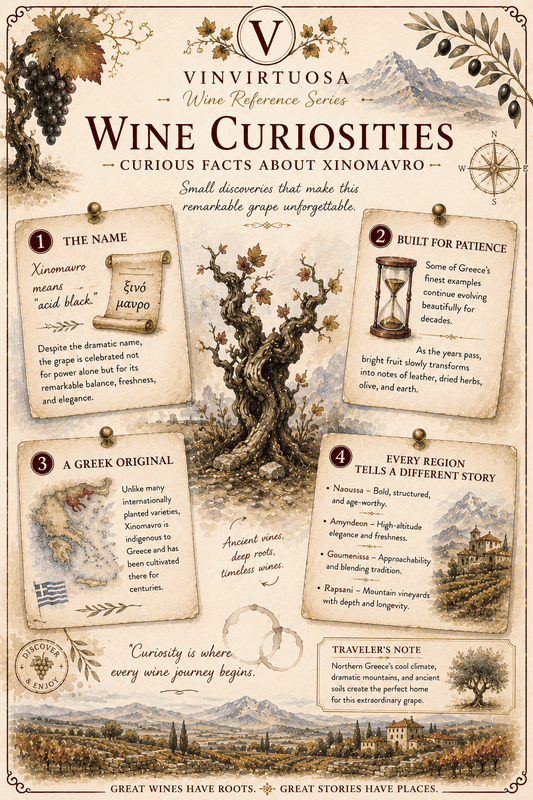
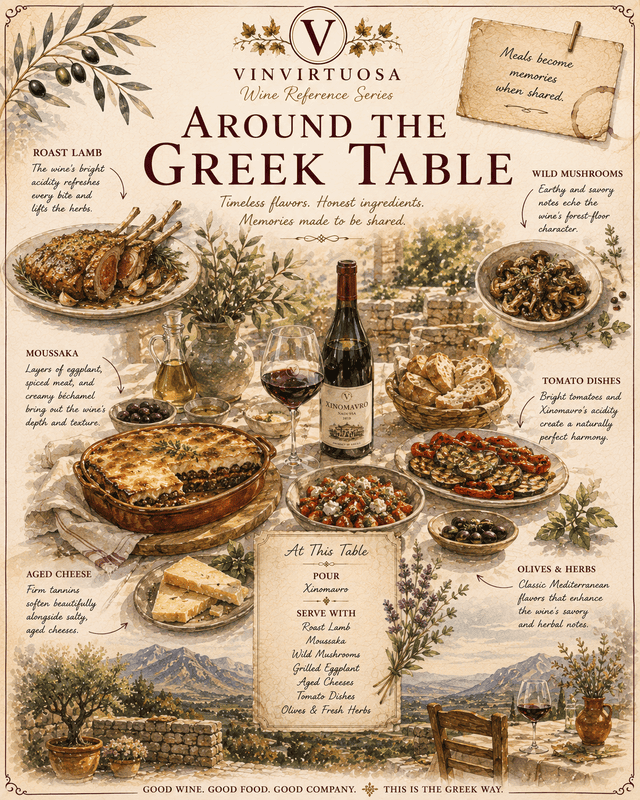
Around the Greek Table
If there is one place where Xinomavro truly comes alive, it is around the dinner table.
Like many of the world’s great food wines, Xinomavro isn’t meant to be enjoyed in isolation. Its vibrant acidity, firm tannins, savory complexity, and remarkable freshness make it a natural companion to meals that bring people together. Every sip seems designed to invite another bite, while every bite encourages another sip.
That harmony is no coincidence.
Greek cuisine has evolved alongside wines like Xinomavro for centuries, creating pairings that feel almost instinctive. The wine’s bright acidity cuts through rich dishes, its earthy complexity echoes roasted vegetables and herbs, and its structured tannins complement slow-cooked meats without overwhelming them.
One of the most classic pairings is roast lamb, especially when seasoned with rosemary, oregano, garlic, and lemon. The wine’s lively acidity balances the richness of the meat, while its herbal and savory notes beautifully mirror the Mediterranean flavors on the plate.
Another natural companion is moussaka, Greece’s beloved layered casserole of eggplant, potatoes, seasoned meat, and creamy béchamel. The dish’s richness is lifted by Xinomavro’s freshness, while the wine’s earthy undertones complement the roasted vegetables and warming spices.
For a lighter pairing, grilled eggplant highlights another side of the wine. The vegetable’s smoky character enhances Xinomavro’s subtle earthy qualities, creating a combination that feels both rustic and elegant.
Tomatoes—whether slow-roasted, simmered into sauces, or served fresh with olive oil and herbs—also have a remarkable affinity for Xinomavro. While tomatoes can be challenging with many red wines because of their natural acidity, Xinomavro’s own vibrant acidity allows the pairing to feel beautifully balanced. The grape’s distinctive notes of tomato leaf often make the connection feel even more seamless.
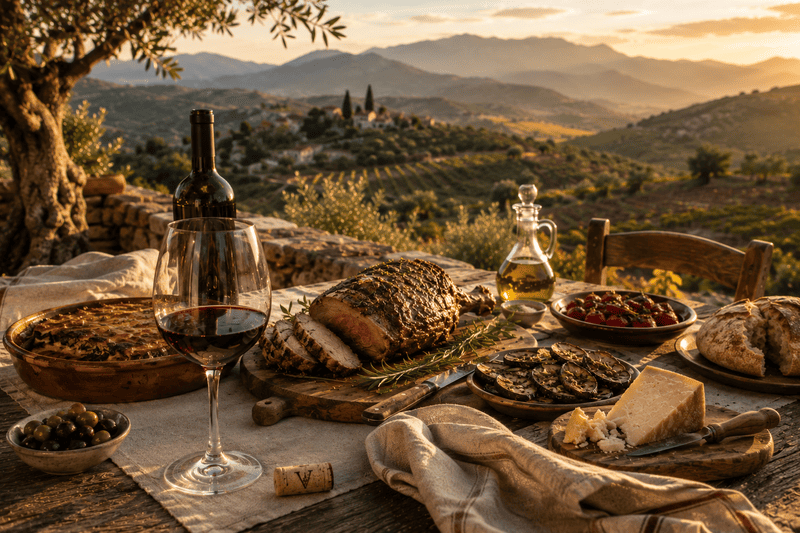
The wine also shines alongside wild mushrooms, whose earthy flavors deepen the wine’s own savory character. Whether folded into a creamy risotto, served over grilled polenta, or simply sautéed with garlic and herbs, mushrooms reveal another layer of Xinomavro’s complexity.
When it comes to roasted meats, Xinomavro is equally versatile. Beef, pork, duck, and game birds all find harmony with the wine’s firm structure and lingering finish, especially when accompanied by roasted root vegetables or aromatic herbs.
A selection of aged hard cheeses offers another effortless pairing. Nutty, salty cheeses such as Kefalotyri, aged Gouda, Pecorino, Manchego, or Parmigiano-Reggiano complement the wine’s acidity while softening its tannins, creating a wonderfully balanced finish.
Throughout every meal, simple Mediterranean ingredients quietly tie everything together. A drizzle of peppery extra virgin olive oil, fragrant sprigs of fresh oregano, thyme, or rosemary, warm crusty bread, and seasonal vegetables all reinforce the wine’s connection to the landscape where it was born.
Perhaps that’s the secret to understanding Xinomavro.
It isn’t simply a wine to drink.
It’s a wine to gather around.
Whether shared during a leisurely Sunday lunch, a holiday celebration, or a quiet evening with close friends, Xinomavro reminds us that some of life’s most memorable moments are created not by elaborate occasions, but by good food, meaningful conversation, and a bottle opened with people we enjoy sharing it with.
Your Next Pour
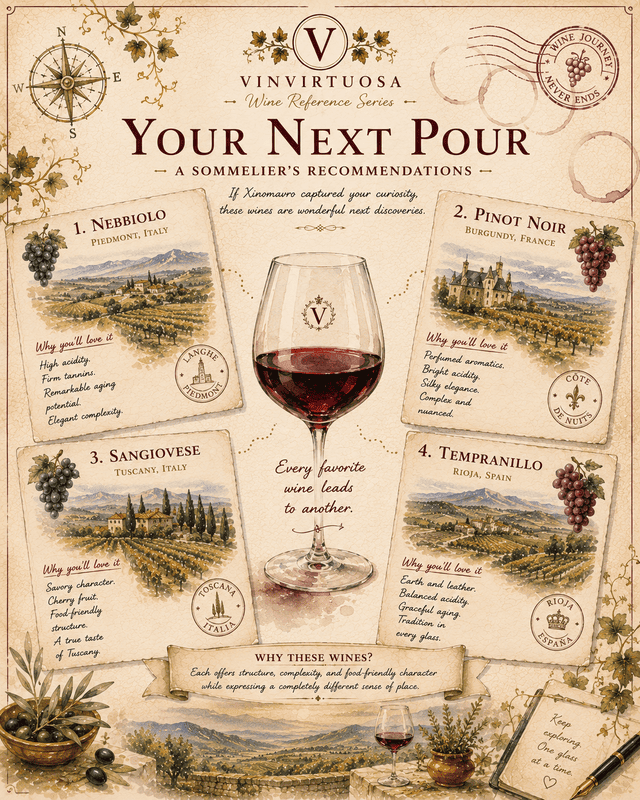
One of the most enjoyable parts of exploring wine is discovering connections between familiar favorites and exciting new experiences. While every grape has its own personality, many share characteristics that can help guide your next bottle with confidence.
If you already enjoy any of the wines below, Xinomavro may be your next unforgettable discovery.
🍷 If You Enjoy Nebbiolo…
Few comparisons are made more often than Xinomavro and Nebbiolo—and for good reason. Both grapes produce wines with vibrant acidity, firm tannins, and remarkable aging potential. If you appreciate the elegance and complexity of Barolo or Barbaresco, Xinomavro offers a similarly rewarding journey while expressing a distinctly Greek sense of place.
🍇 If You Enjoy Pinot Noir…
At first glance, Pinot Noir and Xinomavro might seem like unlikely companions, yet both possess an ability to balance freshness with nuance. As Xinomavro matures, its evolving aromas of dried cherry, earth, herbs, and spice often appeal to Pinot Noir lovers who enjoy wines that tell a story with every sip rather than relying on sheer power.
🍅 If You Enjoy Sangiovese…
Fans of Chianti Classico and other Sangiovese-based wines often discover a familiar rhythm in Xinomavro. Bright acidity, savory character, food-friendly structure, and an affinity for tomato-based dishes create an easy transition between these two historic Mediterranean grapes.
🌿 If You Enjoy Tempranillo…
Whether it’s a youthful Rioja Crianza or a beautifully aged Reserva, Tempranillo lovers often appreciate wines that combine fruit, spice, earth, and graceful maturity. Xinomavro offers many of those same qualities while introducing distinctive notes of tomato leaf, olive, dried herbs, and floral complexity that make every glass feel uniquely Greek.
Your Next Pour
Every great wine journey begins with curiosity.
If your cellar already includes Nebbiolo, Pinot Noir, Sangiovese, or Tempranillo, Xinomavro is a natural next step. It shares enough familiar characteristics to feel approachable, yet offers an entirely new expression of history, landscape, and tradition.
Sometimes the most memorable bottles aren’t the ones you’ve been searching for.
They’re the ones you never expected to discover.
Hidden Gem
One of the greatest pleasures of exploring the world of wine is realizing that exceptional bottles don’t always carry famous names—or extraordinary price tags.
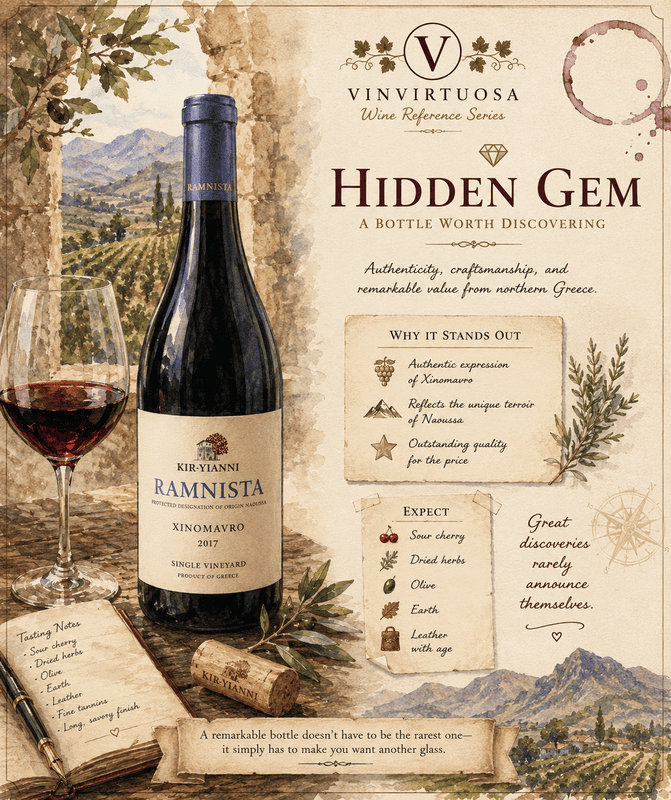
For those looking to experience authentic Xinomavro without venturing into the world of rare collector wines, Kir-Yianni is one of the producers I most often recommend.
Founded in the early 1990s by the late Yiannis Boutaris, whose family has played a significant role in modern Greek winemaking, the estate has become one of the leading ambassadors for Xinomavro. Its wines consistently showcase the grape’s vibrant acidity, refined structure, and unmistakable sense of place while remaining approachable for those discovering the variety for the first time.
One excellent introduction is the estate’s Ramnista bottling. Produced primarily from vineyards in Naoussa, it offers classic aromas of sour cherry, raspberry, dried herbs, tomato leaf, gentle spice, and earthy complexity, supported by firm yet polished tannins and remarkable freshness. While the wine has the structure to reward additional cellaring, it also provides a wonderful snapshot of what makes Xinomavro so compelling today.
What makes producers like Kir-Yianni especially rewarding is their consistency. Rather than chasing rarity or prestige, they focus on expressing the grape and its terroir with clarity and balance. The result is a wine that feels authentic, beautifully crafted, and true to its origins.
If you happen to spot a bottle from Kir-Yianni on a restaurant wine list or the shelves of your local wine shop, don’t hesitate to give it a try.
It may not be the most famous bottle in the room.
But it just might become one of the most memorable.
Serving Tips
Once you’ve found a bottle of Xinomavro, a few simple serving techniques can help you experience the wine at its very best. While every producer crafts the grape a little differently, these guidelines will help highlight its freshness, complexity, and remarkable structure.
Serving Temperature
Xinomavro is best enjoyed slightly cooler than many people expect for red wine.
Aim for 60–65°F (16–18°C). Serving the wine at this temperature allows its vibrant acidity and aromatic complexity to shine while keeping the alcohol beautifully balanced. If the bottle has been stored at room temperature, placing it in the refrigerator for 20–30 minutes before serving is often all it needs.
Decanting
Young Xinomavro can feel tightly wound when first opened. Giving the wine 30 to 60 minutes in a decanter allows oxygen to soften its tannins and reveal additional layers of fruit, herbs, spice, and earthy complexity.
Older bottles may also benefit from gentle decanting, though the primary goal is often to separate the wine from any natural sediment that has formed during aging rather than extended aeration.
Glassware
Choose a large Bordeaux-style or universal wine glass with a generous bowl. The additional space allows the wine to breathe while concentrating its evolving aromas, making it easier to appreciate the subtle layers that continue to emerge with every swirl.
Cellaring
If patience is one of wine’s greatest virtues, Xinomavro rewards it generously.
Many quality bottles continue to evolve beautifully for 10 to 15 years, while outstanding wines from exceptional producers and vintages may continue developing for 20 years or more under proper storage conditions.
Over time, youthful fruit gradually gives way to increasingly complex notes of dried cherry, leather, spice, dried herbs, olive, and forest floor, creating the layered character that collectors admire.
Pair It with Food
Although Xinomavro can certainly be enjoyed on its own, it truly shines at the table.
Its naturally bright acidity and firm structure were practically made for food, allowing the wine to complement everything from roasted lamb and grilled vegetables to tomato-based dishes, mushrooms, aged cheeses, and hearty Mediterranean cuisine.
Like many of the world’s classic wines, Xinomavro becomes even more expressive when shared alongside a thoughtfully prepared meal.
Buying Advice
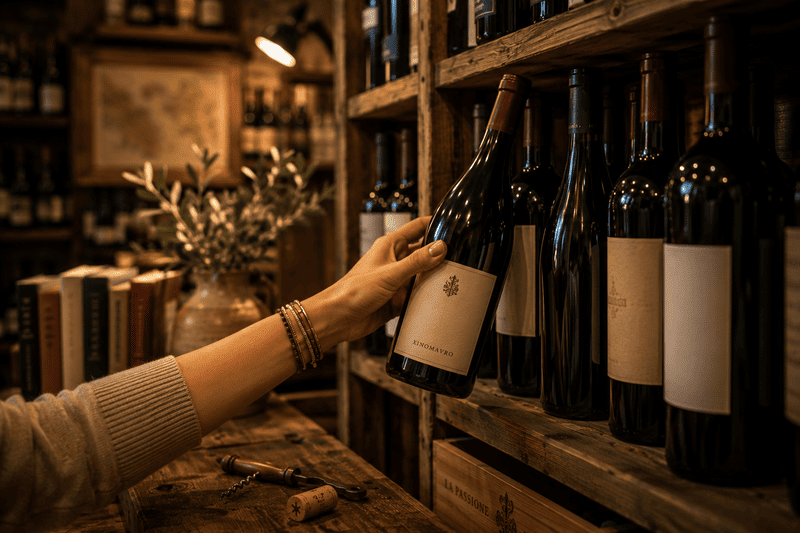
If you’re purchasing your first bottle, don’t feel pressured to seek out the oldest vintage or the most expensive label.
Instead, begin with a respected producer from one of the grape’s classic regions—particularly Naoussa or Amyndeon—and allow your own palate to guide your exploration from there.
One of the joys of discovering Xinomavro is realizing that exceptional experiences often begin with simple curiosity.
Final Thoughts
Some wines become household names.
Others quietly wait for curious wine lovers to discover them.
Xinomavro belongs firmly in the second group.
Its story begins among the mountains and vineyards of northern Greece, where generations of growers have patiently cultivated a grape unlike any other. It continues around family tables filled with roasted lamb, seasonal vegetables, fragrant herbs, and conversations that stretch long into the afternoon. And eventually, it finds its way into the glasses of those willing to explore beyond the familiar.
Perhaps that’s what makes Xinomavro so memorable.
It isn’t simply the wine’s vibrant acidity, remarkable aging potential, or captivating aromas that leave a lasting impression. It’s the way the wine reflects its home. Every bottle carries something of the landscape that shaped it—the cool mountain evenings, the changing seasons, the limestone-rich soils, and centuries of tradition woven into every vintage.
In many ways, discovering Xinomavro reminds us why we fell in love with wine in the first place.
Not because every bottle promises certainty, but because every bottle offers the possibility of discovering something new.
The world of wine is filled with famous names that deserve their reputation.
Yet some of its greatest treasures are found just beyond the familiar labels—waiting quietly on the shelf of a neighborhood wine shop, listed on the final page of a restaurant wine list, or recommended by someone eager to share a favorite discovery.
Xinomavro is one of those treasures.
So the next time you find yourself choosing a bottle, consider looking just a little farther than usual.
You may discover more than a remarkable Greek red wine.
You may discover a new favorite.
And perhaps, somewhere between the first pour and the final sip, you’ll find yourself transported back to the vineyards of northern Greece—where autumn settles over the mountains, conversations linger around the table, and another bottle is opened, ready to begin its own story.
Because sometimes the most unforgettable wines aren’t the ones everyone already knows.
They’re the ones waiting patiently to be discovered.
One glass at a time.