
Introduction
Some wines become famous because they are ancient.
They come wrapped in centuries of tradition, guarded by old stone cellars, monastery walls, royal courts, and family vineyards passed from one generation to the next.
Pinotage became famous because someone decided to invent it.
That alone makes it one of the most fascinating red wines in the world. Unlike grapes such as Pinot Noir, Cabernet Sauvignon, or Riesling, Pinotage does not come with a long European origin story stretching back into the mists of time. It is not a grape that wandered across borders over centuries, quietly adapting to new soils and climates along the way.
Pinotage was created with intention.
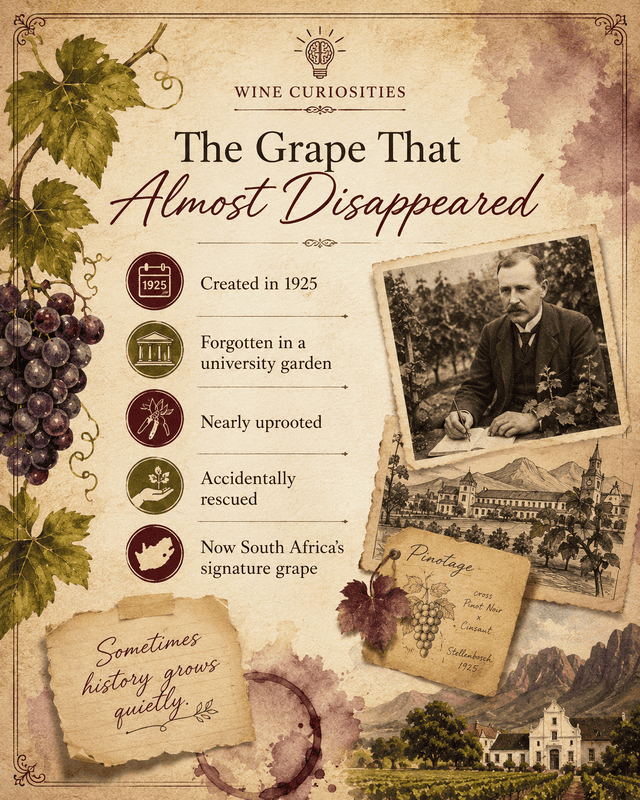
It was born in South Africa in 1925, when Professor Abraham Izak Perold crossed Pinot Noir with Cinsault, a grape that was commonly known in South Africa at the time as Hermitage. The name Pinotage itself comes from that pairing: Pinot from Pinot Noir and -tage from Hermitage.
The result was something entirely new.
Pinotage would eventually become South Africa’s signature red wine, a grape capable of producing deeply colored, boldly flavored wines with notes of blackberry, plum, dark cherry, smoke, earth, spice, cocoa, and sometimes coffee. At its best, Pinotage is generous, distinctive, and full of character. It can be rustic or refined, powerful or surprisingly elegant, fruit-forward or deeply savory.
It is also a wine with a complicated reputation.
For years, Pinotage was one of those bottles people either loved, misunderstood, or avoided because of outdated ideas about what it “should” taste like. Some older examples could be harsh, overly smoky, or marked by strange rubbery aromas that gave the grape a difficult reputation outside South Africa. But modern Pinotage has changed dramatically. Today, thoughtful growers and winemakers are showing just how expressive, polished, and compelling this grape can be.
That is part of what makes Pinotage so exciting.
It is not trying to be Pinot Noir.
It is not trying to be Cabernet Sauvignon.
It is not trying to imitate Bordeaux, Burgundy, or the Rhône.
Pinotage tells a different story.
It tells the story of a country looking for its own wine identity. It tells the story of experimentation, survival, reinvention, and place. It is a grape shaped by South African sunshine, coastal influence, old vineyards, modern ambition, and the belief that a wine does not have to be ancient to be meaningful.
So today, we are giving Pinotage the closer look it deserves.
We will explore where it came from, what it tastes like, why it was created, how it nearly disappeared, where it grows best, and why modern examples are changing minds around the world.
Because Pinotage is more than South Africa’s signature red.
It is proof that sometimes, wine history does not have to be inherited.
Sometimes, it can be imagined.
What Is Pinotage?
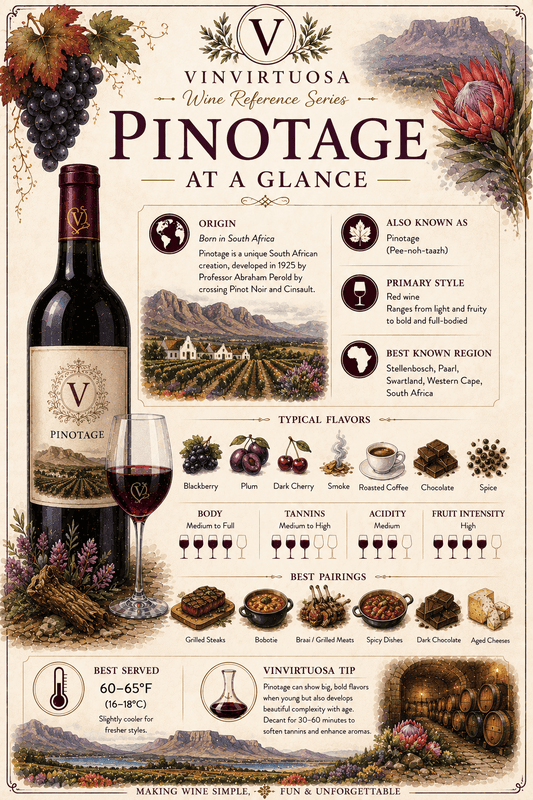
Pinotage is a red wine grape created in South Africa in 1925 by Professor Abraham Izak Perold, the first professor of viticulture at Stellenbosch University.
His goal was both practical and ambitious.
Perold wanted to create a grape that could capture some of Pinot Noir’s beauty while performing better in South Africa’s growing conditions. Pinot Noir was admired for its elegance, perfume, finesse, and ability to produce some of the world’s most captivating red wines. But Pinot Noir is also famously difficult. It is thin-skinned, sensitive, temperamental, and demanding in the vineyard. It does not thrive just anywhere.
South Africa, with its warmth, sunshine, and dry growing conditions, needed something sturdier.
That is where Cinsault came in.
At the time, Cinsault was widely planted in South Africa and was often referred to locally as Hermitage. It was valued because it was productive, vigorous, heat-tolerant, and far easier to grow than Pinot Noir. Where Pinot Noir could be delicate and difficult, Cinsault was resilient and generous.
Perold’s idea was to bring the two together.
He crossed Pinot Noir with Cinsault in the hope of creating a grape that combined the elegance and aromatic charm of Pinot Noir with the strength, productivity, and adaptability of Cinsault. The result was Pinotage.
The name is simple but meaningful:
Pinot from Pinot Noir.
-tage from Hermitage, the old South African name for Cinsault.
This is one of the most important things to understand about Pinotage: it is not a traditional European grape that simply found a second home in South Africa. It was created there. It belongs to South Africa in a uniquely direct way.
That does not mean every bottle tastes the same, of course. Pinotage can take many forms depending on where it is grown, how ripe the grapes are at harvest, how the wine is fermented, whether oak is used, and what style the winemaker wants to create.
Some Pinotage is bright, juicy, and easygoing, full of red and black fruit. Some is bold, dark, smoky, and structured. Some examples show coffee, chocolate, roasted spice, and oak influence. Others lean more toward earth, herbs, wild berries, and savory complexity.
But beneath those differences, Pinotage usually has a personality that is hard to miss.
It tends to offer generous fruit, moderate to full body, noticeable tannin, and a savory edge that separates it from more familiar reds. If Cabernet Sauvignon can feel structured, Syrah can feel peppery, and Malbec can feel plush, Pinotage often sits somewhere unexpected: dark-fruited, earthy, smoky, sometimes rustic, sometimes polished, and always unmistakably itself.
Pinotage Is Not a Hybrid
One point that often causes confusion is whether Pinotage is a hybrid.
It is not.
Pinotage is a crossing, not a hybrid.
That distinction matters.
A crossing is created when two grape varieties from the same species are bred together. Pinotage comes from Pinot Noir and Cinsault, both of which belong to Vitis vinifera, the classic European wine grape species used for most of the world’s fine wines.
A hybrid, on the other hand, usually involves grapes from different species, often combining Vitis vinifera with American grape species for traits such as disease resistance or cold hardiness.
So when we talk about Pinotage, we are not talking about a hybrid grape in the usual wine sense.
We are talking about a purposefully bred Vitis vinifera crossing.
That may sound technical, but the idea is simple: Pinotage was created by bringing together two established wine grapes to form a new variety. It was an act of viticultural matchmaking.
Pinot Noir brought the dream.
Cinsault brought the muscle.
South Africa brought the setting.
And Pinotage became the result.
What makes this grape so compelling is that it was designed with a question in mind:
What if South Africa could have a red wine grape of its own?
Not borrowed.
Not copied.
Not imported and merely adapted.
Created.
That is the heart of Pinotage. It is not just a wine grape. It is a statement of identity in the vineyard.
And like many bold ideas, its beginning was only the first chapter.
The Fascinating Story Behind Pinotage
Every great wine has a story.
Some begin in ancient monasteries. Others were carried across continents by explorers or planted by generations of families who slowly refined their craft over centuries.
Pinotage’s story is different.
It begins with a bold idea, nearly ends before it ever begins, and survives thanks to what can only be described as a fortunate accident.
If the history of Pinotage were written as a novel, no editor would believe the plot.
A Professor with a Vision
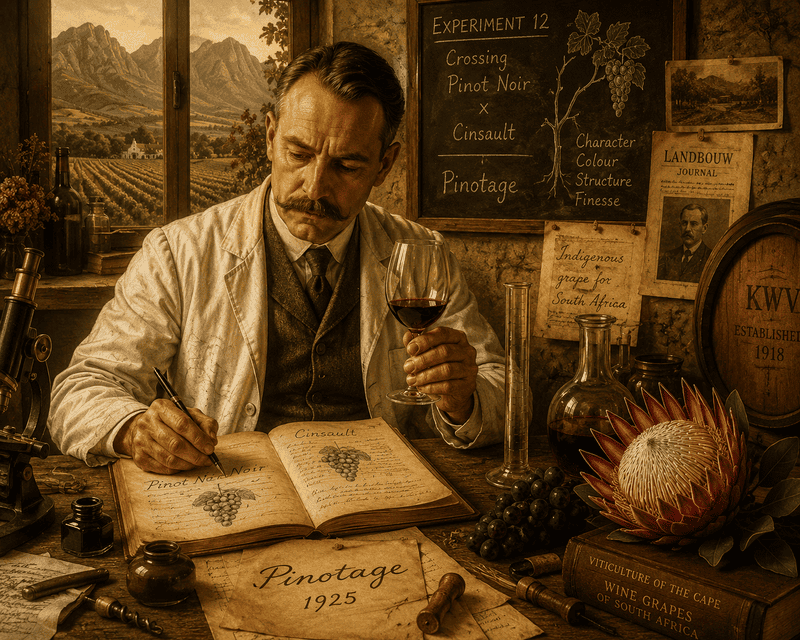
In 1925, Professor Abraham Izak Perold had a challenge in mind.
As South Africa’s first Professor of Viticulture, he believed the country deserved a grape that wasn’t simply borrowed from Europe but was uniquely suited to South African conditions. Pinot Noir produced wines of extraordinary elegance, but it struggled in the Cape’s warmer climate. Cinsault, meanwhile, was vigorous, reliable, and well adapted to local vineyards, though it rarely reached the same heights of complexity.
Perold wondered if he could combine the best qualities of both.
So he made a simple cross between Pinot Noir and Cinsault.
At the time, there was no way of knowing that this modest experiment would eventually give an entire nation its signature wine.
The Forgotten Seedlings
Then something unexpected happened.
Life moved on.
Perold became occupied with new responsibilities, eventually leaving the university grounds where his experimental vines had been planted.
And he forgot about them.
For years, the tiny Pinotage seedlings remained in an overlooked garden on the campus of Stellenbosch University.
No one tended them.
No one celebrated them.
No one even seemed to remember they were there.
The experiment that might have changed South African wine history sat quietly among weeds, almost invisible to everyone around it.
A Lucky Rescue
Eventually, the neglected garden needed to be cleared.
Workers prepared to remove the overgrown plants, believing they were little more than unwanted shrubs.
Fortunately, before the seedlings disappeared forever, someone recognized what they were.
The young vines were rescued and replanted at a nearby research station, where they could finally be studied and cultivated.
It is difficult to overstate how close Pinotage came to never existing at all.
Had those vines been uprooted just a little sooner, South Africa’s most famous grape might have vanished before producing a single bottle.
Growing Into a National Identity
The first experimental wines showed promise, but Pinotage’s journey was far from smooth.
Early growers had to learn how the new variety behaved in the vineyard. Winemakers experimented with fermentation techniques, oak aging, harvest dates, and vineyard sites. Some wines were excellent. Others were less successful. Like many new ideas, Pinotage experienced periods of enthusiasm, disappointment, criticism, and rediscovery.
Yet with each passing decade, growers understood the grape a little better.
They learned that careful vineyard management mattered.
They learned that harvesting at the right moment preserved freshness.
They learned that gentler extraction created more elegant wines.
And they learned that Pinotage did not need to imitate famous European grapes to succeed.
It simply needed to express itself.
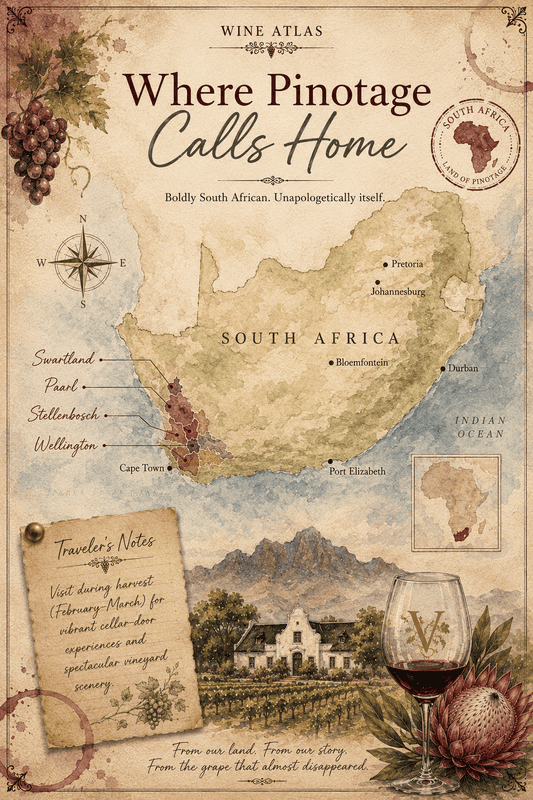
Today, Pinotage has become the flagship red grape of South Africa, planted throughout regions such as Stellenbosch, Paarl, Swartland, and Wellington. It has become a symbol of innovation, resilience, and national pride—a wine that belongs to South Africa in a way few other grapes belong so completely to a single country.
Few wines can say they were almost forgotten before the world even knew they existed.
Pinotage can.
Perhaps that unlikely beginning is part of what makes every bottle feel like a small triumph.
What Does Pinotage Taste Like?
If you’ve never tasted Pinotage before, you might wonder where it fits among the world’s better-known red wines.
Is it rich like Cabernet Sauvignon?
Juicy like Malbec?
Peppery like Syrah?
Elegant like Pinot Noir?
The answer is…not exactly.
Pinotage borrows hints from several familiar styles while ultimately creating a personality all its own. It can be bold without feeling heavy, rustic without lacking elegance, and intensely fruity while still carrying an unmistakable savory character.
That complexity is part of its charm.
A Symphony of Dark Fruit
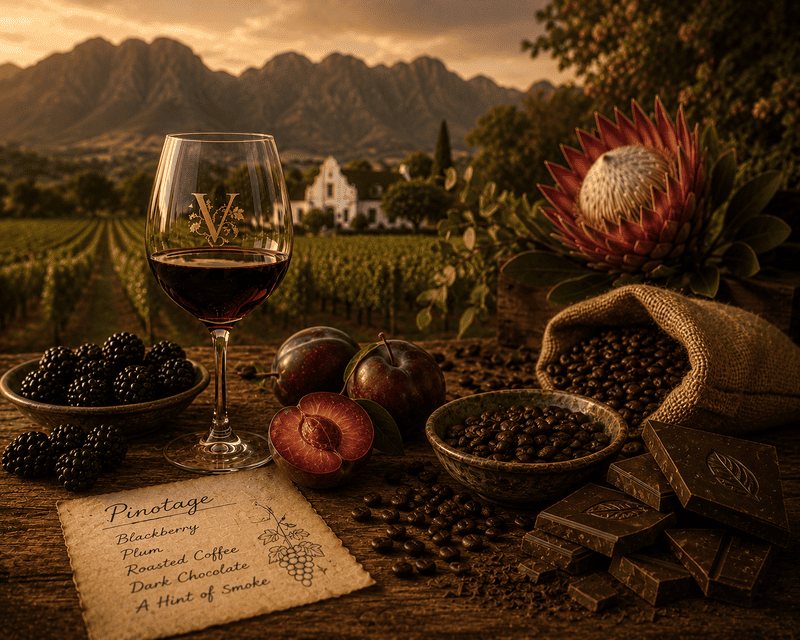
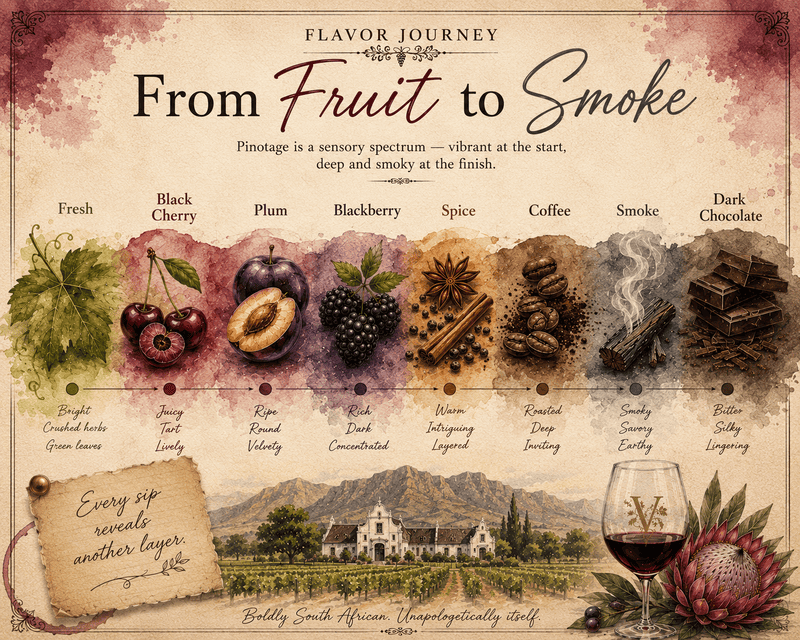
Most Pinotage begins with generous dark fruit aromas.
Blackberry is often the first note people notice, followed by ripe plum, black cherry, blueberry, and sometimes dark raspberry. These fruit flavors give the wine an inviting richness without making it feel overly sweet.
On warmer vineyard sites, the fruit becomes darker and more concentrated, suggesting blackberry preserves, black plum, or baked cherries.
Cooler sites often produce brighter fruit with fresher acidity and a touch more elegance.
Layers Beyond the Fruit
As the wine opens, Pinotage usually reveals another side of its personality.
Earth.
Wild herbs.
Baking spices.
Smoke.
Sometimes even a hint of dried fynbos—the remarkable native shrubland that blankets much of South Africa’s Cape Floral Region.
Many wines also develop notes of cocoa powder, roasted coffee beans, cedar, tobacco, or dark chocolate, especially after spending time in oak barrels.
These savory characteristics give Pinotage much of its individuality. While fruit draws you in, these earthy, smoky layers keep the wine interesting from the first sip to the last.
Different Styles of Pinotage
One of the reasons Pinotage surprises so many people is that there isn’t just one expression of the grape.
Modern producers have embraced a wide range of styles, allowing Pinotage to appeal to many different wine lovers.
Fruit-Driven Pinotage
These wines are vibrant, juicy, and approachable.
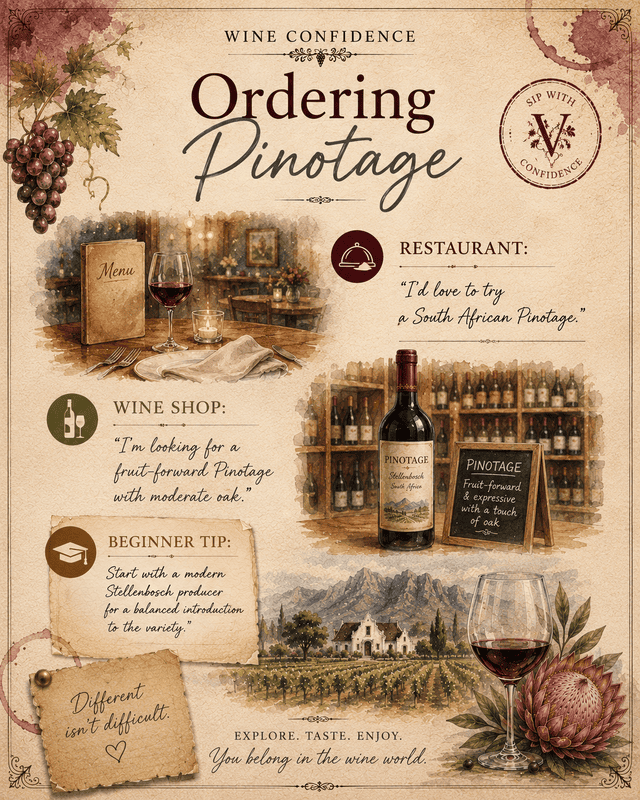
Expect fresh blackberry, plum, cherries, soft spice, and gentle tannins. Often made with little or no new oak, they highlight the grape’s youthful energy and are perfect for casual dinners, burgers, or a weekend braai.
Elegant Pinotage
Some winemakers intentionally pursue a lighter, more refined style.
Earlier harvesting, careful extraction, and restrained oak create wines with brighter acidity, floral aromas, silky tannins, and remarkable freshness. These bottles often surprise people who expect Pinotage to be heavy.
Oak-Aged Pinotage
Premium examples frequently spend months in French or American oak.
Here, flavors of vanilla, cedar, espresso, dark chocolate, baking spice, and smoke weave together with concentrated black fruit. These wines have greater structure and often reward several years of cellaring.
Why Older Pinotage Earned a Difficult Reputation
If you’ve spent time reading about Pinotage online, you’ve probably encountered one recurring description:
“Burnt rubber.”
It is perhaps the most famous—and most misunderstood—tasting note associated with the grape.
The good news is that this characteristic is not an inherent feature of Pinotage itself.
Instead, it was largely the result of earlier winemaking practices. During the grape’s early decades, some producers harvested fruit at less-than-ideal ripeness or used aggressive fermentation methods that encouraged the formation of volatile aroma compounds. Combined with heavy extraction and less refined cellar techniques, these practices sometimes produced wines with smoky, rubbery aromas that overshadowed the fruit.
Those wines shaped Pinotage’s international reputation for many years.
Fortunately, the story did not end there.
Modern vineyard management, improved understanding of the grape, gentler fermentation, careful temperature control, and more thoughtful oak use have transformed Pinotage over the past two decades.
Today’s leading producers are crafting wines that emphasize purity of fruit, freshness, balance, and elegance rather than exaggerated smoky characteristics.
The result is a grape that is finally being appreciated for what it can truly become.
A Wine Unlike Any Other
Perhaps the best way to describe Pinotage is this:
Imagine the dark fruit generosity of Malbec.
The savory depth of Syrah.
A hint of Pinot Noir’s aromatic lift.
Then add a distinctly South African personality that refuses to imitate anyone else.
That is Pinotage.
It is bold without being predictable.
Familiar enough to feel approachable.
Unique enough that, after your first truly great bottle, you’ll remember exactly what made it different.
Where Pinotage Grows Best
By now, we’ve met Pinotage.
We’ve learned how it came into the world, survived against the odds, and developed its own unmistakable personality.
The next question is perhaps the most important one of all:
Where does Pinotage truly feel at home?
The answer lies at the southern tip of Africa.
While small plantings can now be found in countries such as New Zealand, California, Israel, and even parts of Europe, nowhere understands Pinotage quite like South Africa. The grape was created for this landscape, and over the past century it has become deeply intertwined with the country’s vineyards, cuisine, and wine culture.
It is here that Pinotage found not only the climate it needed—but the identity it deserved.
Stellenbosch — The Spiritual Home of Pinotage
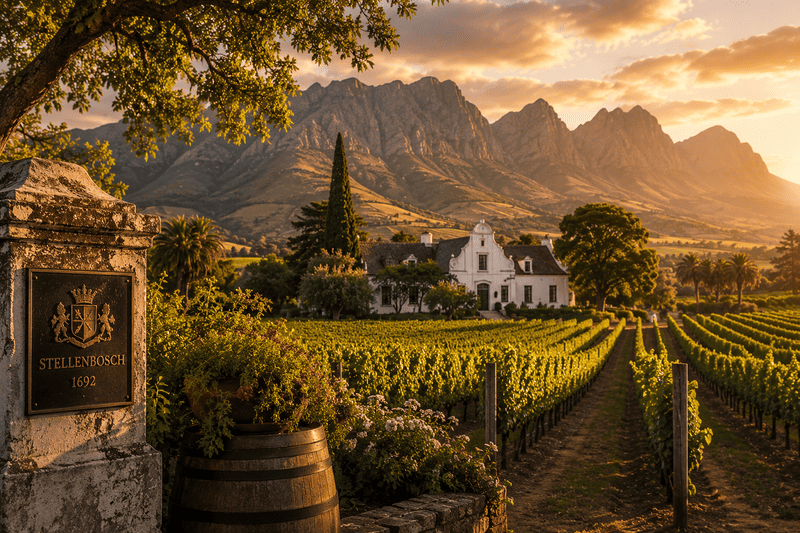
If Pinotage has a hometown, it is Stellenbosch.
Nestled among dramatic mountains just east of Cape Town, Stellenbosch is South Africa’s most celebrated wine region and home to many of the country’s finest Pinotage producers. Rolling vineyards stretch across granite-rich hillsides, while cool afternoon breezes drift inland from nearby False Bay, moderating the warm Mediterranean climate.
These conditions create an ideal balance.
Long, sunny days allow the grapes to ripen fully, developing rich blackberry and plum flavors, while the cooling maritime influence helps preserve freshness and natural acidity. The result is Pinotage with depth, structure, and remarkable balance.
Many of South Africa’s most elegant and age-worthy examples come from this region, combining generous fruit with polished tannins and impressive complexity.
It is no coincidence that the grape was born here.
Paarl — Richness and Power
Travel a little farther north and the landscape begins to change.
Paarl is warmer, drier, and often produces Pinotage with greater concentration and richness. Here, abundant sunshine encourages full ripeness, resulting in wines with darker fruit, fuller body, and generous texture.
Blackberry compote, ripe plum, dark cherry, baking spices, cocoa, and hints of mocha often define the style.
Oak aging is common, giving many Paarl Pinotages an additional layer of vanilla, cedar, espresso, and dark chocolate.
If Stellenbosch often showcases Pinotage’s elegance, Paarl celebrates its generosity.
Swartland — A New Generation of Pinotage
Few South African wine regions have captured the imagination of wine lovers quite like Swartland.
Known for its rugged beauty, dry-farmed vineyards, and independent-minded winemakers, Swartland has become a center of innovation over the past two decades.
Many growers here embrace minimal intervention, allowing old vines, granite and shale soils, and the region’s naturally dry conditions to shape the wines with as little manipulation as possible.
The Pinotages that emerge are often vibrant, savory, and remarkably expressive.
Rather than emphasizing heavy oak or intense extraction, many producers focus on purity of fruit, lively acidity, earthy herbs, mineral notes, and a sense of place.
These wines have played an important role in reshaping Pinotage’s international reputation, showing that the grape can be every bit as refined as it is powerful.
Wellington — Quietly Consistent
Less famous than Stellenbosch or Swartland, Wellington nevertheless plays an important role in South Africa’s Pinotage story.
Surrounded by mountain ranges and blessed with warm days and cool evenings, the region consistently produces healthy, well-ripened grapes. Its diverse soils and varied elevations allow winemakers to craft styles ranging from approachable everyday wines to structured bottles capable of aging gracefully.
Wellington may not always receive the spotlight, but it has quietly helped demonstrate the remarkable versatility of Pinotage.
Sunshine, Sea Breezes, and Ancient Soils
One of the secrets behind South African Pinotage is that no single factor explains its success.
Instead, it is the combination of climate, geography, and geology working together.
Abundant sunshine provides the warmth needed to ripen the grapes fully.
Cooling ocean breezes from the Atlantic and Indian Oceans temper the heat, preserving freshness and helping the fruit retain vibrant acidity.
Mountain elevations create dramatic differences between vineyards, allowing growers to match Pinotage to sites where it performs at its very best.
Beneath it all lie some of the oldest soils on Earth.
Granite, decomposed granite, shale, sandstone, and ancient rocky formations force the vines to dig deep in search of water and nutrients. The resulting wines often display both concentration and complexity, balancing generous fruit with earthy depth and subtle mineral character.
Together, these natural elements create a landscape unlike any other wine region in the world.
It is a landscape that Pinotage seems destined to call home.
Food Pairing with Pinotage
Some wines ask for delicate dishes.
Pinotage asks you to gather around the fire.
This is a wine that feels completely at ease beside glowing coals, smoky aromas, hearty meals, and long conversations shared outdoors. It is one of the reasons Pinotage has become such an important part of South African food culture.
The grape’s generous fruit, moderate acidity, savory complexity, and firm but approachable tannins make it one of the most versatile red wines at the table.
The Perfect Match: A South African Braai
If there is one pairing every wine lover should experience, it is Pinotage alongside a traditional South African braai.
A braai is much more than a barbecue.
It is a celebration.
Friends gather around open flames while steaks, lamb chops, boerewors sausages, chicken, vegetables, and breads cook slowly over hardwood coals. The meal unfolds at its own pace, with conversation lasting as long as the fire itself.
Pinotage feels perfectly at home in this setting.
Its smoky undertones echo the aromas rising from the grill, while its ripe blackberry and plum fruit provide a delicious contrast to charred meat and savory spices.
It is a pairing that seems almost inevitable—as though the wine and the meal were created for one another.
Smoked Meats and Barbecue
Even beyond a traditional braai, Pinotage shines alongside smoked meats.
Brisket.
Pulled pork.
Barbecue ribs.
Grilled sausages.
The wine’s fruit softens smoky flavors, while its earthy notes complement spice rubs, caramelized crusts, and slow-cooked richness.
Whether you’re cooking over charcoal, wood, or simply using your backyard grill, Pinotage is one of the easiest red wines to reach for.
Lamb and Venison
Pinotage also has a wonderful affinity for game and roasted meats.
Grilled lamb chops seasoned with rosemary.
Slow-roasted leg of lamb.
Venison with juniper berries.
Duck with blackberry sauce.
The wine’s combination of dark fruit and savory herbs mirrors many of the flavors naturally found in these dishes, creating pairings that feel balanced rather than overpowering.
Burgers and Rustic Comfort Food
Not every great wine pairing has to be formal.
In fact, Pinotage may be at its happiest beside a great burger.
Whether topped with aged cheddar, caramelized onions, mushrooms, bacon, or smoky barbecue sauce, a well-made burger brings out the wine’s ripe fruit while allowing its earthy character to shine.
The same is true for hearty comfort foods.
Beef stew.
Short ribs.
Shepherd’s pie.
Slow-braised chuck roast.
Rich tomato-based casseroles.
Pinotage has enough structure to stand up to these deeply satisfying dishes without overwhelming them.
Cheese and a Sweet Surprise
Toward the end of the meal, Pinotage continues to impress.
Firm, aged cheeses such as mature Cheddar, Gouda, or Comté complement the wine’s savory complexity beautifully. Their nutty, slightly crystalline character plays wonderfully against Pinotage’s dark fruit and spice.
Then comes a pairing that often surprises people.
Dark chocolate.
Choose chocolate with around 70% cocoa and you’ll discover that Pinotage’s notes of blackberry, cocoa, espresso, and baking spice suddenly become even more expressive. Rather than competing, the wine and chocolate seem to amplify one another.
It is a simple pairing, yet an unforgettable one.
A Wine Meant to Be Shared
Perhaps that is the greatest lesson Pinotage teaches us at the table.
It is not a wine built around perfection or ceremony.
It is built around generosity.
Around gathering friends.
Around lingering over dinner just a little longer.
Around stories told beside a crackling fire with another glass waiting to be poured.
Some wines impress from a distance.
Pinotage invites you to pull up a chair.
And somehow, that feels perfectly South African.

Why Pinotage Matters Today
For much of its history, Pinotage seemed destined to live in the shadow of more familiar grapes.
Wine lovers reached for Cabernet Sauvignon, Pinot Noir, Merlot, or Syrah because they already knew what to expect. Pinotage, meanwhile, carried the weight of old misconceptions and an uneven reputation built during its earliest decades.
But great stories rarely end where they begin.
Over the past twenty years, Pinotage has experienced something of a renaissance.
A new generation of South African growers and winemakers has reimagined what the grape can be. They have embraced lower vineyard yields, more thoughtful site selection, gentler extraction, earlier harvesting, careful oak management, and a philosophy that emphasizes balance over power.
Rather than forcing Pinotage into a style it was never meant to imitate, they have allowed it to become more completely itself.
The results have been remarkable.
Today’s finest Pinotages are vibrant, elegant, expressive, and remarkably nuanced. They retain the grape’s unmistakable personality—its generous dark fruit, savory spice, and earthy depth—while displaying a freshness and refinement that continues to surprise wine lovers around the world.
Many critics who once dismissed Pinotage have returned with fresh eyes and fresh palates, recognizing just how dramatically the category has evolved.
A Symbol of South Africa
Few countries possess a grape that feels so completely intertwined with their national wine identity.
Argentina has Malbec.
New Zealand has Sauvignon Blanc.
Austria has Grüner Veltliner.
For South Africa, that grape is Pinotage.
It is more than simply a successful variety.
It represents decades of experimentation, resilience, and confidence.
Rather than relying solely on Europe’s historic grapes, South Africa created something that reflected its own vineyards, climate, and ambitions. Pinotage became a declaration that the country’s wines could stand proudly on their own merits.
Today, visiting South Africa without tasting Pinotage would be much like traveling to Argentina without trying Malbec or visiting New Zealand without experiencing Marlborough Sauvignon Blanc.
It has become one of the country’s most recognizable ambassadors.
The Rise of Cape Blends
While many outstanding wines are made entirely from Pinotage, the grape also plays an important role in one of South Africa’s most distinctive styles: the Cape Blend.
Unlike classic Bordeaux or Rhône blends, there is no single recipe for a Cape Blend. The defining feature is simply that Pinotage takes a leading role alongside other familiar varieties such as Cabernet Sauvignon, Merlot, Cabernet Franc, Syrah, or Petit Verdot.
These wines combine Pinotage’s dark fruit and unmistakable South African character with the structure, elegance, or spice contributed by its blending partners.
For many wine lovers, Cape Blends provide a wonderful introduction to Pinotage because they offer both familiarity and discovery in the same glass.
Built to Age
Although many Pinotages are delicious when young, the finest examples reward patience.
Premium bottlings from exceptional vineyards can continue evolving for ten, fifteen, or even twenty years under proper cellaring conditions.
As they mature, youthful blackberry and plum gradually give way to more complex aromas of leather, tobacco, cedar, dried herbs, forest floor, cocoa, and warm baking spices. The tannins soften, the fruit becomes more layered, and the wine develops the quiet confidence that only time can create.
These age-worthy bottles have helped demonstrate that Pinotage belongs comfortably among the world’s serious fine wines.
A Future Worth Watching
Perhaps the most exciting chapter of Pinotage’s story has yet to be written.
Around the world, more sommeliers are placing South African wines on their lists. More independent wine shops are introducing customers to premium Pinotage. More winemakers are exploring lighter styles, old-vine bottlings, single-vineyard expressions, and sustainable farming practices that highlight the individuality of each site.
The conversation surrounding Pinotage has changed.
People are no longer asking whether it deserves a place among the world’s great wines.
Increasingly, they are discovering why it has earned one.
Like the country that created it, Pinotage continues to evolve without forgetting where it came from.
Its story is still unfolding.
And that may be its greatest strength of all.
Conclusion
Every great wine tells a story.
Some stories stretch back through centuries of kings, monasteries, and ancient vineyards.
Pinotage tells a different story.
It is the story of a bold idea.
A forgotten experiment.
A fortunate rescue.
Years of trial and refinement.
And ultimately, the confidence of a nation that chose to believe in a grape unlike any other.
Throughout this journey, Pinotage has never tried to become Burgundy’s Pinot Noir.
It has never tried to replace Bordeaux’s Cabernet Sauvignon.
It has never needed to imitate anyone else.
Instead, it found something far more meaningful.
Its own identity.
Today, when you pour a glass of Pinotage, you are tasting more than blackberry, plum, spice, smoke, or dark chocolate.
You are tasting sunshine that ripens vineyards beneath dramatic mountain ranges.
You are tasting cooling ocean breezes drifting inland from two great oceans.
You are tasting ancient granite soils that have nurtured vines for generations.
You are tasting the determination of growers who believed this grape deserved a second chance—and then spent decades proving it.
Most of all, you are tasting South Africa.
Not just its landscape.
Its spirit.
Its resilience.
Its willingness to create rather than simply inherit.
Perhaps that is why Pinotage continues to captivate so many curious wine lovers.
It rewards those willing to venture beyond familiar labels and trusted classics. It reminds us that some of the world’s most memorable wines are not always the oldest or the most famous—they are the ones with the courage to be different.
If you’ve never experienced Pinotage before, consider this your invitation.
Open a bottle.
Share it with friends around a table.
Pair it with food that encourages conversation.
Take your time.
Because somewhere between the first swirl and the final sip, you’ll discover that Pinotage isn’t simply South Africa’s signature red wine.
It’s one of the wine world’s most remarkable stories.
And now, it’s yours to continue.