Introduction
Walk into almost any wine shop in the world and you’ll find Cabernet Sauvignon. Browse a restaurant wine list, and it’s almost guaranteed to make an appearance. From the prestigious estates of Bordeaux to the sun-drenched vineyards of Napa Valley, from Chile’s Maipo Valley to Australia’s Coonawarra region, Cabernet Sauvignon has become the international benchmark for red wine.
For many wine drinkers, Cabernet Sauvignon is the first grape that comes to mind when they think of red wine. It is the bottle chosen for celebrations, steak dinners, special occasions, and cellar collections. It appears on wine lists ranging from casual neighborhood restaurants to Michelin-starred dining rooms. Few wines have achieved the same level of recognition, respect, and global success.
Yet Cabernet Sauvignon’s dominance is far from accidental.
Its rise to the top is the result of a remarkable combination of factors: a flavor profile that appeals to a wide range of wine lovers, an ability to age gracefully for decades, a resilience that allows it to thrive in vineyards around the world, and a fascinating history that spans centuries. Along the way, Cabernet Sauvignon became the foundation of some of the world’s most celebrated wines and helped shape modern wine culture as we know it today.
But how did one grape variety rise from humble beginnings in southwestern France to become the world’s most widely planted and recognized premium red wine grape?
In this article, we’ll explore the story behind Cabernet Sauvignon’s extraordinary success. We’ll look at where it came from, what makes it unique, how it spread across the globe, and why wine lovers continue to reach for it year after year. Whether you’re already a devoted Cabernet fan or simply curious about the grape behind so many iconic bottles, you’ll discover why Cabernet Sauvignon has earned its reputation as the king of red wine.
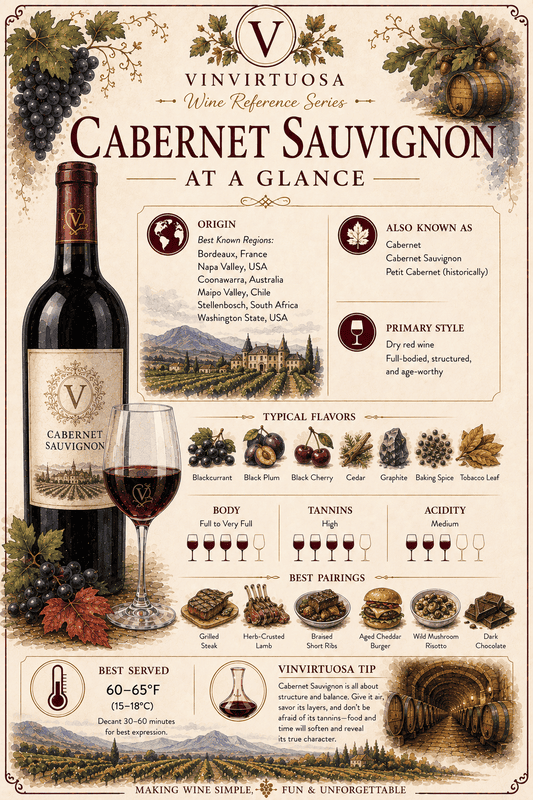
What Is Cabernet Sauvignon?
Cabernet Sauvignon’s story begins in the vineyards of Bordeaux, France, where one of the wine world’s most important accidents occurred.
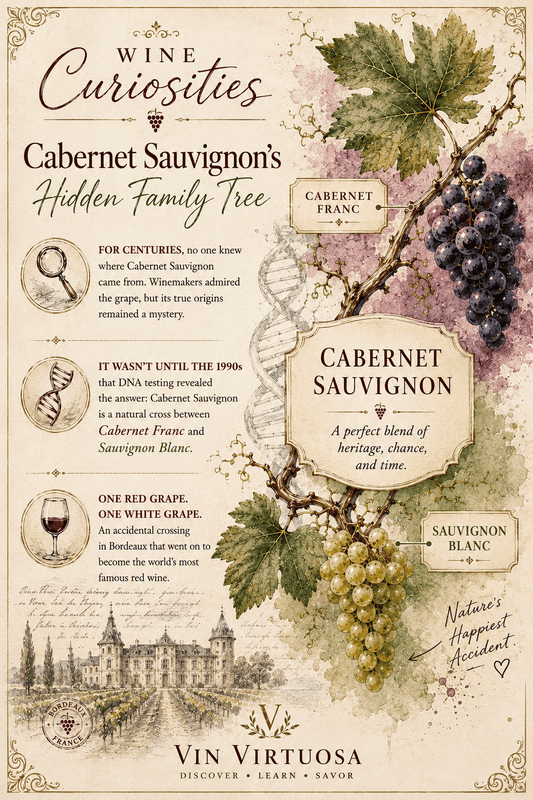
For centuries, growers cultivated grape varieties without fully understanding how they originated. It wasn’t until the 1990s, when DNA analysis became available, that scientists uncovered Cabernet Sauvignon’s true parentage. The results revealed that Cabernet Sauvignon was the natural offspring of two seemingly very different grapes: Cabernet Franc, a red grape known for elegance and aromatic complexity, and Sauvignon Blanc, a white grape famous for its vibrant acidity and freshness.
At some point during the 17th century, these two varieties crossed naturally in a Bordeaux vineyard, creating an entirely new grape variety. No one planned it. No one intentionally bred it. Nature simply did what nature often does best.
The result was extraordinary.
Cabernet Sauvignon inherited some of the most desirable characteristics from both parents. From Cabernet Franc, it gained structure, tannin, dark fruit flavors, and an ability to age gracefully. From Sauvignon Blanc, it inherited bright acidity and distinctive aromatic qualities that help give the wine freshness and balance.
The grape’s thick skins contribute to its deep color, firm tannins, and impressive concentration of flavor. These characteristics allow Cabernet Sauvignon to produce wines that are powerful yet balanced, capable of developing tremendous complexity over time. Young Cabernet Sauvignon often displays bold flavors of blackcurrant, blackberry, black cherry, and plum, while aging can reveal additional layers of cedar, tobacco, leather, graphite, and earthy notes.
Beyond its flavor profile, Cabernet Sauvignon possesses another important advantage: adaptability. The grape can thrive in a remarkable range of climates and soils, from the gravelly vineyards of Bordeaux to the volcanic soils of Chile, the sunny valleys of California, and the diverse wine regions of Australia and South Africa. This versatility helped fuel its expansion across the globe and played a major role in its eventual rise to worldwide prominence.
Today, Cabernet Sauvignon is planted on nearly every major wine-growing continent and serves as the backbone of countless iconic wines. It is a grape capable of producing everything from approachable everyday bottles to some of the most sought-after and collectible wines in the world.
What began as a chance crossing in a French vineyard has become one of the greatest success stories in wine history—a grape that continues to define excellence for winemakers and wine lovers alike.
“Few grapes combine power, elegance, ageability, and food-friendliness as successfully as Cabernet Sauvignon.”
The Characteristics That Made Cabernet Sauvignon Famous
Many grape varieties produce excellent wine. Few have managed to achieve the global recognition and enduring popularity of Cabernet Sauvignon. Its success can be traced to a combination of characteristics that appeal not only to wine drinkers but also to vineyard owners, winemakers, collectors, and restaurateurs.
Simply put, Cabernet Sauvignon excels in many areas where other grapes may shine in only one or two.
Consistency
One of Cabernet Sauvignon’s greatest strengths is its remarkable consistency.
Wine lovers often appreciate knowing what to expect when they open a bottle. While every region and producer brings its own interpretation, Cabernet Sauvignon typically delivers familiar characteristics: dark fruit flavors, noticeable tannins, good structure, and a sense of depth and concentration.
A bottle from Bordeaux may taste very different from one produced in Napa Valley or Chile, but all three are likely to share a recognizable Cabernet identity.
This reliability has helped build consumer confidence over generations. Someone who enjoys Cabernet Sauvignon can travel almost anywhere in the world and find examples that feel both familiar and exciting.
Structure
Cabernet Sauvignon is often described as a “structured” wine, and for good reason.
The grape naturally produces wines with substantial tannins and vibrant acidity. These elements provide the framework that supports the wine’s fruit flavors and allows it to maintain balance over time.
Think of structure as the skeleton of a building. Without it, everything eventually collapses. Cabernet Sauvignon’s firm tannins and acidity give it strength, shape, and longevity.
When paired with food, that structure becomes even more apparent. A rich ribeye steak, grilled lamb chops, or a hearty beef stew can soften the wine’s tannins while allowing its fruit flavors to shine. This ability to complement substantial dishes has made Cabernet Sauvignon a favorite among sommeliers and restaurant wine directors around the world.
Ageability
is often built for the long haul.
Its combination of tannin, acidity, color, and concentration gives it exceptional aging potential. While many everyday examples are enjoyable upon release, higher-quality Cabernet Sauvignons can continue evolving for decades.
Over time, the bold fruit flavors of youth gradually transform into more complex and nuanced characteristics. Blackcurrant and blackberry notes may evolve into aromas of cedar, tobacco, leather, forest floor, and dried herbs. The tannins soften, the texture becomes smoother, and the wine develops layers of complexity that simply cannot be achieved overnight.
This aging ability has made Cabernet Sauvignon a favorite among collectors and helped establish its reputation as one of the world’s most prestigious grape varieties.
A Recognizable Flavor Profile
Part of Cabernet Sauvignon’s success comes from the fact that it has a clear and memorable personality.
Even novice wine drinkers can often recognize Cabernet’s hallmark flavors. Blackcurrant, blackberry, black cherry, plum, cedar, tobacco, and hints of mint or graphite frequently appear in the glass.
These flavors are bold enough to make an impression yet balanced enough to remain versatile and approachable.
Unlike some grape varieties that can vary dramatically depending on where they are grown, Cabernet Sauvignon tends to maintain its core identity. This consistency makes it easier for consumers to explore wines from different regions while still staying within their comfort zone.
Food Friendly
Despite its reputation as a powerful wine, Cabernet Sauvignon is surprisingly versatile at the table.
Its acidity helps refresh the palate, while its tannins interact beautifully with protein-rich foods. This makes Cabernet Sauvignon a natural companion for many classic dishes.
Some of the most famous pairings include:
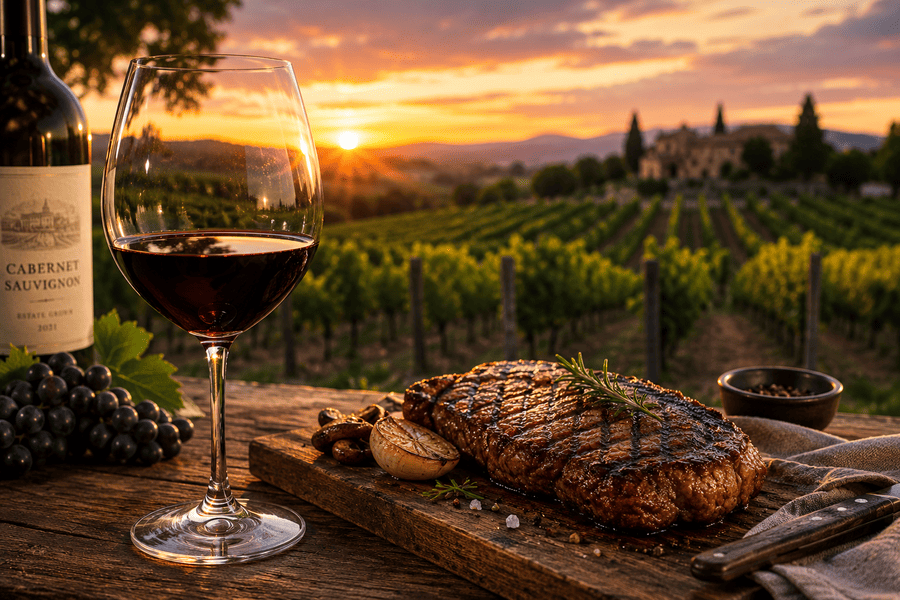
🥩 Grilled ribeye steak
🐑 Roast lamb
🍔 Gourmet burgers
🧀 Aged cheddar
🍄 Mushroom dishes
🍖 Braised short ribs
The wine’s structure allows it to stand up to bold flavors without overpowering them. This food-friendly nature has contributed significantly to its popularity among both casual wine drinkers and fine dining enthusiasts.
When all of these qualities are combined—consistency, structure, ageability, recognizable flavors, and food friendliness—it’s easy to understand why Cabernet Sauvignon has become the benchmark by which many red wines are judged.
Why Cabernet Sauvignon Grows Almost Everywhere
Great wines need more than consumer appeal. They also need grapes that growers are willing and able to cultivate successfully.
Fortunately for vineyard owners, Cabernet Sauvignon possesses a number of agricultural advantages that have helped it spread across nearly every major wine-producing region in the world.
While some grape varieties can be difficult, unpredictable, or highly sensitive to environmental conditions, Cabernet Sauvignon has earned a reputation for reliability and adaptability.
Thick Skins
One of Cabernet Sauvignon’s most important traits is its thick skin.
These thick skins contribute to the wine’s deep color, robust tannins, and concentrated flavors. They also provide an extra layer of protection in the vineyard.
Compared to more delicate grape varieties, Cabernet Sauvignon is generally less vulnerable to certain weather-related challenges and vineyard hazards. The thicker skins help protect the grapes as they ripen, increasing the likelihood of producing healthy fruit at harvest.
Ironically, one of the characteristics that creates Cabernet’s bold wines also helps make it easier to grow.
Resistance and Durability
No grape variety is immune to disease or vineyard challenges, but Cabernet Sauvignon is generally considered more resilient than many other premium wine grapes.
Growers appreciate its ability to perform consistently across a wide range of conditions. This reliability reduces some of the uncertainty that vineyard managers face each growing season.
When farmers are investing years of work and significant financial resources into a vineyard, predictability matters.
Cabernet Sauvignon often rewards that investment.
Adaptability to Different Climates
Perhaps the greatest reason for Cabernet Sauvignon’s global success is its remarkable adaptability.
The grape can produce excellent wines in a variety of climates and regions.
In cooler areas, Cabernet Sauvignon tends to produce wines with greater acidity, firmer structure, and herbal or graphite-driven notes.
In warmer climates, the wines become richer and more fruit-forward, displaying flavors of ripe blackberry, black cherry, plum, and chocolate.
This flexibility allows Cabernet Sauvignon to thrive in places as diverse as:
🇫🇷 Bordeaux
🇺🇸 Napa Valley
🇨🇱 Chile’s Maipo Valley
🇦🇺 Coonawarra and Margaret River
🇿🇦 South Africa
🇦🇷 Argentina
Few grape varieties have demonstrated such consistent success across so many different environments.
Reliable Yields
For growers, consistency isn’t just about quality—it’s also about production.
Cabernet Sauvignon generally provides dependable yields while maintaining the potential to produce high-quality wines. This balance makes it attractive from both an agricultural and economic perspective.
Producers can create everything from affordable everyday wines to highly sought-after luxury bottlings using the same grape variety.
That versatility has encouraged widespread planting throughout the wine world.
Winemaker Flexibility
Cabernet Sauvignon is also exceptionally versatile in the winery.
Some producers showcase it as a single-varietal wine, highlighting its bold fruit and structure. Others blend it with grapes such as Merlot, Cabernet Franc, Petit Verdot, or Malbec to create additional complexity and balance.
It responds well to oak aging, develops beautifully in bottle, and can be crafted in styles ranging from approachable and fruit-forward to powerful and age-worthy.
This flexibility gives winemakers tremendous creative freedom while still preserving Cabernet Sauvignon’s recognizable identity.
Taken together, these vineyard and winery advantages explain why Cabernet Sauvignon expanded far beyond its Bordeaux birthplace. Growers embraced its reliability, winemakers appreciated its versatility, and consumers loved the resulting wines.
Few grape varieties have managed to satisfy all three groups so successfully—and that may be the most important reason Cabernet Sauvignon became the world’s most popular red wine.
“Cabernet Sauvignon succeeds because it offers both familiarity and discovery: recognizable enough for beginners, yet complex enough to reward a lifetime of exploration.”
Bordeaux: Where the Story Began
Although Cabernet Sauvignon is now grown throughout the world, its heart remains in Bordeaux, France.
Located in southwestern France, Bordeaux is one of the most influential wine regions on Earth. For centuries, the region has produced wines that set the standard for quality, ageability, and prestige. While many grape varieties are cultivated there, Cabernet Sauvignon emerged as one of Bordeaux’s defining grapes and eventually became the foundation of many of the world’s most celebrated wines.
The key to understanding Cabernet Sauvignon’s role in Bordeaux lies in geography.
The city of Bordeaux is divided by the Gironde Estuary and its tributaries, creating two distinct wine-producing areas commonly known as the Left Bank and the Right Bank. While the Right Bank is more heavily associated with Merlot, Cabernet Sauvignon reigns supreme on the Left Bank.
The Left Bank Advantage
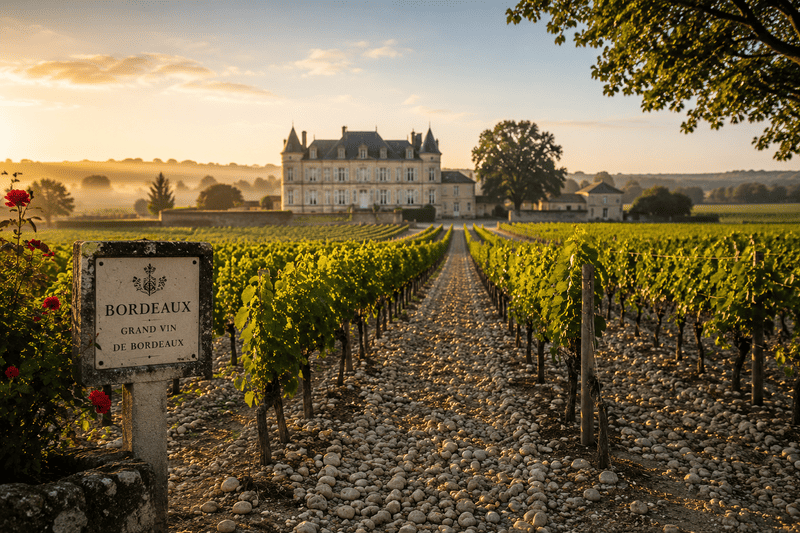
The Left Bank’s gravelly soils are perfectly suited to Cabernet Sauvignon.
These well-draining soils force the vines to send their roots deep into the earth in search of water and nutrients. The result is smaller berries with concentrated flavors, thick skins, and the structure that has made Bordeaux wines famous.
Over generations, winemakers discovered that Cabernet Sauvignon thrived in these conditions, producing wines with exceptional depth, complexity, and longevity.
Today, some of the world’s most prestigious wine appellations are found on Bordeaux’s Left Bank.
Médoc
The Médoc is perhaps the most famous Cabernet Sauvignon territory in the world.
Stretching north from the city of Bordeaux, this historic region contains many of the estates that helped establish Bordeaux’s reputation. Gravel soils dominate the landscape, providing ideal conditions for Cabernet Sauvignon.
Many of the region’s greatest wines are Cabernet-led blends capable of aging for decades.
Pauillac
If Bordeaux had a spiritual home for Cabernet Sauvignon, it might be Pauillac.
This small appellation produces some of the most powerful and age-worthy wines in the world. Pauillac wines are often characterized by intense black fruit, cedar, graphite, tobacco, and remarkable structure.
These are wines built not only for immediate enjoyment but also for long-term cellaring.
Saint-Estèphe
Located at the northern end of the Médoc, Saint-Estèphe often produces some of Bordeaux’s most robust and structured wines.
The combination of gravel and clay soils contributes to wines that can be powerful, firm, and deeply concentrated in their youth. Given time, they evolve into extraordinarily complex expressions of Cabernet Sauvignon.
Saint-Julien
Saint-Julien is frequently described as the most balanced of the Médoc appellations.
Its wines often combine the power of Pauillac with the elegance of Margaux, creating harmonious and refined blends that showcase Cabernet Sauvignon’s versatility.
Margaux
Known for producing some of Bordeaux’s most elegant wines, Margaux demonstrates Cabernet Sauvignon’s ability to express finesse as well as power.
The wines often display floral aromas, silky textures, and remarkable complexity while still maintaining the structure necessary for long-term aging.
The Magic of Blending
One of Bordeaux’s greatest contributions to the wine world is the art of blending.
While Cabernet Sauvignon may be the star of many Left Bank wines, it rarely performs alone.
Instead, Bordeaux winemakers combine Cabernet Sauvignon with complementary grape varieties that enhance the final wine.
Merlot often contributes softness, plush fruit, and approachability.
Cabernet Franc adds aromatic complexity, elegance, and freshness.
Petit Verdot contributes color, structure, spice, and additional depth.
Together, these grapes create wines that are often greater than the sum of their parts.
This blending philosophy became so influential that it has been adopted by wineries across the globe. Today, Cabernet-based blends inspired by Bordeaux can be found everywhere from Napa Valley to Chile, Australia, South Africa, and beyond.
Long before Cabernet Sauvignon conquered the world, Bordeaux demonstrated just how extraordinary the grape could be.
The Judgment of Paris and Cabernet’s Global Explosion
For much of the twentieth century, Bordeaux occupied an almost untouchable position in the wine world.
French wines were widely considered the benchmark against which all others were measured. While quality wines were certainly being produced elsewhere, few consumers, critics, or industry professionals believed that regions outside France could truly compete with Bordeaux’s finest estates.
Then, in 1976, everything changed.
The Event
The story begins with a British wine merchant named Steven Spurrier.
Spurrier operated a wine shop and wine school in Paris and had become intrigued by the growing quality of wines being produced in California. To celebrate the upcoming bicentennial of the United States, he organized a blind tasting featuring top French wines alongside a selection of California wines.
The tasting took place in Paris on May 24, 1976.
The judges were respected French wine experts.
The expectation was simple.
France would win.
The Surprise
What happened next shocked the wine world.
In the red wine category, California Cabernet Sauvignon-based wines competed directly against some of Bordeaux’s most prestigious estates.
When the scores were tallied, a California wine emerged victorious.
The winner was the 1973 Cabernet Sauvignon from Stag’s Leap Wine Cellars.
The result stunned judges, critics, and wine professionals alike.
The assumption that great Cabernet Sauvignon could only come from Bordeaux had been challenged in dramatic fashion.
For the first time, many consumers realized that world-class Cabernet Sauvignon could be produced outside France.
The Impact
The event quickly became known as the Judgment of Paris.
Its impact extended far beyond a single tasting.
The Judgment of Paris fundamentally changed how people thought about wine.
Regions that had previously been viewed as outsiders suddenly gained credibility. California’s reputation soared, and winemakers around the world took notice. If Napa Valley could compete with Bordeaux, perhaps other regions could as well.
Investment poured into vineyards across the globe.
Plantings of Cabernet Sauvignon increased.
Consumers became more willing to explore wines from emerging regions.
Wine critics expanded their focus beyond Europe.
Most importantly, Cabernet Sauvignon became a truly international grape.
The Judgment of Paris helped transform Cabernet Sauvignon from a Bordeaux success story into a global phenomenon. It demonstrated that exceptional Cabernet could be produced in a variety of climates and countries, accelerating the grape’s expansion into nearly every major wine-producing region.
Nearly fifty years later, the influence of that historic tasting can still be felt. The modern wine world—with outstanding Cabernet Sauvignon coming from California, Chile, Australia, South Africa, Argentina, and countless other regions—owes much to that single afternoon in Paris.
If Bordeaux established Cabernet Sauvignon’s reputation, the Judgment of Paris helped launch its worldwide fame.
“If Bordeaux gave Cabernet Sauvignon its reputation, the Judgment of Paris gave it the world.”
Cabernet Sauvignon Around the World
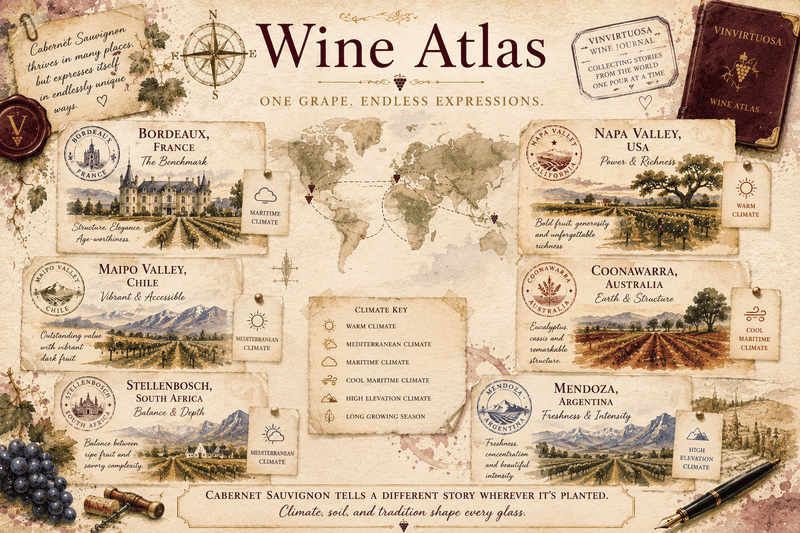
One of the reasons Cabernet Sauvignon became the world’s most popular red wine is its remarkable ability to adapt to different growing regions while still maintaining its recognizable identity.
Whether it’s grown on the gravelly soils of Bordeaux, the sun-soaked hillsides of Napa Valley, or the high-altitude vineyards of Argentina, Cabernet Sauvignon remains unmistakably Cabernet. Yet each region leaves its own fingerprint on the wine, creating distinct styles that reflect local climate, soils, and winemaking traditions.
Exploring Cabernet Sauvignon from around the world is one of the most enjoyable ways to deepen your appreciation for the grape.
France: The Classic Benchmark
France remains Cabernet Sauvignon’s spiritual home.
In Bordeaux, particularly on the Left Bank, Cabernet Sauvignon is prized for its structure, elegance, and ability to age. These wines often emphasize balance over power, showcasing firm tannins, vibrant acidity, and complex aromas rather than overt fruit intensity.
French Cabernet Sauvignon frequently displays flavors of blackcurrant, cedar, graphite, tobacco, and dried herbs. The wines tend to be more restrained and savory in style, often revealing greater complexity as they age.
For many wine lovers, Bordeaux remains the benchmark against which Cabernet Sauvignon from other regions is measured.
United States: Richness and Power
If Bordeaux represents elegance, Napa Valley represents abundance.
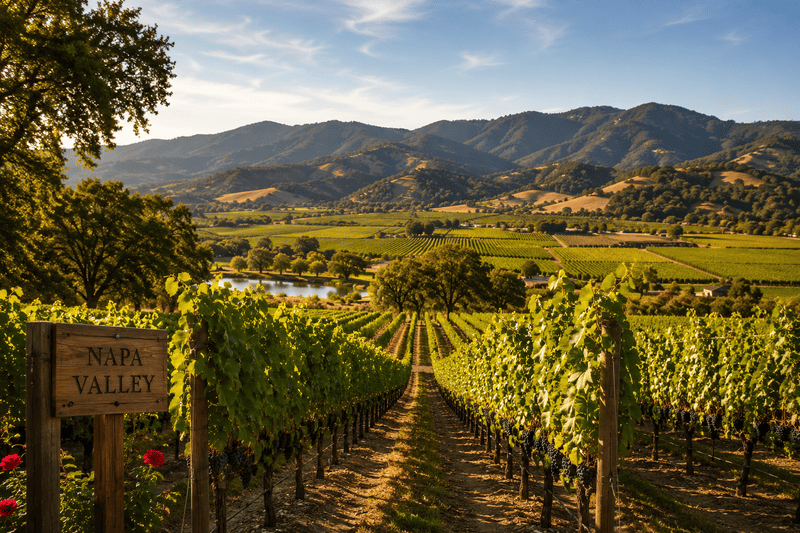
California’s warm climate allows Cabernet Sauvignon to achieve exceptional ripeness, producing wines that are rich, concentrated, and intensely flavored. Napa Valley, in particular, has become one of the most famous Cabernet-producing regions in the world.
These wines often feature ripe blackberry, black cherry, cassis, dark chocolate, and vanilla notes, supported by generous oak influence and velvety textures.
Napa Cabernet Sauvignon is often larger, bolder, and more fruit-driven than its French counterparts, yet the best examples retain the balance and structure necessary for long-term aging.
The success of Napa Valley Cabernet helped establish California as one of the world’s premier wine-producing regions and played a major role in Cabernet Sauvignon’s global rise.
Chile: Exceptional Quality and Value
For wine drinkers seeking outstanding value, Chile is one of the most exciting Cabernet Sauvignon destinations in the world.
Cabernet Sauvignon thrives in Chile’s Mediterranean climate, producing wines that combine ripe fruit flavors with freshness and structure. Many examples offer exceptional quality at prices that are often lower than comparable wines from California or France.
The Maipo Valley is widely regarded as Chile’s Cabernet heartland. Often called the “Bordeaux of South America,” Maipo produces elegant wines featuring blackcurrant, plum, cedar, and subtle herbal notes.
Further south, the Colchagua Valley tends to produce richer, fuller-bodied expressions with darker fruit flavors and greater concentration.
Together, these regions have helped establish Chile as one of the world’s leading sources of high-quality Cabernet Sauvignon.
Australia: Bold and Fruit-Driven
Australia’s warm climate and innovative winemaking culture have produced a distinctive style of Cabernet Sauvignon that has earned fans around the globe.
Australian Cabernet often emphasizes ripe fruit, generous texture, and approachable character. Blackberry, cassis, plum, eucalyptus, and dark chocolate are common flavor descriptors.
Regions such as Coonawarra and Margaret River have become particularly famous for Cabernet Sauvignon. Coonawarra’s unique terra rossa soils contribute structure and complexity, while Margaret River often produces wines that combine New World fruit intensity with Old World elegance.
Australian Cabernet Sauvignon demonstrates how the grape can be both powerful and refined.
South Africa: A Rising Star
South Africa may not receive the same attention as Bordeaux or Napa Valley, but its Cabernet Sauvignon deserves serious consideration.
Over the past several decades, South African producers have dramatically improved quality, creating wines that increasingly compete on the world stage.
South African Cabernet Sauvignon often displays a fascinating combination of ripe dark fruit, herbal complexity, earthy undertones, and savory notes. The wines can be powerful without becoming overly ripe, offering a balance that appeals to many enthusiasts.
As international recognition continues to grow, South Africa is becoming an increasingly important part of Cabernet Sauvignon’s global story.
Argentina: Cabernet at High Altitude
While Argentina is best known for Malbec, Cabernet Sauvignon has quietly established itself as one of the country’s most impressive red varieties.
Many of Argentina’s Cabernet vineyards are planted at high elevations near the Andes Mountains. The combination of intense sunlight, cool nighttime temperatures, and long growing seasons allows grapes to ripen fully while retaining freshness and acidity.
These high-altitude conditions often produce Cabernet Sauvignons with vibrant fruit flavors, firm structure, and remarkable concentration.
The result is a style that combines ripe blackberry and black cherry flavors with freshness, elegance, and a distinct sense of place.
One Grape, Many Expressions
What makes Cabernet Sauvignon so fascinating is its ability to express regional character while remaining unmistakably itself.
A Bordeaux Cabernet, a Napa Cabernet, and a Chilean Cabernet may taste very different from one another, yet all share the structure, dark fruit profile, and aging potential that define the variety.
This adaptability has allowed Cabernet Sauvignon to become a truly global grape—and one of the most exciting wines for curious drinkers to explore.
What Cabernet Sauvignon Tastes Like
One of the reasons Cabernet Sauvignon has achieved such widespread popularity is that it offers a flavor profile that is both distinctive and memorable.
Even people who are relatively new to wine often find Cabernet Sauvignon easy to recognize. Its combination of dark fruit, firm structure, and savory complexity creates a personality that stands out in the glass.
Of course, climate, region, winemaking choices, and bottle age all influence flavor. A young Napa Cabernet will taste quite different from a mature Bordeaux. Yet certain characteristics consistently appear, helping define Cabernet Sauvignon’s unmistakable identity.
Dark Fruit Flavors
At its core, Cabernet Sauvignon is a dark-fruited wine.
The most common fruit aromas and flavors include:
🍇 Blackcurrant (often called cassis)
🍇 Blackberry
🍒 Black Cherry
🍑 Plum
Blackcurrant is perhaps Cabernet Sauvignon’s signature note and one of the aromas most commonly associated with the grape.
In cooler climates, these fruit flavors may appear fresher and more restrained. In warmer regions, they become richer, riper, and more concentrated.
A young Napa Valley Cabernet might burst with ripe blackberry and black cherry, while a Bordeaux Cabernet may lean more toward blackcurrant and subtle plum notes.
Herbal and Savory Notes
Beyond fruit, Cabernet Sauvignon often displays a fascinating range of herbal characteristics.
Common examples include:
🌿 Mint
🌱 Sage
🌿 Dried Herbs
🌱 Eucalyptus
These notes can add complexity and freshness to the wine.
Some wine lovers specifically seek out these herbal nuances because they create balance and prevent the wine from feeling overly fruit-driven.
Australian Cabernets, in particular, are sometimes known for their distinctive eucalyptus character, while Bordeaux often displays subtle dried herb and graphite notes.
The Influence of Oak
Many Cabernet Sauvignons spend time aging in oak barrels, which can significantly influence flavor and texture.
Oak aging may contribute aromas and flavors such as:
🌰 Vanilla
🌲 Cedar
🍞 Toast
🍫 Chocolate
These characteristics often complement Cabernet Sauvignon’s dark fruit profile beautifully.
The combination of blackcurrant, cedar, vanilla, and tobacco has become one of the classic signatures of premium Cabernet Sauvignon.
Oak can also help soften tannins and add complexity, contributing to the wine’s overall harmony.
How Cabernet Changes with Age
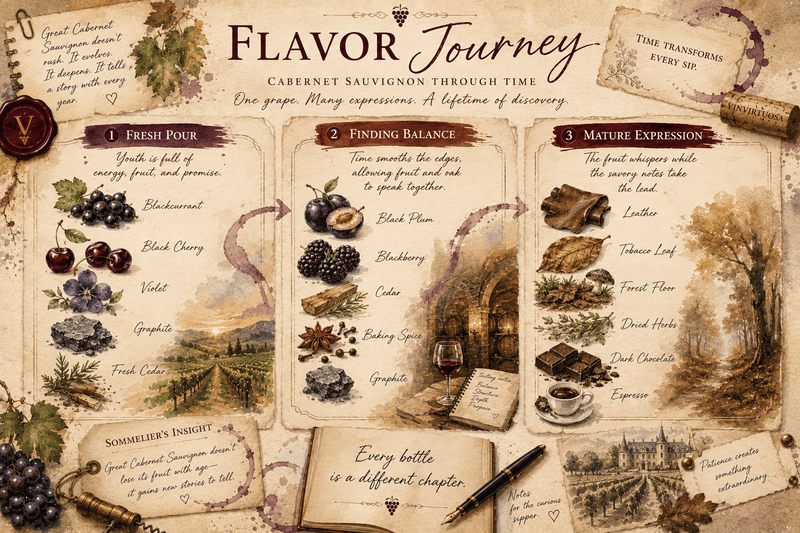
One of Cabernet Sauvignon’s most remarkable qualities is its ability to evolve over time.
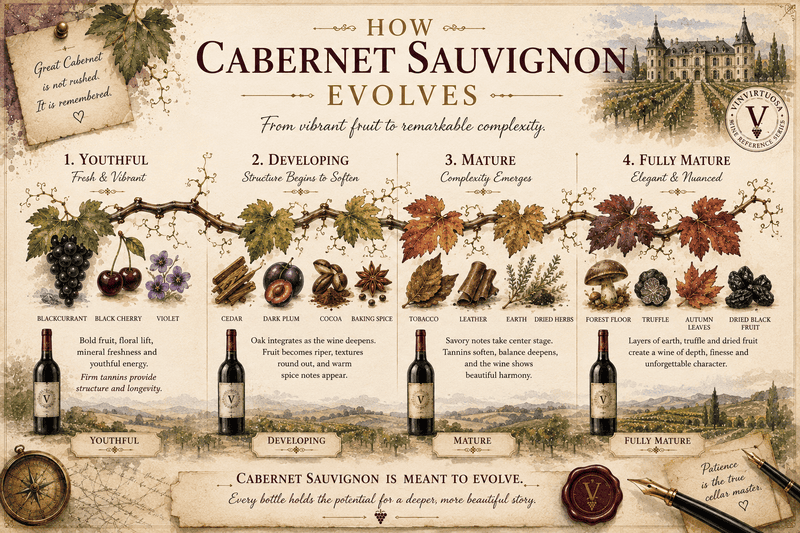
Young Cabernet Sauvignon is often dominated by fruit. Blackcurrant, blackberry, plum, and oak influences tend to be the most noticeable characteristics. The tannins are typically firmer, and the wine may feel powerful and energetic.
As the wine ages, a transformation begins.
Primary fruit flavors gradually become less prominent, allowing secondary and tertiary characteristics to emerge.
You may begin to notice:
🧳 Leather
🚬 Tobacco
🌎 Earth
🍄 Forest Floor
🌿 Dried Herbs
These flavors create additional layers of complexity and are one reason mature Cabernet Sauvignon is so highly prized by collectors.
A Wine That Tells a Story
Perhaps the most fascinating aspect of Cabernet Sauvignon is that it often tastes different at various stages of its life.
A young Cabernet tells a story of fruit, energy, and power.
A mature Cabernet tells a story of patience, evolution, and complexity.
Whether enjoyed shortly after release or decades later, Cabernet Sauvignon offers an experience that continues to reward exploration—and that’s one more reason it remains the world’s most popular red wine.
Why Cabernet Sauvignon Ages So Well
Not every wine is designed to improve with age.
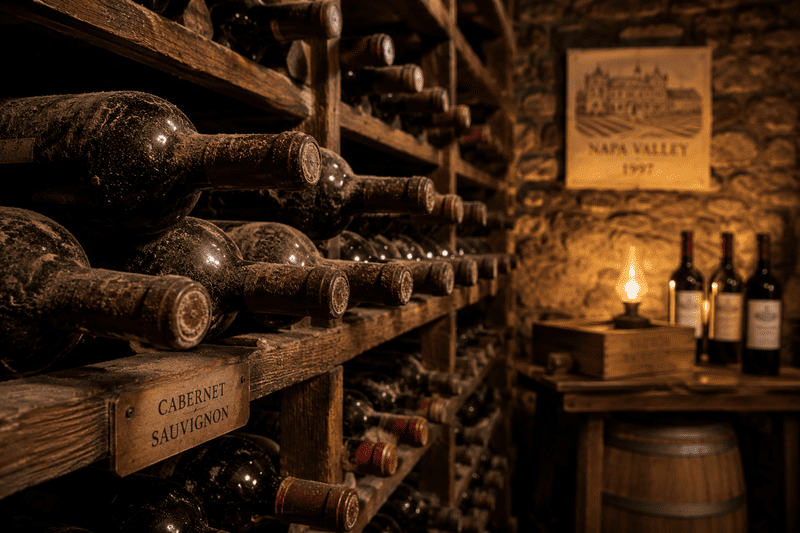
Many wines are crafted to be enjoyed within a year or two of release, offering fresh fruit flavors and immediate appeal. Cabernet Sauvignon, however, belongs to a special category of wines that can evolve and develop for years—and sometimes decades.
This extraordinary aging potential is one of the reasons Cabernet Sauvignon has earned such a prestigious reputation among collectors and wine enthusiasts.
But what exactly allows Cabernet Sauvignon to stand the test of time?
The answer lies in three key elements: tannin, acidity, and concentration.
The Role of Tannins
If Cabernet Sauvignon has a secret weapon, it’s tannin.
Tannins are naturally occurring compounds found primarily in grape skins, seeds, and stems. Because Cabernet Sauvignon has thick skins, it naturally produces wines with relatively high tannin levels.
When a wine is young, tannins can feel firm, grippy, or even slightly drying on the palate. This is why some young Cabernet Sauvignons seem powerful or even a bit aggressive when first opened.
Over time, however, tannins slowly soften and integrate into the wine. This gradual transformation helps create the silky texture and complexity often found in mature Cabernet Sauvignon.
Think of tannins as the wine’s structural framework. Just as a building needs a strong foundation to remain standing for decades, Cabernet Sauvignon relies on tannins to support long-term aging.
The Importance of Acidity
Acidity is often referred to as the backbone of wine.
While tannins provide structure, acidity provides freshness and energy.
Without sufficient acidity, a wine can feel flat and tired over time. Cabernet Sauvignon’s naturally moderate-to-high acidity helps preserve its vitality as it ages, preventing it from becoming heavy or dull.
Even after years in the bottle, well-made Cabernet Sauvignon can retain remarkable freshness because of this important characteristic.
Acidity acts almost like a built-in preservation system, helping the wine maintain balance as its flavors evolve.
Concentration Matters
The third piece of the aging puzzle is concentration.
Cabernet Sauvignon’s thick skins contribute not only tannin but also deep color, flavor intensity, and aromatic complexity. The wine begins life with an abundance of fruit, structure, and extract.
This concentration gives Cabernet Sauvignon something to lose over time.
As primary fruit flavors gradually fade, new aromas and flavors emerge. Because the wine started with such depth and intensity, it can continue evolving without becoming thin or lacking character.
The result is a wine that changes rather than simply declines.
Young Cabernet vs. Aged Cabernet
One of the most fascinating aspects of Cabernet Sauvignon is how dramatically it can transform over time.
Young Cabernet Sauvignon
Young Cabernet is often:
🍇 Fruit-driven
🍒 Bold
🍷 Rich and concentrated
🔥 Powerful
🌿 Vibrant and energetic
The fruit takes center stage, with flavors of blackcurrant, blackberry, black cherry, and plum dominating the experience.
Oak influences such as vanilla, chocolate, and toast may also be prominent.
Aged Cabernet Sauvignon
With time, the wine develops greater complexity and nuance.
Aged Cabernet often becomes:
🧳 More complex
🌎 More savory
🍄 More layered
✨ More subtle and refined
🌿 More aromatic
Instead of focusing primarily on fruit, mature Cabernet begins to reveal secondary and tertiary characteristics such as leather, tobacco, cedar, earth, dried herbs, and forest floor.
The texture softens, the components integrate, and the wine becomes increasingly harmonious.
The Reward of Patience
One of the joys of Cabernet Sauvignon is that it can provide two entirely different experiences depending on when you choose to drink it.
Young Cabernet offers power, energy, and bold fruit.
Mature Cabernet offers complexity, elegance, and depth.
Neither is inherently better—they are simply different expressions of the same grape.
This ability to evolve over time is one of the primary reasons Cabernet Sauvignon remains a favorite among collectors and one of the world’s most respected wine varieties.
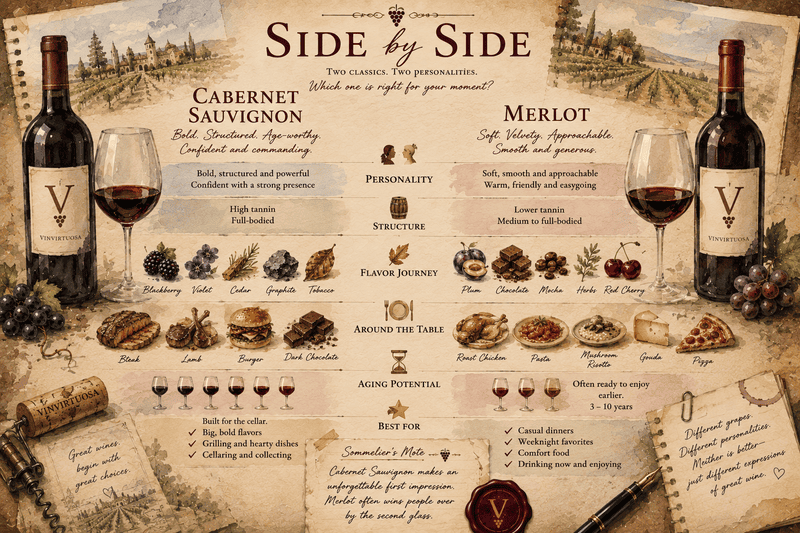
Cabernet Sauvignon Food Pairing Guide
Cabernet Sauvignon may be famous for its structure, ageability, and prestige, but it is also one of the most rewarding wines to pair with food.
Its bold flavors, firm tannins, and refreshing acidity allow it to complement a wide range of dishes, particularly those featuring rich flavors and substantial textures.
One of the simplest rules of wine pairing is that powerful wines generally require flavorful foods. Cabernet Sauvignon is a perfect example.
Classic Cabernet Sauvignon Pairings
These pairings have become classics because they consistently bring out the best in both the wine and the food.
🥩 Ribeye Steak
Few pairings are more iconic than Cabernet Sauvignon and a well-marbled ribeye.
The fat in the steak helps soften Cabernet’s tannins, while the wine’s acidity refreshes the palate between bites. At the same time, the wine’s dark fruit and savory notes complement the char and richness of the meat.
It’s a pairing that has stood the test of time for good reason.
🍔 Gourmet Burgers
A gourmet burger loaded with caramelized onions, aged cheese, mushrooms, or bacon can be an excellent Cabernet companion.
The wine’s structure handles the richness of the burger, while its fruit flavors provide contrast and balance.
This pairing demonstrates that Cabernet Sauvignon doesn’t always require a formal occasion to shine.
🐑 Lamb Chops
Lamb and Cabernet Sauvignon have been partners for centuries.
The savory character of lamb pairs beautifully with Cabernet’s herbal and earthy nuances. The wine’s tannins also help balance the richness of the meat, creating a harmonious combination.
Herb-crusted lamb chops are particularly delicious alongside Cabernet Sauvignon.
🧀 Aged Cheddar
While many people automatically think of red wine and cheese, not all combinations work equally well.
Aged cheddar is one of Cabernet Sauvignon’s best cheese companions. The cheese’s sharpness and concentrated flavor stand up to the wine’s intensity, while its creamy texture softens the tannins.
🍄 Mushroom Dishes
Mushrooms often reveal a different side of Cabernet Sauvignon.
The earthy flavors found in roasted mushrooms, mushroom risotto, or mushroom-based sauces can highlight the wine’s savory characteristics, especially in older bottles.
This pairing works particularly well with mature Cabernet Sauvignon that has begun developing earthy and forest-floor notes.
Unexpected Pairings Worth Trying
While steak may get most of the attention, Cabernet Sauvignon can surprise you with its versatility.
🍫 Dark Chocolate
Dark chocolate and Cabernet Sauvignon can be a spectacular match when chosen carefully.
The bitterness of high-quality dark chocolate complements the wine’s tannins, while flavors of blackberry, cassis, vanilla, and cocoa often overlap beautifully.
Look for chocolate with a cocoa content of around 70% or higher for the best results.
🔥 Barbecue
The smoky, slightly sweet flavors of barbecue can work wonderfully with Cabernet Sauvignon.
The wine’s fruit provides balance to smoky flavors, while its structure helps handle rich meats and bold sauces.
Barbecued brisket, smoked ribs, and grilled tri-tip are particularly successful combinations.
🍖 Braised Short Ribs
This pairing feels almost tailor-made for Cabernet Sauvignon.
Slow-cooked short ribs develop rich, savory flavors that mirror many of the characteristics found in mature Cabernet. The wine’s acidity helps cut through the richness while its tannins interact beautifully with the protein.
For many wine lovers, this is comfort food at its finest.
🍕 Meat Lovers Pizza
It may not be the first pairing that comes to mind, but a hearty meat lovers pizza can work surprisingly well with Cabernet Sauvignon.
Pepperoni, sausage, bacon, and cheese provide enough richness and intensity to stand up to the wine’s structure. Meanwhile, Cabernet’s acidity helps balance the richness of the toppings.
It’s proof that great wine pairings don’t always have to be complicated.
A Wine Built for the Table
One of the reasons Cabernet Sauvignon became so popular is that it consistently performs well with food.
Whether you’re enjoying a perfectly grilled steak, a casual burger night, or a special holiday meal, Cabernet Sauvignon often feels right at home on the table.
Its combination of fruit, acidity, tannin, and complexity allows it to elevate a meal while remaining approachable and enjoyable—a quality that has helped make it one of the world’s favorite wines for generations.
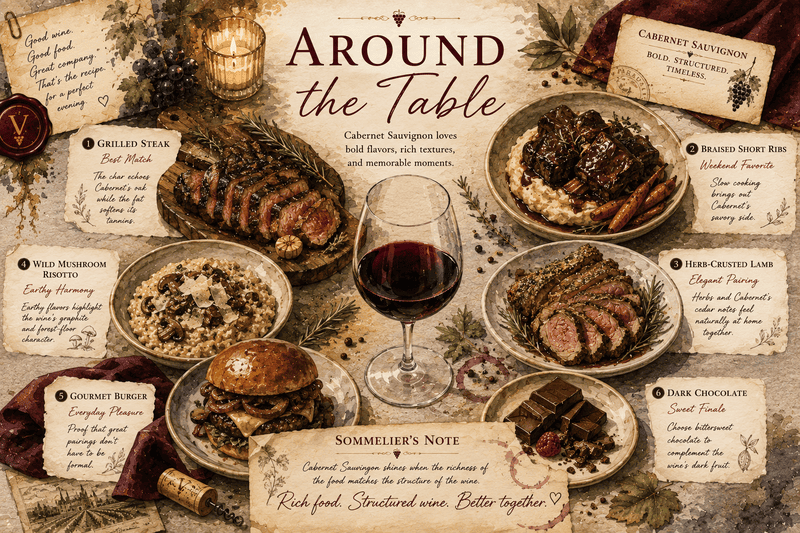
Three Cabernet Sauvignon Styles to Explore
One of the reasons Cabernet Sauvignon became the world’s most popular red wine is that it can express itself in dramatically different ways depending on where it is grown.
A Cabernet Sauvignon from Chile will not taste exactly like one from Napa Valley, and neither will resemble a classic Bordeaux. Yet all three styles showcase the grape’s hallmark structure, dark fruit flavors, and aging potential.
If you’re looking to deepen your appreciation for Cabernet Sauvignon, consider exploring these three classic styles.
Budget-Friendly Discovery: Chilean Cabernet Sauvignon
Chile has quietly become one of the world’s greatest sources of value-driven Cabernet Sauvignon.
The country’s Mediterranean climate, abundant sunshine, and ideal growing conditions allow Cabernet Sauvignon to ripen consistently while maintaining freshness and balance. The resulting wines often deliver impressive quality at very approachable prices.
Expect flavors of:
🍇 Blackcurrant
🍇 Blackberry
🍒 Black Cherry
🌿 Subtle herbs
🌲 Cedar
Many Chilean Cabernets strike a beautiful balance between fruit intensity and structure, making them approachable for newer wine drinkers while still offering enough complexity to satisfy enthusiasts.
Ideal For:
🍔 Weeknight dinners
🔥 Grilling season
🍕 Casual gatherings
🍷 Everyday enjoyment
Example Bottle:
Concha y Toro Marques de Casa Concha Cabernet Sauvignon
New World Powerhouse: Napa Valley Cabernet Sauvignon
If Bordeaux is Cabernet Sauvignon’s birthplace, Napa Valley is where the grape became a global superstar.
Thanks to California’s warm climate and abundant sunshine, Napa Cabernet Sauvignon is known for producing some of the richest and most powerful expressions of the variety.
These wines often showcase:
🍇Ripe Blackberry
🍒 Black Cherry
🍇 Cassis
🍫 Dark Chocolate
🌰 Vanilla
🍞Toasted Oak
The wines are typically full-bodied, concentrated, and luxurious, with velvety textures and impressive aging potential.
For many wine lovers, Napa Valley Cabernet represents the ultimate special-occasion red wine.
Ideal For:
🥩 Steak dinners
🎉 Celebrations
🍷 Dinner parties
🎁 Memorable gifts
Example Bottle:
Columbia Crest H3 Cabernet Sauvignon (Washington State) offers a similar New World style at a more approachable price point, while premium Napa Valley Cabernets provide an opportunity to experience the category at its highest level.
Classic Benchmark: Left Bank Bordeaux
To understand Cabernet Sauvignon’s history, every wine lover should experience a classic Bordeaux.
Unlike many New World examples, Bordeaux wines often emphasize structure, elegance, and complexity over sheer fruit intensity. Cabernet Sauvignon serves as the backbone of many Left Bank blends, supported by Merlot, Cabernet Franc, and Petit Verdot.
These wines commonly display:
🍇 Blackcurrant
✏️ Graphite
🌲 Cedar
🚬 Tobacco
🌿 Dried Herbs
🌎 Earthy Notes
Young Bordeaux can be firm and structured, but with age, these wines develop extraordinary complexity and nuance.
For many collectors and enthusiasts, Bordeaux remains the gold standard of Cabernet Sauvignon.
Ideal For:
🥂 Milestone celebrations
📚 Building a wine cellar
🍷 Special tastings
🎉 Anniversaries and holidays
Example Bottle:
Château Lynch-Bages from Pauillac is a classic example of Cabernet Sauvignon’s ability to combine power, elegance, and exceptional aging potential.
A World of Cabernet to Explore
One of the greatest joys of Cabernet Sauvignon is discovering how differently it can express itself around the world.
A Chilean Cabernet may introduce you to the grape’s outstanding value.
A Napa Valley Cabernet may showcase its richness and power.
A Bordeaux may reveal its elegance and age-worthy complexity.
Together, these styles tell the story of why Cabernet Sauvignon became the world’s most popular red wine—and why wine lovers continue to explore it generation after generation.
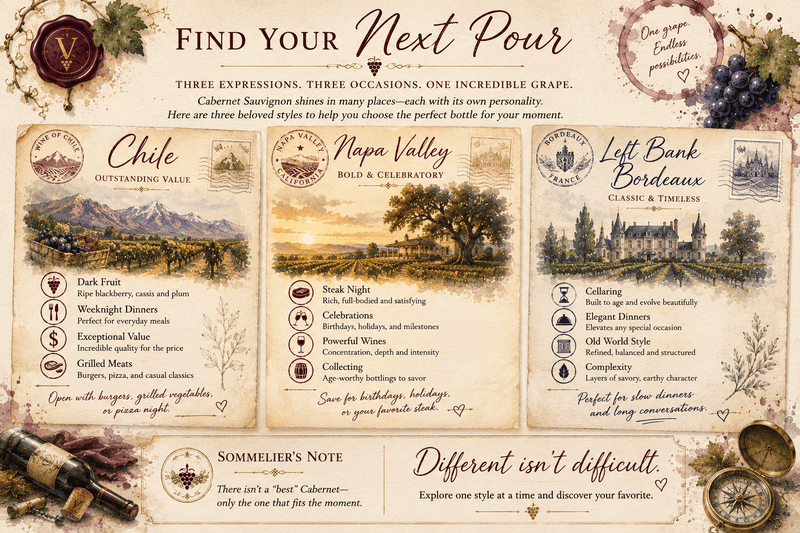
Cabernet Sauvignon vs. Merlot
If Cabernet Sauvignon is the world’s most recognizable red wine grape, Merlot is probably its closest rival.
The two varieties are frequently blended together in Bordeaux and are often planted side-by-side in vineyards around the world. They share some similarities, yet they offer very different drinking experiences.
Understanding the distinction can help you choose the wine that best suits your palate and the occasion.
Structure and Tannin
One of the biggest differences between Cabernet Sauvignon and Merlot is tannin.
Cabernet Sauvignon typically contains higher tannin levels, giving it more structure and a firmer texture. Young Cabernet can feel powerful, grippy, and age-worthy.
Merlot, by contrast, generally produces softer, rounder wines with smoother tannins. This often makes Merlot more approachable at a younger age.
If Cabernet Sauvignon is the athlete of the wine world, Merlot is the smooth conversationalist.
Flavor Profile
Both wines feature dark fruit flavors, but their personalities differ.
Cabernet Sauvignon commonly displays:
🍇 Blackcurrant
🍇 Blackberry
🍒 Black Cherry
🌲 Cedar
🌱 Herbs
Merlot often leans toward:
🍑 Plum
🍒 Red and Black Cherry
🍫 Chocolate
🌿 Soft Herbs
☕ Mocha
Cabernet Sauvignon tends to emphasize structure and intensity, while Merlot often highlights richness and softness.
Aging Potential
Because of its higher tannins and acidity, Cabernet Sauvignon generally has greater long-term aging potential.
Many quality Cabernets can improve for ten, twenty, or even thirty years under proper storage conditions.
Merlot can also age beautifully, particularly examples from top producers, but it is often enjoyed earlier in its life cycle.
For collectors building a cellar, Cabernet Sauvignon frequently becomes the preferred choice.
Food Pairing Differences
Both wines are food-friendly, but they tend to shine with different dishes.
Cabernet Sauvignon excels with:
🥩 Steak
🐑 Lamb
🍔 Burgers
🍖 Braised meats
Merlot often pairs beautifully with:
🍝 Pasta dishes
🍗 Roast chicken
🍄 Mushroom-based recipes
🧀 Mild cheeses
Its softer tannins make it slightly more versatile with lighter fare.
Which One Is Better?
The answer, of course, is neither.
Cabernet Sauvignon and Merlot simply offer different experiences.
Choose Cabernet Sauvignon when you’re craving structure, bold flavors, and aging potential.
Choose Merlot when you’re looking for something softer, rounder, and immediately approachable.
The good news is that many of the world’s greatest wines contain both grapes, proving that Cabernet Sauvignon and Merlot are often at their best when they work together.
For wine lovers, the real winner isn’t Cabernet or Merlot—it’s having the opportunity to enjoy both.
Why Cabernet Sauvignon Continues to Dominate
Wine trends come and go.
In recent years, consumers have embraced everything from natural wines and orange wines to obscure grape varieties and lower-alcohol styles. Wine drinkers today have more choices than ever before, and many are eager to explore beyond traditional favorites.
Yet despite all of these shifts, Cabernet Sauvignon remains firmly at the top of the wine world.
Its enduring success is not the result of marketing hype or historical prestige alone. Cabernet Sauvignon continues to dominate because it consistently delivers qualities that wine lovers value.
Global Recognition
Few grape varieties enjoy the universal recognition of Cabernet Sauvignon.
Ask someone with only a basic knowledge of wine to name a red grape, and Cabernet Sauvignon is often the first answer.
That familiarity creates confidence.
Consumers know what they’re ordering in a restaurant. They know what they’re buying at a wine shop. They know that whether they’re purchasing a bottle from California, Chile, Australia, South Africa, or France, they’re likely to encounter a wine with recognizable characteristics and dependable quality.
In a world filled with choices, familiarity remains a powerful advantage.
Consistent Quality
One of Cabernet Sauvignon’s greatest strengths is its reliability.
Not every bottle will taste identical, nor should it. Part of wine’s appeal lies in its ability to express place. However, Cabernet Sauvignon consistently delivers the structure, dark fruit flavors, and complexity that drinkers expect.
This consistency has helped build trust across generations.
Whether someone is spending $15 or $150, Cabernet Sauvignon often provides a level of predictability that many consumers appreciate.
At the same time, the grape offers enough regional variation to keep wine enthusiasts engaged and curious.
Remarkable Ageability
Few widely available wine grapes age as gracefully as Cabernet Sauvignon.
Its natural combination of tannin, acidity, and concentration allows it to evolve over years and sometimes decades.
This aging potential contributes significantly to the grape’s prestige. Collectors appreciate its ability to develop complexity, while casual wine drinkers enjoy knowing that a special bottle can be saved for an important occasion.
The fact that Cabernet Sauvignon can provide pleasure both shortly after release and many years later is a rare and valuable quality.
A Natural Partner for Food
Wine ultimately exists to be enjoyed, and Cabernet Sauvignon excels at the table.
Its combination of fruit, acidity, and tannin allows it to complement a remarkable range of dishes.
From grilled steaks and lamb chops to burgers, braised short ribs, aged cheeses, and hearty mushroom dishes, Cabernet Sauvignon consistently enhances the dining experience.
This versatility has helped secure its place on restaurant wine lists around the world.
For many wine lovers, Cabernet Sauvignon isn’t just a beverage—it’s part of a memorable meal shared with family and friends.
Availability Across Every Price Point
Another reason for Cabernet Sauvignon’s continued dominance is accessibility.
Unlike some grape varieties that are concentrated in only a handful of regions, Cabernet Sauvignon is grown almost everywhere wine is made.
As a result, consumers can find examples at nearly every price point.
There are affordable everyday bottles perfect for a weeknight dinner.
There are mid-range wines ideal for entertaining guests.
And there are iconic collector bottles capable of commanding hundreds or even thousands of dollars.
Very few grape varieties offer such a broad spectrum of experiences while maintaining a recognizable identity.
The Benchmark for Red Wine
When wine professionals discuss structure, ageability, tannin, food pairing, or cellar potential, Cabernet Sauvignon frequently serves as the reference point.
Students preparing for wine certifications study Cabernet Sauvignon extensively because it demonstrates so many of the characteristics that define fine red wine.
Winemakers around the world continue to plant it because consumers trust it.
Collectors continue to cellar it because it rewards patience.
Restaurants continue to pour it because guests order it.
And wine lovers continue to enjoy it because, quite simply, it delivers.
For all of these reasons, Cabernet Sauvignon remains the benchmark by which many red wines are judged.
Final Thoughts
From its accidental origins in a Bordeaux vineyard to its status as a global wine icon, Cabernet Sauvignon’s journey is one of the most remarkable stories in the wine world.
Few grape varieties have managed to combine so many desirable qualities in a single package. It offers bold fruit flavors and complex savory notes. It can be enjoyed young or cellared for decades. It pairs beautifully with food, adapts to a wide range of climates, and consistently produces wines that capture the attention of both casual drinkers and serious collectors.
Along the way, Cabernet Sauvignon helped shape some of the world’s most celebrated wine regions, inspired generations of winemakers, and became the standard against which many other red wines are measured.
Whether you’re opening an affordable bottle from Chile on a Tuesday evening, sharing a Napa Valley Cabernet with friends over dinner, or celebrating a milestone with a classified-growth Bordeaux, Cabernet Sauvignon continues to earn its reputation as the world’s most popular red wine.
Its combination of power, complexity, versatility, and longevity has captivated wine lovers for generations.
And if history is any indication, its reign is far from over.
So the next time you pour a glass of Cabernet Sauvignon, take a moment to appreciate what’s in your glass. You’re not simply tasting a wine—you’re experiencing one of the greatest success stories in the history of wine.
“Cabernet Sauvignon didn’t become the world’s most popular red wine by accident. It earned that reputation one vineyard, one bottle, and one generation of wine lovers at a time.”