Introduction: Why Red Wine Doesn’t All Taste the Same
Walk into any wine shop and you’ll likely see shelves lined with red wines from around the world. Some labels are familiar, others less so, but to many wine drinkers they all seem to fall into one of two categories: wines they enjoy and wines they don’t.
The truth is far more interesting.
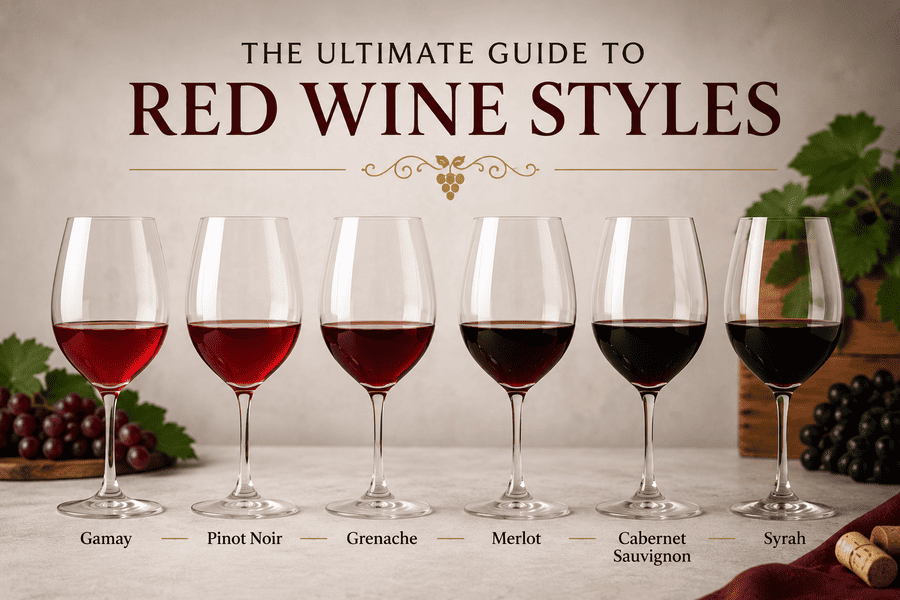
Red wine is one of the most diverse categories in the wine world. A glass of Pinot Noir from Burgundy can be delicate and ethereal, while a Cabernet Sauvignon from Napa Valley may be bold and powerful. A juicy Grenache from Spain can burst with ripe red fruit, while a peppery Syrah from France can offer layers of spice, smoke, and savory complexity. Although all of these wines are red, they can taste remarkably different and create completely different experiences at the table.
Part of the magic of wine lies in this diversity. Factors such as grape variety, climate, winemaking techniques, and aging all influence how a wine looks, smells, tastes, and feels. Understanding these differences allows you to move beyond simply choosing a red wine and begin selecting a style that matches your personal preferences, the food you’re serving, or even the mood of the occasion.
Perhaps you’ve ordered a glass of Cabernet Sauvignon and found it too heavy, or tasted a Pinot Noir and wished for something richer. Knowing the basic categories of red wine styles can help explain why. Once you understand the spectrum from light-bodied to full-bodied wines, choosing a bottle becomes far less intimidating and much more enjoyable.
Whether you’re new to wine or looking to deepen your appreciation for reds, this guide will walk you through the major red wine styles, what makes them unique, and which wines to explore in each category. By the end, you’ll have a clearer understanding of why red wine doesn’t all taste the same—and perhaps discover a few new favorites along the way.
“Every great wine journey starts with understanding your palate.”
What Does “Body” Mean in Wine?
One of the most common terms you’ll hear when discussing wine is “body.” Wine professionals use it constantly, but for many consumers the concept can feel a little abstract.
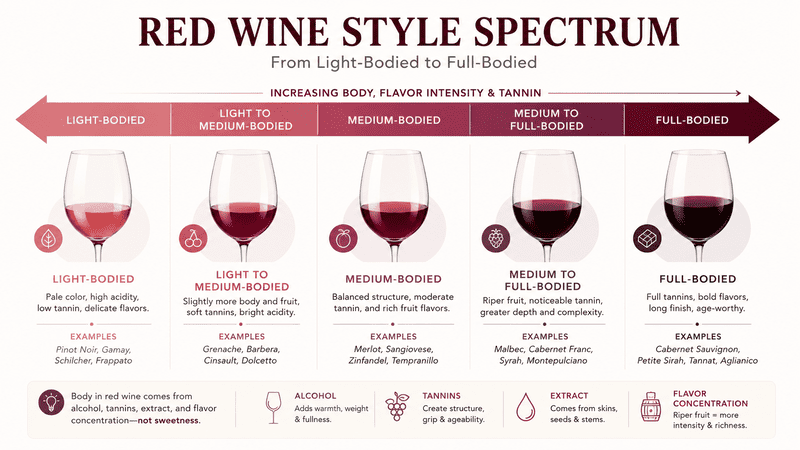
Simply put, body refers to how heavy or light a wine feels in your mouth. It’s not about how strong the flavors are or how expensive the bottle is. Instead, body describes the wine’s weight, texture, and overall presence on the palate.
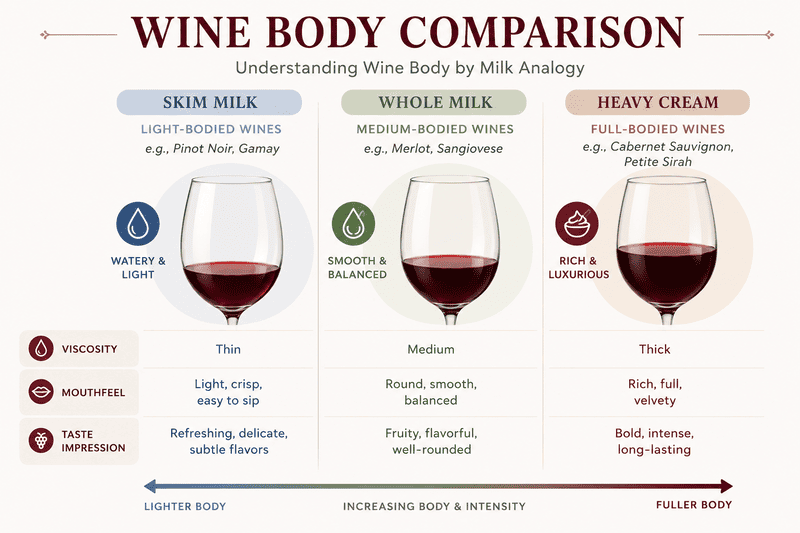
An easy way to understand body is to compare wine to milk.
Imagine taking a sip of skim milk. It feels light, refreshing, and relatively delicate. Now compare that to whole milk, which has a richer texture and a bit more weight. Finally, think about heavy cream, which feels dense, rich, and coating.
Wine follows a similar spectrum:
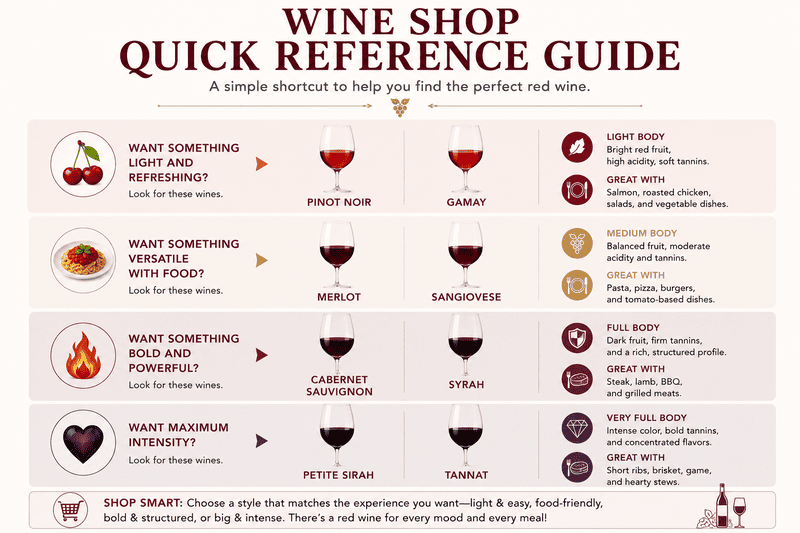
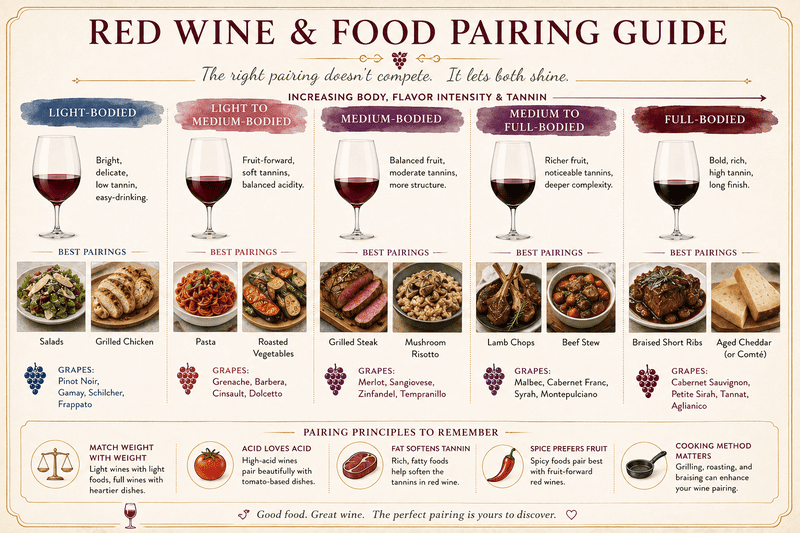
Light-Bodied Wines
Feel more like skim milk. They are often fresh, vibrant, and easy to drink, with less weight on the palate.
Medium-Bodied Wines
Comparable to whole milk. They offer more richness and structure while still maintaining balance and approachability.
Full-Bodied Wines
Similar to heavy cream. These wines feel more substantial, delivering greater weight, concentration, and often a longer finish.
Several factors contribute to a wine’s body:
Alcohol Level
Alcohol plays a significant role in how weighty a wine feels. Wines with higher alcohol levels generally create a fuller sensation on the palate. This is one reason why warm-climate wines, which often achieve higher ripeness and alcohol levels, can feel richer than wines from cooler regions.
Tannin
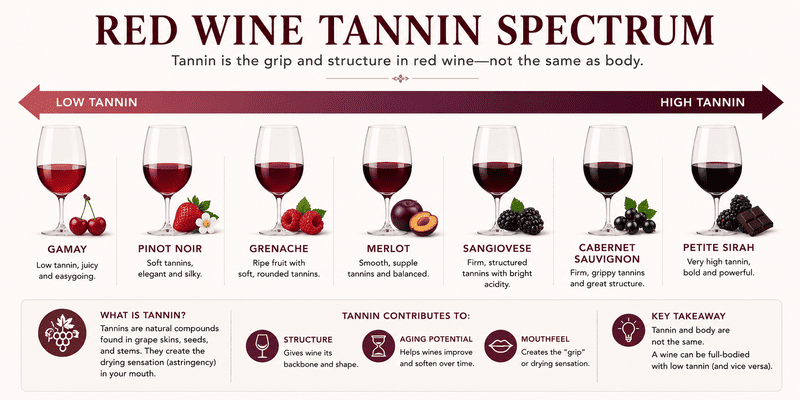
Tannins are natural compounds found in grape skins, seeds, and stems. They create that drying sensation you may notice when drinking certain red wines. While tannins don’t directly determine body, they contribute to a wine’s structure and can make a wine feel more substantial and powerful.
Fruit Concentration
Some wines naturally deliver more concentrated fruit flavors than others. A wine packed with ripe blackberry and plum flavors may feel richer than a wine emphasizing tart cranberry and red cherry notes, even if both have similar alcohol levels.
Winemaking Choices
The decisions made in the winery also influence body. Extended skin contact, oak aging, and harvesting grapes at higher ripeness levels can all contribute to a fuller, richer style. Conversely, winemakers seeking freshness and elegance may choose techniques that preserve a lighter-bodied profile.
Understanding body is one of the most useful skills a wine drinker can develop. Once you learn to recognize how a wine feels—not just how it tastes—you’ll find it much easier to identify the styles you enjoy most.
The simple takeaway?
Body isn’t about flavor intensity—it’s about weight and texture in your mouth.
A light-bodied wine can still be packed with flavor, while a full-bodied wine may be surprisingly balanced and elegant. Body is simply another tool that helps us understand and appreciate the incredible diversity of red wine.
Light-Bodied Red Wines: Elegant, Fresh, and Food-Friendly
When many people think of red wine, they imagine something bold, dark, and powerful. Yet some of the most captivating red wines in the world are the exact opposite. Light-bodied reds emphasize freshness, finesse, and nuance rather than sheer intensity, offering a style that is both approachable and endlessly fascinating.
These wines are typically characterized by higher acidity, lower tannins, and a more delicate texture on the palate. Rather than overwhelming the senses with richness, they often showcase bright red fruit flavors such as cherry, raspberry, cranberry, and strawberry. Their lighter structure makes them incredibly versatile at the table, pairing beautifully with a wide range of foods that might overwhelm heavier red wines.
Another advantage of light-bodied reds is that many can be served slightly cooler than their fuller-bodied counterparts. A brief chill before serving can enhance their freshness and make them especially enjoyable during warmer months.
Wine professionals and enthusiasts often have a special appreciation for light-bodied reds because they can be remarkably transparent expressions of grape variety and place. Without heavy oak influence or massive fruit concentration dominating the profile, subtle differences in soil, climate, and winemaking often shine through. These wines reward attention and invite exploration.
As modern wine drinkers increasingly seek freshness, balance, and food-friendly styles, light-bodied reds have experienced a surge in popularity. They demonstrate that great wine doesn’t need to be powerful to be memorable.
“Light-bodied wines prove that elegance can be just as captivating as power.”
Spotlight: Gamay
For many wine lovers, Gamay is one of the wine world’s best-kept secrets.
Most closely associated with France’s Beaujolais region, Gamay produces wines that are vibrant, energetic, and immensely enjoyable. Typical flavors include red cherry, raspberry, strawberry, violet, and subtle spice notes, all supported by refreshing acidity and modest tannins.
Unfortunately, Gamay has spent decades battling an image problem. Many consumers associate the grape exclusively with Beaujolais Nouveau, the youthful wine released just weeks after harvest each November. While Beaujolais Nouveau can be fun and festive, it represents only one expression of the grape.
The real treasures of the region are often found in the ten Cru Beaujolais villages, where Gamay can achieve remarkable complexity and age-worthiness. Wines from villages such as Morgon, Fleurie, Moulin-à-Vent, and Brouilly reveal a serious side of Gamay that many wine drinkers never discover.
What makes Gamay so appealing is its combination of freshness, fruit, and approachability. It’s a wine that feels equally at home at a casual picnic, a holiday gathering, or a sophisticated dinner table.
Perfect Pairings:
- Charcuterie boards
- Roast turkey
- Grilled chicken
- Picnic fare
- Soft cheeses
Spotlight: Pinot Noir
If Cabernet Sauvignon is often called the king of red grapes, Pinot Noir is frequently considered its most elegant counterpart.
Pinot Noir has earned a devoted following around the world thanks to its ability to produce wines of extraordinary complexity and grace. The grape’s spiritual home is Burgundy, France, where it has been cultivated for centuries and where some of the world’s most sought-after wines are made.
As a thin-skinned variety, Pinot Noir naturally produces wines with lighter color, softer tannins, and a silky texture. Aromas and flavors often include red cherry, raspberry, cranberry, rose petals, forest floor, mushroom, and subtle spice. With age, these wines can develop remarkably complex earthy and savory characteristics.
One reason Pinot Noir fascinates wine lovers is its extraordinary ability to reflect terroir. Small differences in soil, elevation, climate, and vineyard location can dramatically influence the final wine. This sensitivity allows Pinot Noir to tell the story of where it was grown perhaps more clearly than almost any other grape variety.
Today’s wine lovers can explore a wide range of Pinot Noir styles from around the globe. Burgundy remains the benchmark, but outstanding examples are also produced in Oregon’s Willamette Valley, California’s Sonoma Coast, New Zealand’s Central Otago, and Germany, where the grape is known as Spätburgunder.
Despite its reputation for elegance, Pinot Noir can be surprisingly versatile at the table.
Perfect Pairings:
- Salmon
- Duck
- Roast chicken
- Mushroom dishes
- Pork tenderloin
Other Light-Bodied Reds Worth Exploring
While Gamay and Pinot Noir may be the most recognizable examples, adventurous wine drinkers have many other light-bodied reds worth seeking out.
Frappato from Sicily offers bright red fruit, floral aromas, and refreshing acidity.
Schiava (Vernatsch) from northern Italy is known for its delicate body, gentle tannins, and vibrant red berry character.
Trollinger, popular in Germany, produces easy-drinking wines with juicy fruit and lively freshness.
Poulsard, one of the traditional grapes of France’s Jura region, creates pale-colored wines that are delicate, earthy, and wonderfully distinctive.
These lesser-known varieties showcase just how diverse and exciting the world of light-bodied red wine can be.
Medium-Bodied Red Wines: The Perfect Middle Ground
If light-bodied wines emphasize elegance and freshness, medium-bodied reds often represent the sweet spot between delicacy and power. They offer enough structure and concentration to satisfy lovers of richer wines while maintaining the balance and drinkability that make lighter styles so appealing.
Medium-bodied reds typically feature moderate tannins, balanced acidity, and a greater sense of richness without becoming heavy or overwhelming. For many wine drinkers, this category serves as the ideal entry point into the world of red wine because it provides versatility, complexity, and broad food-pairing potential.
These wines often perform beautifully in a wide variety of situations, whether you’re enjoying a casual weeknight meal, hosting a dinner party, or exploring new regions and grape varieties.
“Medium-bodied reds are the bridge between delicate elegance and bold power.”
Spotlight: Grenache (Garnacha)
Grenache, known as Garnacha in Spain, is one of the most widely planted red grape varieties in the world. Despite its popularity, it is frequently misunderstood.
Because Grenache often produces wines that are lighter in color than Cabernet Sauvignon or Syrah, many assume it is a light-bodied wine. In reality, most Grenache falls comfortably into the medium-bodied category, offering generous fruit concentration, elevated alcohol levels, and a rounded, approachable texture.
Typical flavors include strawberry, raspberry, red cherry, and hints of white pepper, dried herbs, and spice. The grape’s naturally softer tannins make it particularly appealing to drinkers who enjoy fruit-forward wines without aggressive structure.
In Spain, Garnacha often produces wines with ripe fruit and warmth, while examples from Southern Rhône appellations such as Châteauneuf-du-Pape and Gigondas frequently add savory complexity and herbal nuances.
Grenache’s combination of fruit, spice, and versatility makes it one of the wine world’s most food-friendly varieties.
Perfect Pairings:
- Grilled lamb
- Mediterranean cuisine
- Roasted vegetables
- Barbecue
Spotlight: Cabernet Franc
Although often overshadowed by its famous offspring, Cabernet Sauvignon, Cabernet Franc has quietly earned a devoted following among wine professionals and enthusiasts.
The grape plays an important role in both Bordeaux and France’s Loire Valley, where it produces wines that balance bright fruit, savory complexity, and refreshing acidity. Common flavor notes include raspberry, red currant, graphite, herbs, violet, and, in some examples, a distinctive bell pepper character.
Compared to Cabernet Sauvignon, Cabernet Franc typically offers softer tannins and a lighter frame, making it more approachable while still providing structure and complexity.
Loire Valley Cabernet Franc often emphasizes freshness and minerality, while examples from California, Washington State, and other New World regions may showcase riper fruit and greater richness.
Many sommeliers appreciate Cabernet Franc because it delivers both elegance and character, often providing exceptional value compared to more famous varieties.
Perfect Pairings:
- Grilled steak
- Pork loin
- Herb-roasted chicken
- Vegetables seasoned with fresh herbs
Spotlight: Merlot
For decades, Merlot was one of the most beloved red wine varieties in the world. Then came the movie Sideways, whose infamous criticism of the grape helped shape consumer perceptions for years.
Fortunately, Merlot never stopped making excellent wine.
Known for its plush texture and approachable style, Merlot typically offers flavors of plum, black cherry, blackberry, cocoa, and baking spices. Its softer tannins and generous fruit profile make it an inviting choice for both newcomers and experienced wine drinkers.
Some of the world’s finest Merlot-based wines come from Bordeaux’s Right Bank, particularly regions such as Saint-Émilion and Pomerol. Outstanding examples are also produced in Washington State, California, Italy, and many other wine regions around the globe.
Today, Merlot is experiencing a well-deserved resurgence as wine lovers rediscover the balance, complexity, and food-friendliness that made the grape so popular in the first place.
Perfect Pairings:
- Burgers
- Roast pork
- Mushroom risotto
- Meatloaf
Other Medium-Bodied Reds Worth Exploring
The medium-bodied category contains many of the world’s most versatile and food-friendly wines.
Sangiovese, the backbone of Chianti, combines bright acidity with savory cherry flavors.
Tempranillo, Spain’s signature grape, offers red fruit, tobacco, and earthy complexity.
Barbera from Italy delivers vibrant acidity and juicy fruit with minimal tannin.
Zweigelt, Austria’s most widely planted red grape, balances freshness with spice and dark berry flavors.
Dolcetto, from Italy’s Piedmont region, provides soft tannins, dark fruit, and everyday drinkability.
Together, these wines showcase why medium-bodied reds are often considered the most versatile category in the world of wine.
“Body isn’t about flavor intensity—it’s about how a wine feels on your palate.”
Full-Bodied Red Wines: Bold, Powerful, and Structured
If light-bodied wines are known for their elegance and medium-bodied wines for their balance, full-bodied reds are celebrated for their power, concentration, and presence. These are the wines that make a statement the moment they are poured into the glass.
Full-bodied red wines typically possess higher alcohol levels, firmer tannins, and greater fruit concentration than their lighter counterparts. They often deliver intense flavors of dark fruits, spice, chocolate, tobacco, and savory notes, creating wines that feel substantial and layered on the palate.
These wines can be deeply satisfying, particularly during cooler months or alongside hearty meals. Their structure allows them to stand up to richly flavored foods that might overwhelm lighter wines. The tannins, acidity, and concentration found in many full-bodied reds also contribute to their ability to age gracefully, sometimes for decades.
However, it’s important to remember that bigger does not automatically mean better.
Many new wine drinkers assume full-bodied wines represent the highest level of quality simply because they are more powerful. In reality, wine quality is determined by balance, complexity, and craftsmanship—not body alone. A beautifully made Pinot Noir can be every bit as compelling as a world-class Cabernet Sauvignon. They simply offer different experiences.
The beauty of wine lies in its diversity. Some occasions call for the delicacy of Gamay, while others demand the richness of Cabernet Sauvignon. Understanding the difference allows you to choose the right wine for the right moment.
Spotlight: Cabernet Sauvignon
Few grape varieties have achieved the global reputation of Cabernet Sauvignon. Often referred to as the “king of red grapes,” Cabernet Sauvignon is planted in virtually every major wine-producing country and serves as the benchmark for many of the world’s most collectible wines.
Cabernet Sauvignon typically produces deeply colored wines with flavors of blackcurrant, blackberry, dark cherry, cedar, tobacco, graphite, and baking spice. The grape’s naturally thick skins contribute significant tannin, creating wines with impressive structure and aging potential.
One of Cabernet Sauvignon’s greatest strengths is its ability to evolve over time. Young examples often showcase bold fruit and firm tannins, while mature bottles can develop extraordinary layers of complexity, revealing notes of leather, cigar box, dried herbs, and earth.
The grape thrives in many regions, but some of the most famous examples come from Bordeaux, Napa Valley, Washington State, Coonawarra in Australia, and Chile’s Maipo Valley.
For many wine enthusiasts, Cabernet Sauvignon serves as an introduction to the world of cellar-worthy wines and long-term collecting.
“Cabernet Sauvignon often serves as many wine drinkers’ gateway into serious wine collecting.”
Its combination of power, structure, and longevity has made it one of the most admired red wines in the world.
Perfect Pairings:
- Grilled steak
- Prime rib
- Lamb chops
- Aged cheddar
- Gouda and hard alpine cheeses
Spotlight: Syrah
If Cabernet Sauvignon is known for structure and age-worthiness, Syrah is often celebrated for its intensity, complexity, and unmistakable personality.
Syrah produces deeply colored wines packed with flavors of blackberry, blueberry, black plum, cracked black pepper, smoked meat, olive tapenade, and spice. Depending on where it is grown, the grape can express itself in dramatically different ways.
In France’s Northern Rhône Valley, Syrah is the sole permitted red grape in appellations such as Côte-Rôtie, Hermitage, and Cornas. These wines often display savory characteristics, floral aromas, peppery spice, and remarkable elegance beneath their power.
Travel to Australia and the grape takes on a slightly different identity as Shiraz. Australian Shiraz is frequently richer and more fruit-forward, showcasing ripe blackberry, plum, chocolate, and baking spice flavors, often with a softer, more generous texture.
Neither style is superior; they simply represent different expressions of the same grape. Exploring both is one of the most enjoyable ways to discover how climate and winemaking influence wine style.
Syrah’s bold flavors and robust structure make it a natural partner for richly flavored foods.
Perfect Pairings:
- Barbecue
- Braised short ribs
- Venison
- Smoked meats
- Lamb shanks
Other Full-Bodied Reds Worth Exploring
Cabernet Sauvignon and Syrah may dominate discussions of full-bodied red wine, but they are far from the only options worth exploring.
Malbec, particularly from Argentina, offers dark fruit flavors, velvety texture, and approachable tannins.
Petit Sirah (Durif) delivers concentrated blackberry fruit, firm structure, and impressive aging potential.
Mourvèdre (Monastrell) produces savory wines with dark fruit, herbs, earth, and spice, especially in Spain and Southern France.
Tannat, originally from southwest France and now a flagship grape of Uruguay, is famous for its powerful tannins and remarkable structure.
Aglianico, one of southern Italy’s greatest red grapes, creates deeply complex wines capable of aging for decades.
Together, these varieties demonstrate that the world of full-bodied red wine extends far beyond Cabernet Sauvignon and Syrah.
“Powerful wines aren’t better than elegant wines—they’re simply different expressions of the grape.”
How Climate Influences Red Wine Style
One of the most fascinating aspects of wine is that the same grape variety can produce dramatically different wines depending on where it is grown.
A Pinot Noir from Burgundy may taste completely different from a Pinot Noir grown in California. Likewise, a Cabernet Sauvignon from Bordeaux can offer a vastly different experience than one from Napa Valley. One of the primary reasons for these differences is climate.
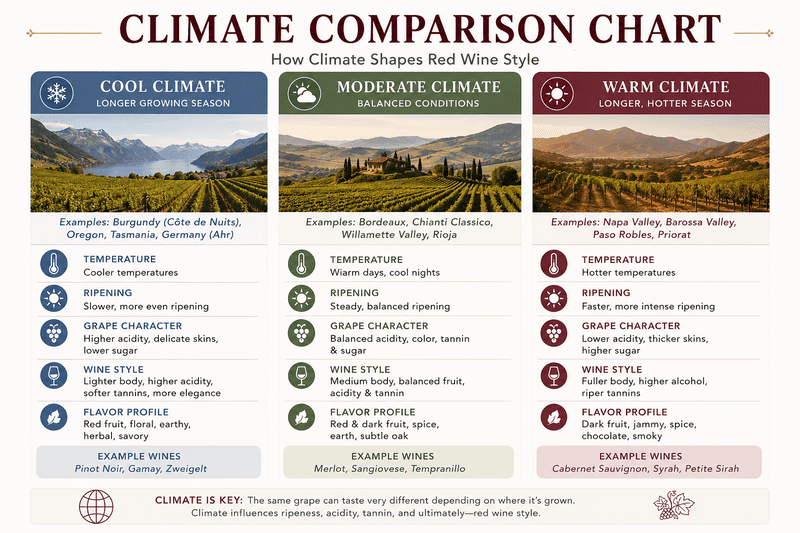
Climate influences how grapes ripen, how much sugar they develop, how much acidity they retain, and ultimately how a wine tastes and feels in the glass.
Cool Climate Regions
In cooler growing regions, grapes ripen more slowly and generally retain higher levels of acidity. The resulting wines often emphasize freshness, elegance, and subtle complexity rather than sheer richness.
Examples of cool-climate regions include:
- Burgundy, France
- Oregon’s Willamette Valley
- Germany
- New Zealand’s Central Otago
- Canada’s Niagara Peninsula
Common characteristics of cool-climate red wines include:
- Higher acidity
- Lower alcohol levels
- Brighter red fruit flavors
- Greater emphasis on elegance and nuance
- More restrained body
A cool-climate Pinot Noir, for example, may showcase cranberry, cherry, floral notes, and earthy complexity with remarkable freshness and precision.
Warm Climate Regions
In warmer climates, grapes typically achieve higher levels of ripeness and sugar accumulation. As a result, wines often display richer fruit flavors, fuller body, and higher alcohol levels.
Examples of warm-climate regions include:
- Napa Valley, California
- Barossa Valley, Australia
- Paso Robles, California
- Mendoza, Argentina
- McLaren Vale, Australia
Common characteristics of warm-climate red wines include:
- Riper fruit flavors
- Higher alcohol levels
- Fuller body
- Softer acidity
- Greater richness and concentration
A warm-climate Cabernet Sauvignon, for example, may offer generous blackberry, cassis, and chocolate notes with a broad, powerful texture.
Why This Matters
Understanding climate helps explain why wine can be so diverse and exciting. The grape variety is only part of the story. Where it is grown often has just as much influence on the final wine as the grape itself.
This is why two bottles made from the same variety can taste completely different despite sharing the same name on the label. Climate, along with soil, elevation, and winemaking decisions, shapes the character of every wine.
The next time you discover a wine you love, pay attention not only to the grape variety but also to where it was grown. You may find that your preferences are influenced as much by climate and region as by the grape itself.
How to Discover Your Personal Red Wine Style
One of the most rewarding aspects of wine is realizing that there is no “correct” preference. Some wine lovers gravitate toward delicate, high-acid reds bursting with freshness, while others prefer powerful, structured wines built for long aging. Most of us fall somewhere in between.
The key is understanding your palate.
Rather than focusing on scores, prestige, or price tags, pay attention to the characteristics that consistently appeal to you. The more you understand your preferences, the easier it becomes to select wines you’ll genuinely enjoy.
Start by asking yourself a few simple questions:
Do I Prefer Fresh Fruit or Rich Fruit?
Some wines emphasize bright, tart flavors such as cranberry, red cherry, and raspberry. Others showcase darker, riper notes of blackberry, plum, and blackcurrant.
If you enjoy vibrant, refreshing fruit flavors, you may be naturally drawn toward lighter-bodied styles such as Gamay and Pinot Noir.
If you prefer darker, richer fruit profiles, medium- and full-bodied wines like Merlot, Cabernet Sauvignon, and Syrah may be more appealing.
Do I Prefer Soft Tannins or Firm Structure?
Tannins create the drying sensation you feel on your gums and tongue when drinking certain red wines.
Wines such as Gamay and Pinot Noir typically offer softer, gentler tannins, while Cabernet Sauvignon and Syrah often deliver more structure and grip.
Neither is better than the other—it simply comes down to personal preference.
Do I Prefer Elegant Wines or Powerful Wines?
Some wines captivate through subtlety and nuance. Others impress through concentration and intensity.
Elegant wines often reveal new layers with each sip, while powerful wines command attention from the moment they hit the glass.
Many wine lovers eventually discover that they enjoy both styles in different situations.
A Simple Red Wine Exploration Roadmap
If you’re unsure where to go next on your wine journey, try following this progression:
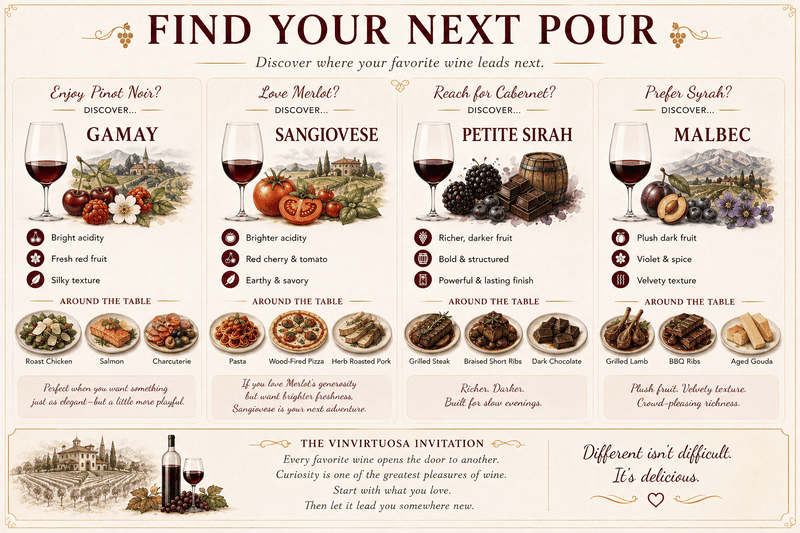
If you enjoy Gamay → Try Pinot Noir
Both emphasize freshness and red fruit, but Pinot Noir typically offers greater complexity and structure.
If you enjoy Pinot Noir → Try Grenache
Grenache introduces more richness and body while maintaining bright fruit and approachability.
If you enjoy Grenache → Try Cabernet Franc
Cabernet Franc adds savory complexity, herbal notes, and additional structure without becoming overly powerful.
If you enjoy Cabernet Franc → Try Merlot
Merlot offers a plush texture, darker fruit flavors, and a richer mouthfeel.
If you enjoy Merlot → Try Cabernet Sauvignon
Cabernet Sauvignon builds on Merlot’s fruit profile while adding firmer tannins and greater aging potential.
If you enjoy Cabernet Sauvignon → Explore Syrah
Syrah delivers similar power but often introduces fascinating peppery, smoky, and savory characteristics.
The goal isn’t to find the “best” red wine. It’s to discover the styles that make you excited to pour another glass and continue exploring.
“The best red wine is the one that matches your taste, your meal, and your moment.”
Five Red Wines to Try
Reading about wine styles is helpful, but tasting them is where the real learning begins. These bottles provide an excellent introduction to the range of red wine styles discussed in this guide and offer something for nearly every budget.
Budget-Friendly Pick
Côtes du Rhône Rouge
Approximate Price: $12–18
If you’re looking for an everyday red that consistently overdelivers, it’s hard to beat a good Côtes du Rhône. Typically based on Grenache with supporting varieties such as Syrah and Mourvèdre, these wines offer ripe red fruit, spice, and versatility at a very approachable price point.
Recommended Producers:
- Famille Perrin Côtes du Rhône
- Paul Jaboulet Aîné Parallèle 45 Côtes du Rhône
- E. Guigal Côtes du Rhône
Why You’ll Love It:
- Affordable and widely available
- Food-friendly and versatile
- Excellent introduction to Rhône-style reds
- Delivers impressive value for the price
Pinot Noir Pick
Elk Cove Pinot Noir (Willamette Valley, Oregon)
Approximate Price: $30–40
Oregon has become one of the world’s premier regions for Pinot Noir, and Elk Cove consistently delivers wines that showcase the grape’s elegance and complexity. Expect bright cherry fruit, subtle earthiness, balanced acidity, and impressive finesse.
Why You’ll Love It:
- Classic Oregon style
- Excellent balance and freshness
- Beautiful expression of Pinot Noir
Grenache Pick
Juan Gil Silver Label Garnacha
Approximate Price: $18–25
This Spanish Garnacha offers tremendous value and demonstrates why Grenache has become a favorite among wine professionals. Rich red fruit, spice, and soft tannins make it both approachable and satisfying.
Why You’ll Love It:
- Generous fruit character
- Smooth texture
- Outstanding value
- A great introduction to Grenache
Cabernet Sauvignon Pick
Pine Ridge Vineyards Cabernet Sauvignon (Napa Valley)
Approximate Price: $55–75
Pine Ridge has long been one of Napa Valley’s respected Cabernet Sauvignon producers. Their Cabernet Sauvignon delivers layers of blackberry, cassis, dark cherry, cedar, and spice supported by polished tannins and impressive structure.
Why You’ll Love It:
- Classic Napa Valley Cabernet
- Rich, concentrated fruit
- Excellent balance of power and elegance
- Shows why Cabernet Sauvignon remains one of the world’s most celebrated red grapes
Splurge Bottle
Château d’Issan, Margaux
Approximate Price: $90–150+ depending on vintage
For a truly memorable International Red Wine Day experience, consider a classic Bordeaux from Château d’Issan. This historic Margaux estate produces wines that beautifully balance power and refinement, showcasing the elegance that has made Bordeaux one of the world’s most revered wine regions.
Predominantly a blend of Cabernet Sauvignon and Merlot, Château d’Issan offers layers of blackcurrant, plum, cedar, violet, tobacco, and graphite that evolve beautifully with age.
Why You’ll Love It:
- A benchmark Bordeaux blend
- Elegant yet structured
- Complex and age-worthy
- Demonstrates why Bordeaux remains the standard for fine wine around the world
Whether you choose a simple weeknight Côtes du Rhône or a celebrated Bordeaux from Margaux, the most important thing is to taste with curiosity, pay attention to what you enjoy, and continue exploring the incredible diversity of red wine.
Final Thoughts: There’s No “Best” Red Wine
After exploring the many styles of red wine—from the vibrant freshness of Gamay and Pinot Noir to the richness of Grenache and Merlot and the power of Cabernet Sauvignon and Syrah—you’ve probably noticed an important theme:
Wine isn’t about finding the single best bottle.
It’s about discovering the styles that resonate with your palate, your table, and your experiences.
The wine world is filled with endless debates about regions, vintages, critics’ scores, and rankings, but the most important opinion is ultimately your own. The bottle that creates a memorable dinner with friends, elevates a favorite meal, or inspires you to learn something new may become far more meaningful than the most expensive wine on the shelf.
One of the greatest joys of wine is that preferences evolve over time. A wine you overlooked a few years ago may become a favorite today. As your palate develops, you’ll continue to discover new grapes, regions, and styles that expand your appreciation for what wine can be.
Whether you find yourself drawn to the elegance of Pinot Noir, the versatility of Merlot, the savory complexity of Cabernet Franc, or the bold structure of Cabernet Sauvignon, every bottle offers an opportunity to learn, explore, and connect with a centuries-old tradition enjoyed around the world.
This International Red Wine Day, consider stepping outside your comfort zone. Pick up a bottle you’ve never tried before, revisit a grape you haven’t explored in years, or share a favorite wine with someone new.
The world of red wine is vast, diverse, and endlessly fascinating—and the journey is just beginning.
Cheers to discovering your next favorite red.