Why Fall Is One of the Best Wine Seasons of the Year
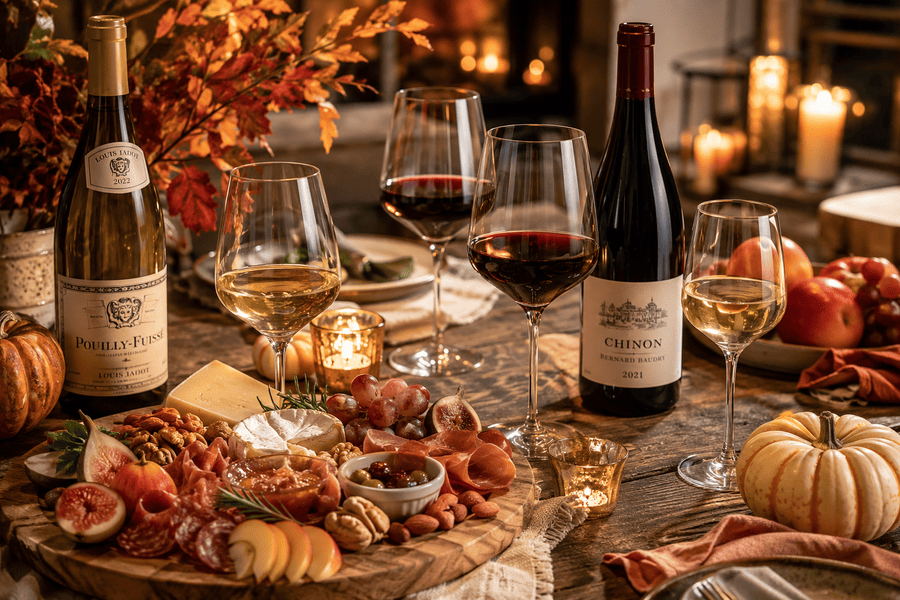
There is something magical about the moment summer begins to soften into fall. The evenings get a little cooler, the light turns golden, and suddenly the foods we crave begin to change. The crisp salads, chilled seafood, and poolside glasses of rosé that carried us through summer slowly give way to roasted vegetables, cozy pastas, bubbling casseroles, charcuterie boards, and the first truly comforting dinners of the season.
That is exactly what makes fall such an exciting time to drink wine.
Fall sits at a delicious crossroads. It is no longer the season of only ultra-light whites, easy patio sippers, and barely-there rosés—but it is not quite winter either. September, October, and early November do not always call for the biggest, boldest, most tannic red wines on the shelf. Instead, fall invites wines with balance: bottles that offer a little more depth, texture, spice, and warmth while still keeping enough freshness to work with the season’s shifting moods.
This is the time of year when Chardonnay starts to feel especially comforting alongside roast chicken or butternut squash ravioli. Chenin Blanc suddenly makes perfect sense with pork, apples, roasted vegetables, and creamy cheeses. Sparkling wine becomes a brilliant choice for fall entertaining, whether you are serving a cheese board, football snacks, or a tray of savory pastries. And then, of course, come the reds: Pinot Noir for mushroom pasta, Grenache for roasted chicken and sausage, Merlot for cozy comfort food, Syrah for chili and braised meats, and Cabernet Franc for herb-laced, savory fall dinners.
Fall wines need to be flexible. They should feel cozy without being heavy, flavorful without overwhelming the meal, and comforting without losing their sense of elegance. The best bottles for this season are the ones that can handle a warm afternoon, a chilly evening, a casual weeknight dinner, or an impromptu gathering around the table.
Whether you are lighting the first candle of the season, planning a relaxed dinner party, opening a bottle for a cozy movie night, or looking for the perfect wine to pair with roast chicken, mushrooms, pork tenderloin, chili, or apple desserts, fall offers endless opportunities to explore.
In this guide, we will look at eight wines that beautifully capture the spirit of the season—from textured whites and festive sparkling wines to reds that are earthy, plush, spicy, and savory enough for crisp evenings and comfort food.
Fall wine season isn’t just about drinking bigger reds—it’s about finding bottles with enough texture, freshness, spice, and savory depth to match the season.
What Makes a Wine Feel Right for Fall?
A “fall wine” is not defined by one single grape, region, or color. While red wines often get most of the attention once the weather cools down, some of the best bottles for fall are white, sparkling, or somewhere in between. What really matters is how the wine feels with the season—how it matches the food, the weather, and the mood.
Fall is a season of transition, so the wines that work best tend to offer a combination of freshness, texture, flavor, and versatility. They should be able to move easily from warm September afternoons to chilly October nights, from a simple cheese board to a cozy roast chicken dinner.
A Little More Texture and Body
As summer fades, wines with a bit more texture start to feel especially appealing. That does not mean every fall wine needs to be big or heavy. It simply means the wine should have enough presence to stand up to richer seasonal foods.
A lightly oaked Chardonnay, for example, can feel beautifully suited to fall because it has both freshness and roundness. Chenin Blanc can offer bright acidity along with a waxy, textured quality that makes it wonderful with pork, apples, and roasted vegetables. Merlot brings plush fruit and softness, while Syrah offers darker fruit, pepper, smoke, and savory depth.
Fall foods often have more richness than summer dishes, so wines with a little more weight can feel especially satisfying at the table.
Savory, Earthy, or Spiced Flavors
Autumn naturally brings out deeper, more savory flavors in the kitchen. Think roasted mushrooms, caramelized squash, braised meats, toasted nuts, dried herbs, smoky chili, and warm spices. Wines that echo those flavors often feel right at home this time of year.
Pinot Noir can bring notes of cherry, cranberry, mushroom, dried leaves, and forest floor. Grenache often offers red fruit, white pepper, baking spice, and dried herbs. Cabernet Franc can show raspberry, herbs, graphite, tobacco, and earthy notes. Even white wines can feel autumnal when they lean into flavors of apple, pear, honey, almond, toast, or spice.
These flavors do not need to be dramatic. Sometimes just a hint of cedar, pepper, smoke, or baking spice is enough to make a wine feel like it belongs beside a fall meal.
Strong Food-Pairing Ability
Fall is one of the best cooking seasons of the year, which means food-friendly wines matter. As the meals become more layered and comforting, the wine should be able to support the dish rather than fight with it.
Acidity is especially important here. Wines with good freshness can cut through richness, lift savory flavors, and keep each bite from feeling too heavy. That is why Chenin Blanc can be so good with pork and roasted vegetables, why sparkling wine works beautifully with salty snacks and cheese boards, and why Pinot Noir can be so lovely with mushroom dishes.
Balance is also key. A great fall wine should have enough flavor to stand beside heartier meals, but not so much alcohol, tannin, or oak that it overwhelms the food. The best pairings often come from wines that feel complete: fresh enough, flavorful enough, and flexible enough to work across the table.
Seasonal Flexibility
The perfect fall wine should be able to handle more than one kind of evening. One day may still feel warm enough for a chilled glass of Chenin Blanc or sparkling wine on the patio. The next may call for Merlot with baked pasta, Syrah with chili, or Cabernet Franc with roasted vegetables and herbs.
That flexibility is part of what makes fall wine drinking so enjoyable. You are not locked into one style. You can move from crisp to cozy, from bright to savory, from elegant to bold.
A great fall wine might pair with roast chicken on Monday, a cheese board on Friday, and Thanksgiving-style side dishes a few weeks later. It might feel just as appropriate for a casual night in as it does for a small dinner party with friends.
With that in mind, here are eight wines that capture the best of fall—whether you are craving a cozy white, a food-friendly red, or a bottle of bubbles for the season’s first gatherings.
The 8 Best Wines to Welcome Fall
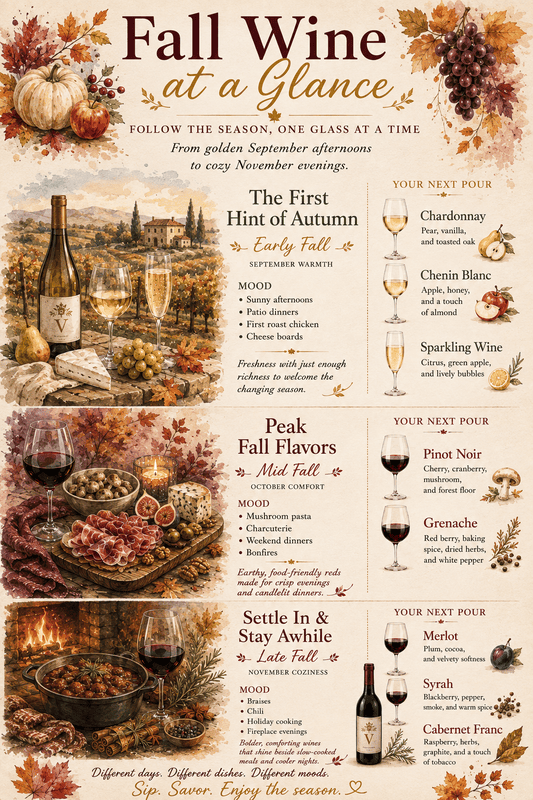
The beauty of fall wine season is that it does not belong to one single style. Some evenings still call for a chilled glass of white wine with roast chicken or pork, while others practically beg for something earthier, softer, spicier, or more deeply savory. That is what makes this time of year so much fun to drink through: you can move gradually from fresh, textured whites and celebratory sparkling wines into reds that feel increasingly cozy as the weather cools and the food on the table becomes richer.
The wines below are arranged with that seasonal progression in mind. We begin with white wines that are perfect for the early weeks of fall—bottles that still have freshness but enough texture and depth to pair beautifully with the season’s first comforting meals. From there, we move into sparkling wine for entertaining and then into a lineup of reds that range from elegant and earthy to plush, spicy, and deeply savory.
Whether your fall table leans toward roast chicken, butternut squash ravioli, pork tenderloin, charcuterie boards, mushroom pasta, or chili simmering on the stove, these are the wines I would reach for first.
Some of the best fall wines are white: bottles with enough texture for creamy dishes, enough freshness for roasted vegetables, and enough versatility for everything in between.
Chardonnay: The Cozy White That Loves Roast Chicken and Creamy Fall Dishes
If there is one white wine that slips effortlessly from late summer into fall, it is Chardonnay. Familiar, versatile, and available in a wide range of styles, Chardonnay can feel just as appropriate on a warm September evening as it does beside a roast chicken dinner in October. It has enough freshness to keep it lively, but when chosen well, it also brings the texture, roundness, and subtle richness that make it especially satisfying as the weather cools.
This is the time of year when Chardonnay starts to show off a different side of its personality. In the height of summer, you may gravitate toward bright, crisp whites that feel light and refreshing on the patio. But as soon as roasted vegetables, creamy sauces, and heartier weeknight dinners begin returning to the table, Chardonnay suddenly makes a lot of sense. Fall is a wonderful season for styles that have a little more body—perhaps a touch of oak, a creamier texture, or notes of baked fruit and toast—without tipping into anything too heavy or buttery.
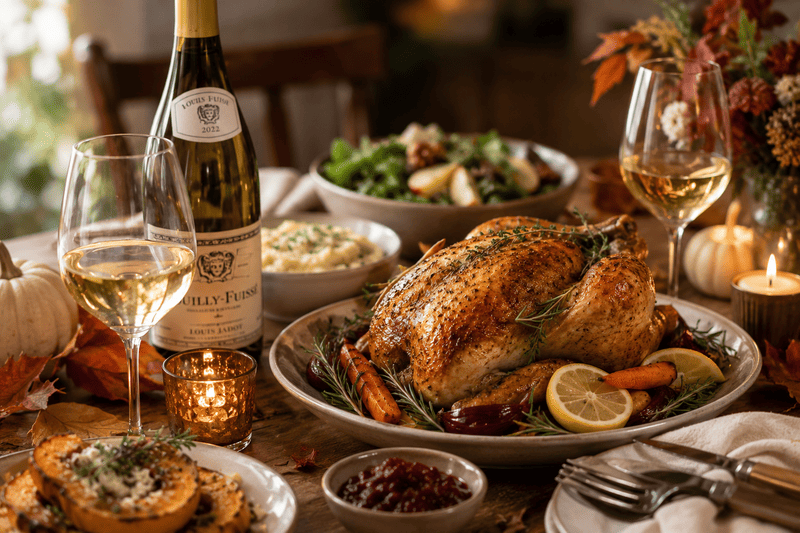
One of Chardonnay’s biggest strengths is how beautifully it works with some of fall’s most comforting dishes. Roast chicken is a classic for a reason: the wine’s fruit, acidity, and subtle richness mirror the cozy simplicity of the dish without overwhelming it. Chardonnay is also excellent with pork chops, especially if apples, sage, brown butter, or a creamy pan sauce enter the picture. It shines with creamy mushroom pasta, where its texture can echo the sauce while its acidity keeps everything from feeling too rich. Butternut squash ravioli is another natural match, especially if the dish includes browned butter, Parmesan, or herbs. Even roast salmon, particularly when served with fall vegetables or a slightly richer preparation, can be a beautiful partner.
Flavor-wise, Chardonnay can cover a lot of ground, but for fall, I especially love bottles that show notes of apple, pear, baked apple, lemon curd, vanilla, toast, and hazelnut. Depending on the style, you may also find hints of butter or cream, though the best fall Chardonnays balance that richness with freshness rather than leaning into heaviness. That balance is what makes the wine so useful this time of year. It feels comforting, but not sleepy; rich, but not overwhelming.
If you are someone who wants a versatile white for dinner, something a little more substantial than your go-to summer Sauvignon Blanc, or a bottle that can move comfortably from seafood into poultry, pork, mushrooms, and fall vegetables, Chardonnay is one of the smartest places to start.
Bottle Ideas to Try
Budget / approachable: Chalk Hill Chardonnay
A terrific value Chardonnay that offers ripe orchard fruit, gentle richness, and enough freshness to pair beautifully with roast chicken, creamy pasta, pork chops, and cozy fall dinners.
Step-up option: Louis Jadot Pouilly-Fuissé
A lovely step up for readers who want a more polished, Burgundian expression of Chardonnay, with orchard fruit, subtle richness, and the freshness to pair beautifully with roast chicken, creamy pasta, pork, and fall vegetables.
Chenin Blanc: The Bright, Versatile White You’ll Want with Pork, Apples, and Roasted Vegetables
If Chardonnay is the cozy, familiar white of fall, Chenin Blanc is the smart underdog—the bottle that wine lovers quietly reach for when they want something food-friendly, versatile, and a little more interesting than the usual suspects. It may not be the first grape that comes to mind when people think about autumn wine, but it absolutely deserves a place on the fall table.
Chenin Blanc is one of the most underrated white wines for this time of year because it offers a combination that fall food loves: bright acidity paired with texture. That balance makes it incredibly useful. It can handle dishes that are savory and seasonal without feeling too heavy, and it has enough freshness to keep richer flavors from becoming overwhelming. In other words, it is a white wine that knows how to work at the dinner table.
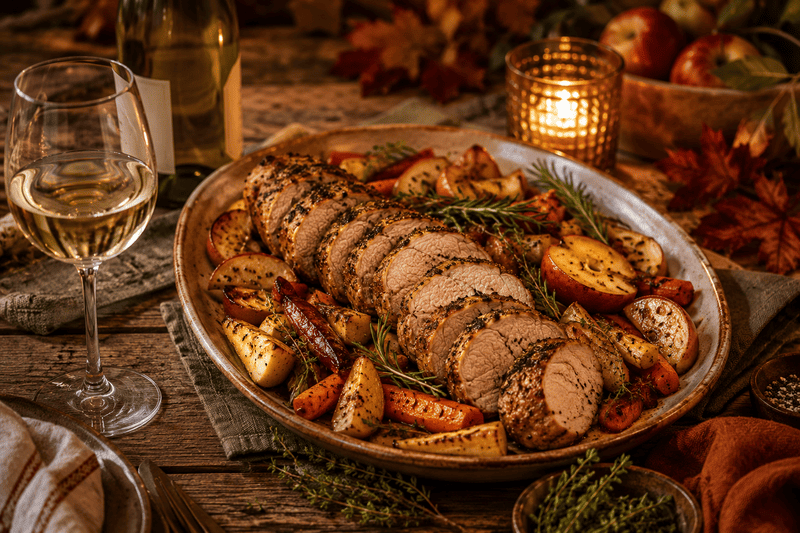
This is a bottle I especially love with roast pork, particularly if apples or a touch of sweetness are involved. Pork tenderloin with an apple glaze, pork chops with roasted squash, or a simple roast pork loin with herbs can all be fantastic with Chenin Blanc. It is equally at home with roasted root vegetables, butternut squash, and creamy goat cheese, and it can be a surprisingly strong choice for Thanksgiving-adjacent side dishes—especially those that involve sweet potatoes, roasted carrots, squash, or savory stuffing-like flavors. Chenin Blanc also deserves consideration with spicy foods, where its acidity and occasional hint of sweetness can be incredibly refreshing.
Part of what makes Chenin Blanc so interesting is that it can show a wide range of styles. Some bottles are fully dry and mineral-driven, while others carry a touch of sweetness. That is not a bad thing—it is part of the grape’s charm—but it does mean readers should pay attention to the producer and style. A dry Chenin Blanc can be wonderfully crisp and savory, while an off-dry version may lean a little more toward orchard fruit, honey, and softness. Both can work in fall, but they will pair differently. Dry styles are excellent with roasted vegetables, pork, and cheese, while slightly off-dry versions can be especially appealing with spicy dishes or meals that incorporate fruit.
In the glass, Chenin Blanc often offers flavors of apple, pear, quince, honey, chamomile, ginger, and wet stone or mineral notes. Some versions have a waxy or textural quality that makes them feel particularly satisfying as the weather cools. That combination of orchard fruit, freshness, subtle spice, and texture is exactly why Chenin Blanc feels so right in fall. It is bright enough for the season’s earlier, warmer days, but layered enough to work with the savory dishes that start appearing once summer is firmly behind us.
For readers who enjoy discovering wines that feel just a little more wine-savvy without being intimidating, Chenin Blanc is a fantastic choice. It is a natural fit for anyone who loves food-focused whites, enjoys pairing wine with seasonal produce, or wants something fresher than Chardonnay but more autumnal than a simple patio white.
Bottle Ideas to Try
Budget / approachable: MAN Family Wines Chenin Blanc
An easy, affordable introduction to Chenin Blanc that offers bright orchard fruit, lively acidity, and enough versatility to pair with pork, vegetables, cheese, and casual weeknight dinners.
Step-up option: Domaine Huet Vouvray “Le Mont” Sec
If you want to see just how elegant and layered Chenin Blanc can be, this is a beautiful step up. Expect more depth, mineral tension, and structure, with the kind of complexity that makes Chenin Blanc such a compelling food wine in fall.
Sparkling Wine: The Fall Entertaining Bottle You Shouldn’t Put Away After Summer
Sparkling wine has a way of being unfairly boxed into two very specific roles: summer brunch companion and holiday celebration bottle. It gets pulled out for mimosas, anniversaries, New Year’s Eve, and perhaps the occasional warm-weather aperitif—then too often disappears just as fall entertaining begins. That is a mistake, because sparkling wine is one of the most useful bottles you can have on hand as the seasons change.
In many ways, fall is sparkling wine season in disguise.
This is the time of year when the calendar starts to fill with casual gatherings, game-day spreads, dinner parties, brunches, impromptu cheese boards, and the first little hints of holiday entertaining. Friends stop by with snacks, family visits become more frequent, and suddenly there are more occasions where you want a bottle that feels festive without requiring a formal reason to open it. Sparkling wine does that beautifully. It immediately makes a gathering feel special, but it is also one of the easiest wines in the world to pair with food.
A good bottle of bubbles can handle an impressive range of fall favorites. It is a natural match for cheese boards, especially those built around creamy cheeses, salty nuts, crackers, fruit, and charcuterie. It shines with fried appetizers, from crispy chicken bites to arancini to fried goat cheese. It is wonderful with salty snacks and football spreads—potato chips, popcorn, deviled eggs, sliders, and all the little things that show up during game-day grazing. Sparkling wine is also a brilliant pre-dinner bottle when guests arrive. Pour a glass alongside olives, almonds, gougères, or savory pastries, and suddenly even a casual fall get-together feels elevated.
It is not just for savory snacks, either. Fall sparkling wine can be charming with apple tarts, flaky pastries, and brunch dishes where fruit, butter, or a touch of sweetness enters the picture. That versatility is one of the reasons I love it so much this time of year. A bottle of Brut sparkling wine can move from the appetizer table to dinner to dessert with remarkable ease, especially when the gathering includes a mix of flavors and textures. And while Brut styles are generally the safest, most versatile choice for fall entertaining, a well-made sparkling rosé can be a beautiful seasonal option too—especially for early fall gatherings, charcuterie boards, savory pastries, and brunch spreads.
If you are wondering what style to buy, Brut sparkling wines are still the easiest place to start. They tend to have enough freshness and dryness to work with salty snacks, fried foods, cheese, and savory dishes without feeling overly sweet. They also often bring exactly the kinds of flavors that feel right this time of year: citrus, apple, pear, brioche, almond, toast, and mineral notes, depending on the producer and method. Sparkling rosé, meanwhile, can add an extra layer of charm when it brings red berry fruit, orchard fruit, and enough yeasty complexity to feel festive rather than frivolous.
There are plenty of directions you can go here. Crémant is often a wonderful value if you want something elegant and food-friendly without stepping all the way into Champagne pricing. Cava and other traditional-method Spanish sparklers can be excellent for entertaining, especially if you want crispness, character, and affordability. Champagne, of course, is always welcome if the budget allows, and domestic sparkling wines can offer beautiful quality as well—especially for readers who want something easy to find in the U.S.
If Chardonnay is the cozy dinner white of fall and Chenin Blanc is the food-loving underdog, sparkling wine is the bottle I want in the fridge for everything in between: the cheese board before dinner, the football snacks on Sunday, the brunch with friends, the “I wasn’t planning to open anything special but now people are here” moment. It brings freshness, energy, and a little bit of celebration to a season that is full of opportunities to gather.
Bottle Ideas to Try
Budget / approachable: Gruet Brut
A reliable, widely available sparkling wine that consistently overdelivers for the price. Crisp, dry, and easy to pair with everything from salty snacks and cheese boards to brunch dishes and fried appetizers.
Step-up option: Raventós i Blanc De Nit
A beautiful sparkling rosé with freshness, finesse, and just enough complexity to make it feel especially at home in early fall. With notes of strawberry, orchard fruit, brioche, and toast, it’s a lovely choice for charcuterie boards, savory pastries, brunch spreads, or a gathering where you want something festive but a little different.
Pinot Noir: The Elegant Transitional Red for Mushroom Dishes, Salmon, and Cool Nights
If sparkling wine is the lively social bottle of fall, Pinot Noir is the red that gently ushers the season into its earthier, cozier phase. It is one of the best “bridge” reds you can buy—a wine that still carries enough freshness and finesse for the tail end of warm weather, but enough savory depth to feel completely at home once the evenings turn crisp and dinner starts leaning toward mushrooms, roast chicken, and heartier comfort food.
Pinot Noir does not usually enter a room loudly. It is not a blockbuster red built on power, heavy oak, or towering tannins. Instead, its appeal lies in its grace. It has a way of echoing the quieter side of fall: the smell of leaves on a cool day, the earthy depth of mushrooms in a pan, the comfort of a roast chicken dinner, the elegance of a table set with simple seasonal food and candlelight. It is a red that feels thoughtful rather than forceful, and that is exactly why it belongs in this article.
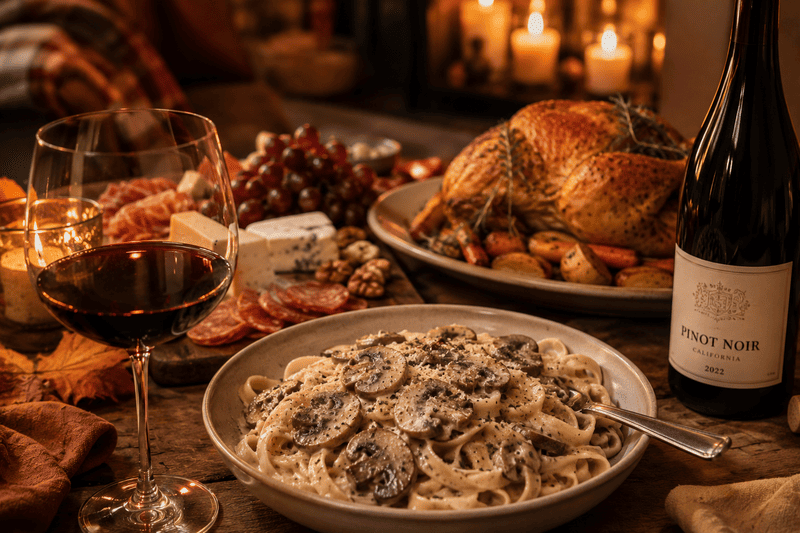
One of Pinot Noir’s greatest strengths in fall is how naturally it pairs with earthy dishes. Mushroom risotto is one of the classic examples, and for good reason. Pinot’s red fruit, acidity, and subtle forest-floor notes can make mushrooms taste even more savory while keeping the dish from feeling heavy. It is equally lovely with roast chicken, where the wine’s freshness and soft texture complement the bird without overpowering it. Salmon, especially when roasted or glazed in a slightly richer style, can be beautiful with Pinot Noir as well. Duck is another natural match, particularly when the dish includes cherries, herbs, or autumn spices.
Pinot Noir also deserves a place at the table with pork tenderloin, lentil dishes, and charcuterie boards loaded with cheeses, cured meats, nuts, fruit, and crusty bread. It is the sort of red that can handle a wide range of foods because it does not demand to dominate the meal. Instead, it weaves itself into the flavors already on the plate.
In the glass, Pinot Noir often brings notes of cherry, raspberry, cranberry, rose petal, dried leaves, tea, spice, and—depending on the producer—mushroom or forest floor. That earthy edge is one of the reasons it feels so right for fall. Pinot Noir mirrors the season’s rustic side without becoming heavy or brooding. It can feel elegant, but it can also feel quietly comforting, especially when paired with foods that lean savory, herbaceous, or gently earthy.
This is also an excellent bottle for readers who enjoy red wine but do not necessarily want something massive or oak-driven. If Cabernet Sauvignon feels too structured, Syrah too bold, or heavily oaked reds too overwhelming, Pinot Noir can be a wonderful answer. It offers enough depth to feel like a proper cool-weather wine, but it keeps things graceful and food-friendly.
For me, Pinot Noir is one of the most reliable red wines of early and mid-fall because it captures the season without overpowering it. It feels at home with mushroom pasta, roast chicken, salmon, duck, and cozy dinners that call for a red with elegance rather than sheer force. If you are looking for a wine that reflects the earthy, slightly rustic side of autumn while still feeling polished and approachable, Pinot Noir is one of the best places to begin.
Bottle Ideas to Try
Budget / approachable: Elouan Pinot Noir
A smooth, fruit-friendly Pinot Noir that offers enough richness for cool-weather dinners while still keeping Pinot’s signature red-fruited charm. A good easy-drinking option for roast chicken, mushroom dishes, salmon, and casual fall entertaining.
Step-up option: Willamette Valley Vineyards Whole Cluster Pinot Noir
A lovely step up if you want something a little more layered and autumnal, with bright fruit, spice, and earthy complexity that feels especially at home with mushroom risotto, duck, roast chicken, and cozy fall dinners.
Grenache: The Juicy, Soft-Spiced Red Made for Roast Chicken, Sausage, and Early Fall Comfort Food
If Pinot Noir is the graceful, earthy bridge into fall, Grenache is the red that invites you to relax into the season. It is warm without being heavy, flavorful without being aggressive, and generous without losing its sense of balance. In many ways, Grenache is one of the most underrated reds for early fall because it captures exactly what this part of the season often calls for: a wine with enough body and warmth to feel cozy, but enough freshness and softness to remain incredibly easy to drink.
This is the bottle I think of for those first truly comfortable autumn evenings—the ones where you can finally leave the windows open, roast a chicken, light a candle, and let dinner stretch a little longer than usual. Grenache has a way of feeling relaxed and inviting, which makes it especially appealing at a time of year that often blends weeknight comfort with casual entertaining. It is the kind of red you can pour at a laid-back dinner with friends, bring to a fall cookout, or open on a Sunday evening when the menu calls for something flavorful but not overly serious.
One of Grenache’s greatest strengths is its versatility at the table. It is wonderful with roast chicken, especially when herbs, garlic, or a pan sauce are involved. It loves sausage in all kinds of forms—from grilled sausages to sausage pasta to sausage and peppers. It works beautifully with burgers, especially those topped with caramelized onions, roasted peppers, or smoky cheeses. Mediterranean dishes are another natural fit, particularly meals that feature olives, tomatoes, eggplant, lamb, herbs, or olive oil. Grenache is also a lovely partner for roasted vegetables, tomato-based dishes with herbs, and charcuterie boards built around cured meats, hard cheeses, nuts, and fruit.
That food-friendliness is part of what makes Grenache such a smart choice for fall. It has more body than Pinot Noir, which gives it enough presence for heartier meals, but it does not carry the weight or tannic structure of a big Cabernet Sauvignon. That makes it ideal for readers who want a red that feels more substantial than a delicate summer red, yet still approachable enough for casual dinners and mixed company. It is a crowd-pleasing style of wine without being boring.
In the glass, Grenache often brings a generous mix of strawberry, raspberry, and red plum, along with baking spice, white pepper, dried herbs, and sometimes a subtle note of orange peel. Those flavors make it feel especially autumnal. There is fruit, certainly, but it is usually wrapped in warmth and spice rather than bright, candy-like sweetness. Good Grenache can feel juicy and comforting at the same time—exactly the kind of bottle that works when the food starts getting roastier, herbier, and a little more savory.
This is why I think of Grenache as the “easygoing but still autumnal” red. It is not brooding, stern, or overly structured. Instead, it brings warmth, spice, and a relaxed sense of pleasure to the table. If Pinot Noir feels too delicate and Cabernet Sauvignon feels too serious, Grenache often lands in a very happy middle ground.
For readers who want a red with a little more body than Pinot Noir but without the intensity of a heavier full-bodied wine, Grenache is a wonderful place to turn. It is one of fall’s most versatile bottles—just as happy beside roast chicken and charcuterie as it is with burgers, sausage, roasted vegetables, and herb-laced pasta.
Bottle Ideas to Try
Budget / approachable: Evodia Garnacha
A fantastic value bottle that delivers juicy red fruit, soft spice, and enough warmth to feel right at home with roast chicken, burgers, charcuterie, and casual fall dinners.
Step-up option: Juan Gil Silver Label
A richer, more polished expression of Garnacha that still keeps the grape’s generous fruit and spice intact. This is a great bottle for readers who want something cozy and crowd-pleasing with a little more depth for cooler evenings.
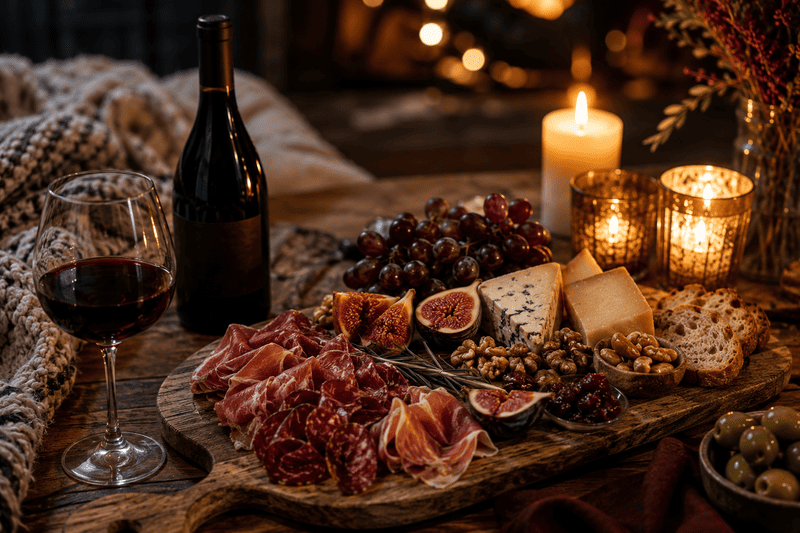
Merlot: The Plush, Comforting Red for Cozy Dinners and Cooler Evenings
If Grenache feels like the relaxed, easygoing side of fall, Merlot is where the season starts to settle into comfort-food mode. This is the red for cooler evenings, softer sweaters, baked pasta, meatloaf, and dinners that are meant to warm you from the inside out. Plush, approachable, and wonderfully versatile, Merlot deserves far more love than it often gets—and fall is one of the best times to remember just how satisfying it can be.
Merlot has spent years fighting against an unfair reputation, which is a shame, because when it is done well, it can be one of the most useful and enjoyable red wines on the table. It has enough fruit to feel generous, enough softness to make it approachable, and enough structure to hold up to hearty meals without becoming overwhelming. In other words, Merlot is exactly the kind of wine that shines when dinner starts getting richer and the evenings start getting colder.
This is the bottle I reach for when the menu leans deeply comforting. Meatloaf is a classic Merlot pairing because the wine’s plush fruit and gentle tannins fit the dish so naturally. It is equally good with burgers, especially when mushrooms, onions, or smoky cheeses come into play. Roast pork can be a lovely match, particularly if the dish includes herbs, roasted root vegetables, or a savory glaze. Merlot also works beautifully with mushroom dishes, whether that means a mushroom pasta, a creamy mushroom sauce, or a simple roasted mushroom side. Baked pasta, shepherd’s pie, and beef stew all fall comfortably into Merlot territory as well.
Part of Merlot’s charm is that it rarely asks too much of the drinker. It does not require a special occasion, a decanter, or a steakhouse reservation to make sense. It is simply a deeply accommodating wine—one that can handle weeknight dinners, family-style meals, and cozy nights in without feeling too casual or too formal. That balance is part of why it works so well in fall. It can be the bottle you open with takeout and a movie, or the one you serve at a dinner table full of comfort food and conversation.
Flavor-wise, Merlot tends to bring notes of plum, black cherry, cocoa, mocha, herbs, cedar, and soft spice. Depending on the producer, it may lean more fruit-forward and plush or more structured and savory, but in either case, it usually offers a softness that makes it especially inviting as the weather cools. There is something about those darker fruit notes mixed with cocoa, cedar, and gentle spice that feels perfectly aligned with fall cooking.
If I had to describe Merlot in one image, I would say it feels like the wine equivalent of putting on a soft sweater and making a comforting dinner. It is not flashy. It is not trying to prove anything. It is simply warm, reliable, and deeply satisfying in the right moment—which, in fall, is often exactly what you want.
For readers who love the idea of a red that can handle hearty meals without the tannic grip of Cabernet Sauvignon or the smoky intensity of Syrah, Merlot is an excellent choice. It offers depth without drama, comfort without heaviness, and enough versatility to pair with everything from burgers and roast pork to mushroom dishes and beef stew.
Bottle Ideas to Try
Budget / approachable: J. Lohr Los Osos Merlot
A fantastic value Merlot that delivers ripe dark fruit, soft texture, and just enough richness to feel perfectly at home with burgers, meatloaf, pasta, and cozy fall dinners.
Step-up option: L’Ecole No. 41 Merlot
A polished, beautifully balanced Merlot with deeper fruit, savory nuance, and structure, making it a wonderful choice for roast pork, mushroom dishes, shepherd’s pie, or a more elevated fall dinner.
When fall cooking turns toward chili, baked pasta, braises, and cozy weeknight dinners, richer reds like Merlot and Syrah start to feel right at home.
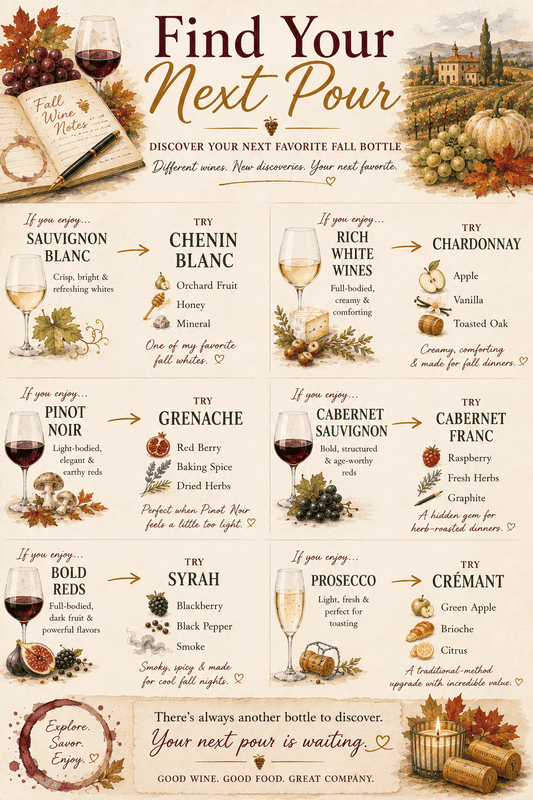
Syrah: The Smoky, Savory Red for Chili, Braises, and Firepit Weather
By the time you reach Syrah in the fall wine lineup, the season has shifted. The windows are open less often. The sweaters are heavier. The dinners are darker, slower, smokier, and more substantial. This is the moment when chili starts simmering on the stove, braises return to the table, and the idea of a red with real depth begins to sound less like a splurge and more like a necessity. Syrah is the bottle for that moment.
If Pinot Noir and Grenache represent the gentler, more transitional side of fall, Syrah is where the article fully leans into cooler evenings, savory dishes, and that first real craving for richer reds. It is bold without always being bulky, powerful without needing to be overly polished, and deeply satisfying when the food on the table has a little smoke, a little spice, and a lot of soul.
One of the reasons Syrah works so well in fall is that it can show two equally compelling sides of its personality. In some expressions, it leans peppery, savory, and smoky, with notes that feel almost tailor-made for cool-weather cooking. In others, it turns darker and more plush, bringing ripe blackberry and blueberry fruit wrapped in spice and texture. Either style can be fantastic in fall, because both have the depth and structure to stand up to heartier meals.
This is a wine that belongs with chili—especially if the bowl in front of you is rich with beans, beef, smoky spices, and just enough heat to make the wine’s fruit feel even more generous. It is excellent with grilled sausages, particularly when they are served with onions, peppers, mustard, or charred vegetables. Barbecue is another natural fit, especially when smoke and spice are part of the equation. Syrah also shines with lamb, braised short ribs, and dishes that lean heavily on black pepper, herbs, or slow-cooked savory richness.
In the glass, Syrah often offers flavors of blackberry, blueberry, black olive, black pepper, smoked meat, licorice, and violet. That combination is a big part of its appeal. It can be dark and brooding, yes, but it can also be beautifully aromatic and lifted. A good Syrah does not simply taste “big”; it tastes layered. The fruit gives it generosity, the spice gives it energy, and the savory notes give it the kind of complexity that makes it so compelling with fall food.
This is not necessarily the red I would open for every early-September dinner, but once fall really starts to settle in, Syrah becomes one of the season’s great comfort wines. It feels especially right for nights when the meal is smoky, meaty, or slow-cooked, and when you want the wine to bring both warmth and character to the table. It is the bottle for firepit weather, for chili night, for lamb with herbs, for grilled sausages after the sun has gone down earlier than you wanted it to.
For readers who enjoy bold reds but want something more savory and peppery than jammy, fruit-driven styles, Syrah is a wonderful place to land. It offers richness, but it also offers personality. And in a season built around comfort, spice, and deeply flavorful food, that combination can be hard to beat.
Bottle Ideas to Try
Budget / approachable: Columbia Crest Grand Estates Syrah
A reliable, affordable Syrah with dark fruit, spice, and enough smoky character to make it a great partner for burgers, sausages, chili, and casual cool-weather dinners.
Step-up option: Marietta Gibson Block Estate Grown Syrah
A more distinctive California Syrah with dark fruit, savory spice, and enough structure to feel special without becoming overly serious. This is a great step-up bottle for lamb, braised meats, barbecue, grilled sausages, or a cozy fall dinner when you want something richer and more memorable.
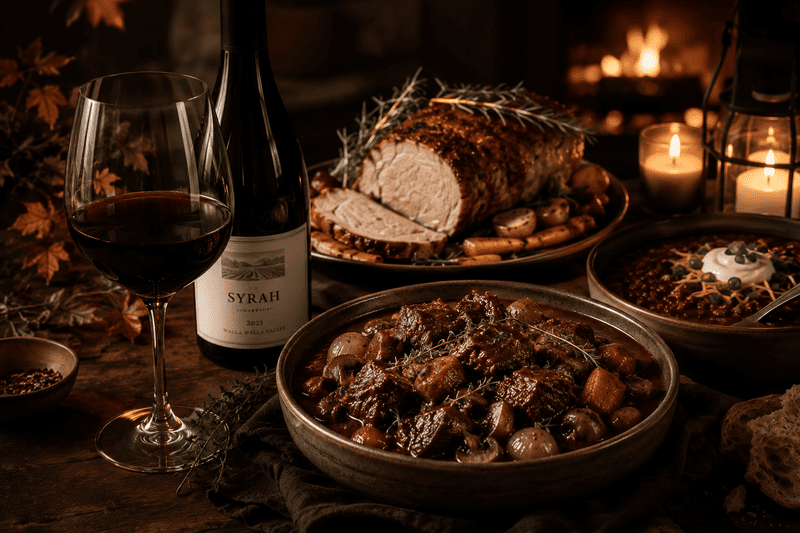
Cabernet Franc: The Savory, Herb-Laced Red That Shines with Roasted Vegetables and Fall Dinners
If Syrah is the point where the article reaches for boldness, Cabernet Franc is where it regains a little elegance and ends on something more distinctive, savory, and quietly sophisticated. It may not always be the first bottle people think of when they imagine fall red wine, but in many ways it is one of the smartest choices of the entire season.
Cabernet Franc has a beautiful way of balancing fruit, freshness, herbs, and earthy depth. It is expressive without being overpowering, savory without becoming austere, and food-friendly in a way that makes it especially useful once the menu turns toward roast chicken, pork, mushrooms, lentils, and root vegetables. If Cabernet Sauvignon can sometimes feel too firm or too steakhouse-focused for everyday fall dinners, Cabernet Franc often feels more nimble—still serious enough for cool weather, but much more comfortable around vegetables, herbs, and earthy dishes.
This is one of the reasons I love Cabernet Franc in fall: it shines with the foods that define the season without demanding that every meal revolve around a heavy cut of meat. Roast chicken is a beautiful example. The wine’s red fruit, herbal lift, and subtle earthiness can complement crispy skin, pan juices, and herbs wonderfully. Pork tenderloin is another natural pairing, especially when apples, root vegetables, mustard, or rosemary are involved. Mushrooms, lentils, and roasted vegetables are equally compelling partners, and Cabernet Franc can be especially rewarding with meals that feature sage, thyme, rosemary, stuffing-like flavors, or the earthy sweetness of roasted carrots, squash, and beets.
That vegetable-friendly side is one of Cabernet Franc’s greatest strengths. Some reds feel most at home with steaks, braises, and heavier meat dishes. Cabernet Franc can certainly handle meat, but it often feels most interesting when it is paired with dishes that highlight herbs, earthiness, and savory complexity rather than pure richness. That makes it an especially clever wine for fall, when so many meals revolve around mushrooms, root vegetables, poultry, and herb-forward cooking.
In the glass, Cabernet Franc can offer flavors of raspberry, red currant, plum, violets, graphite, tobacco, earth, and herbal notes that range from fresh green herbs to a more subtle leafy or peppery lift. Those herbal tones are part of what make the wine so compelling. In the wrong context, they can surprise people who are expecting something softer or more fruit-driven, but in fall they often feel exactly right. Paired with roast chicken, lentils, mushrooms, or pork, those notes become part of the wine’s charm rather than something to work around.
Cabernet Franc is the quietly sophisticated fall red—the bottle for readers who love food-friendly wines and want to branch out beyond the most obvious choices. It has enough freshness to keep the palate lively, enough fruit to feel inviting, and enough savory depth to make it memorable. It is not the loudest wine in this lineup, but it may be one of the most rewarding.
For readers who enjoy reds with character, structure, and a little herbal complexity—especially if they love pairing wine with roast chicken, vegetables, pork, and earthy dishes—Cabernet Franc is a beautiful way to close out the fall wine season. It is the kind of bottle that rewards curiosity, shines with food, and reminds you that some of the best wines of autumn are not always the biggest ones.
Bottle Ideas to Try
Budget / approachable: Bodega Garzón Cabernet Franc Reserva
A polished, accessible Cabernet Franc that offers ripe fruit, gentle herbal notes, and enough structure to pair beautifully with roast chicken, pork, mushrooms, and cozy fall dinners.
Step-up option: Bernard Baudry Chinon
A classic Loire Cabernet Franc that beautifully captures the grape’s savory, herb-laced side. With its freshness, earthy nuance, and food-friendly structure, it’s a wonderful choice for readers who want to explore Cabernet Franc with roast chicken, lentils, mushrooms, roasted vegetables, or a more elegant fall meal.
Cabernet Franc is the quietly sophisticated fall red—the one that shines with savory food and rewards readers who want to branch out.
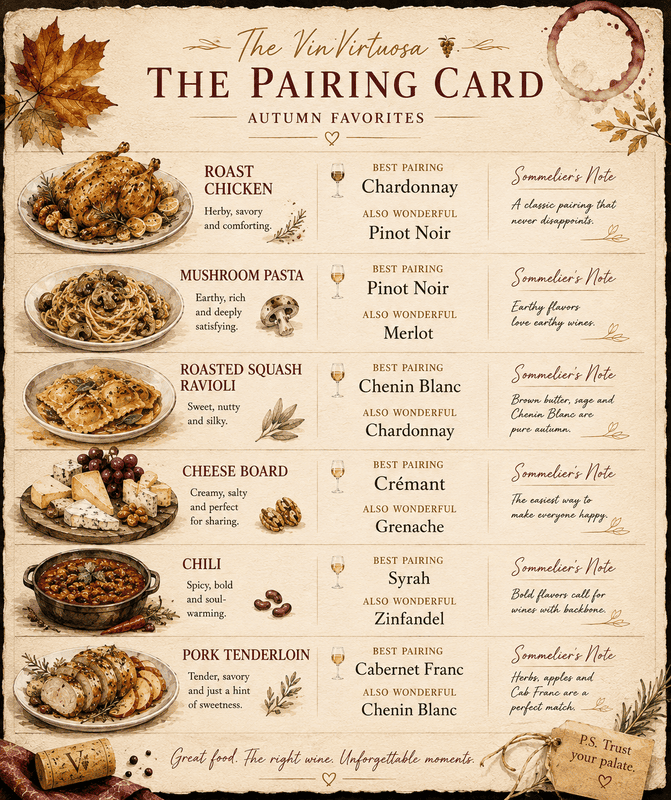
How to Build a Fall Wine Lineup Without Overthinking It
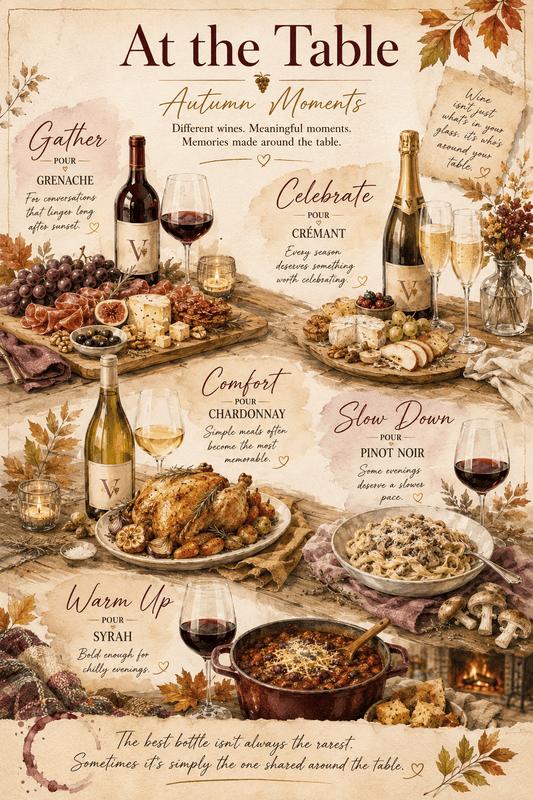
One of the best things about fall wine season is the variety. One night calls for a creamy Chardonnay with roast chicken, another for Pinot Noir with mushroom pasta, and another for Syrah with chili simmering on the stove. That range is part of what makes this season so much fun—but it can also make shopping feel a little overwhelming if you start thinking you need all eight wines on this list at once.
The good news is that you absolutely do not.
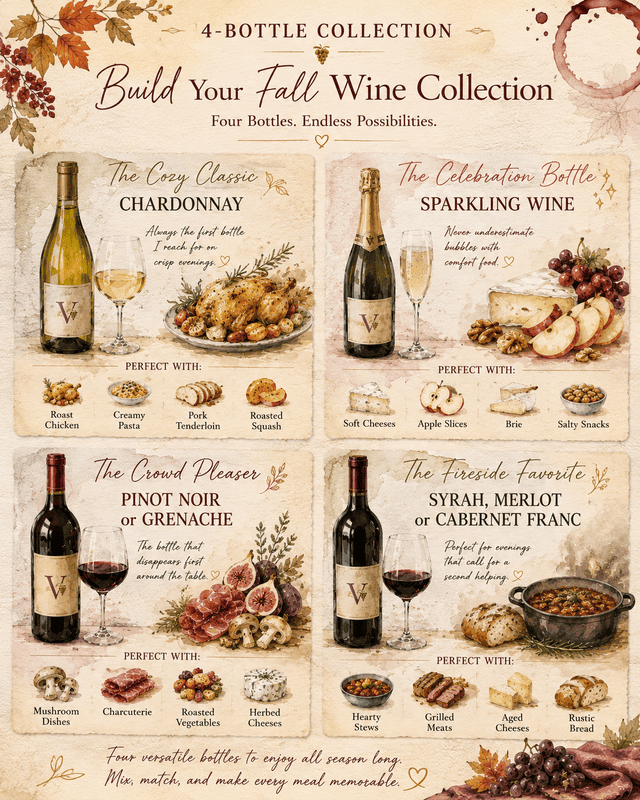
You do not need to stock your kitchen like a wine bar to enjoy fall wine season well. In fact, a simple four-bottle lineup can cover a surprising number of meals, moods, and gatherings. The trick is to think less about collecting every possible bottle and more about building a small lineup that gives you flexibility. If you have one versatile white, one bottle of bubbles, one lighter red, and one richer red, you can handle almost every kind of fall dinner or impromptu get-together with confidence.
Keep One Versatile White on Hand
A good fall white is one of the smartest bottles you can keep in the house because it gives you an easy option for weeknight dinners that are comforting but not overly heavy. If your fall cooking tends to lean creamy, buttery, or roast-chicken friendly, Chardonnay is a beautiful choice. It is especially useful with roast chicken, pork chops, creamy pasta, butternut squash ravioli, and richer seafood dishes.
If your meals lean a little brighter, more vegetable-driven, or more savory-sweet, Chenin Blanc is another excellent option. It is wonderful with pork, roasted squash, root vegetables, goat cheese, and even certain spicy dishes. It also has a freshness that can be especially appealing in early fall, when the weather is still shifting and not every meal calls for something rich.
You do not necessarily need both on hand at all times. Choose the one that better reflects how you cook and eat in fall. If you love creamy pasta, roast chicken, and richer comfort food, start with Chardonnay. If you gravitate toward pork, roasted vegetables, cheese boards, and dishes with apples, herbs, or spice, Chenin Blanc may be the better fit.
Keep One Bottle of Bubbles in the Fridge
If there is one wine category that quietly saves the day over and over again, it is sparkling wine.
Fall is full of moments when a bottle of bubbles suddenly becomes useful: friends stop by, someone brings cheese, brunch plans appear out of nowhere, you decide to put together a snack board, or you simply want something festive before dinner. Sparkling wine is one of the easiest bottles to pair with a wide range of foods, and it instantly makes even a casual gathering feel a little more celebratory.
This is the bottle for cheese boards, fried appetizers, salty snacks, brunch spreads, and spontaneous celebrations. It is also a wonderful insurance policy when you are not quite sure what food is coming but you know people are coming over. A bottle of Brut sparkling wine or a food-friendly sparkling rosé can handle more than most people give it credit for.
If you only keep one sparkling bottle on hand all season, you will probably find more excuses to open it than you expected.
Keep One Lighter Red and One Richer Red
This is where fall wine shopping gets especially fun. Once you have a white and a sparkling wine covered, the easiest way to build a flexible red wine lineup is to keep one bottle that leans lighter and more versatile, and one that leans deeper, richer, or more savory.
For the lighter-to-medium red slot, Pinot Noir and Grenache are both excellent choices. Pinot Noir is ideal if you love mushroom dishes, roast chicken, salmon, lentils, and elegant, earthy reds that never feel too heavy. Grenache is the better fit if you want something a little warmer and juicier—great for burgers, sausage, roasted vegetables, charcuterie, and relaxed early-fall dinners.
For the richer or cozier red slot, Merlot, Syrah, and Cabernet Franc all bring something different to the table. Merlot is the comfort-food specialist, perfect for meatloaf, baked pasta, roast pork, mushroom dishes, and beef stew. Syrah is the bold, smoky option for chili, grilled sausages, lamb, barbecue, and nights when you want something darker and more savory. Cabernet Franc offers a more herb-laced, food-focused style that shines with roast chicken, pork tenderloin, mushrooms, lentils, and roasted vegetables.
Choosing one from each category gives you a simple but extremely useful little fall wine bench: something lighter for earthy or poultry-based meals, and something deeper for richer, colder-weather dinners.
Match the Bottle to the Meal or Mood
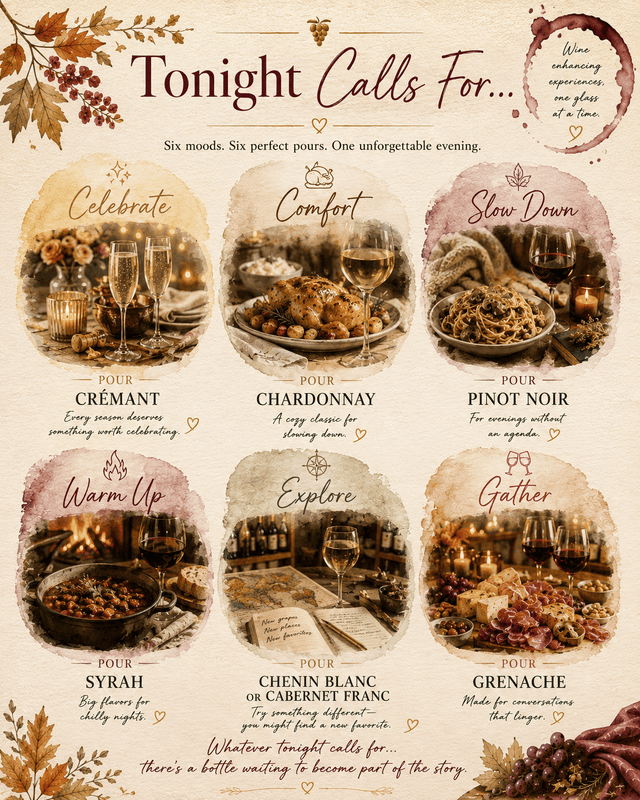
If you are not sure which bottle to open, think about the meal or the mood before anything else. Fall wine pairing does not have to be complicated; often it is simply about matching the weight and personality of the wine to the feeling of the evening.
If roast chicken is on the menu, Chardonnay or Pinot Noir are both excellent places to start. If you are making mushroom pasta, Pinot Noir and Merlot are especially appealing. Chili or braised meat practically asks for Syrah. A charcuterie board and a few friends around the table could go in several directions, but Sparkling Wine and Grenache are both wonderful choices. Pork with apples or roasted vegetables feels right at home with Chenin Blanc or Cabernet Franc.
In other words, the goal is not to memorize a giant pairing chart. It is simply to know what kind of role each bottle can play in your kitchen. Once you understand that, building a fall wine lineup becomes much easier—and much more fun.
With just four thoughtfully chosen bottles—a white, a sparkling wine, a lighter red, and a richer red—you can cover almost every kind of fall meal and gathering with confidence.
You don’t need all eight wines at once. A white, a sparkling bottle, a lighter red, and a richer red can cover almost every kind of fall meal and gathering.
Final Thoughts
One of the best things about fall wine season is that it does not demand one single style of drinking. This is not a season that belongs only to the biggest red you can find, nor is it a time to retire white wine and sparkling wine the moment the weather cools down. Fall is far more interesting than that.
The best wines for this season are often the ones that balance comfort with freshness, richness with structure, and savory depth with enough energy to keep the meal feeling alive. That is what makes fall such a rewarding time to explore wine. You can move from Chardonnay and Chenin Blanc into Pinot Noir, Grenache, Merlot, Syrah, and Cabernet Franc depending on the weather, the meal, and the mood. One week may call for sparkling wine and a cheese board on the patio. The next may call for Merlot with baked pasta or Syrah with chili by the firepit.
That range is part of the fun.
If you are looking for a simple way to use this season as an excuse to expand your palate, try this: pick up one white you do not usually buy, one red that feels especially autumnal, and one bottle of bubbles you might not normally think to open in October. Fall is one of the easiest times of year to experiment because the food is so varied and the mood is already built around gathering, lingering, and enjoying what is on the table.
Whether your ideal fall evening involves roast chicken and Chardonnay, mushroom pasta and Pinot Noir, charcuterie and sparkling wine, or a cozy bowl of chili with a glass of Syrah, the season offers no shortage of delicious ways to explore. The best wines to welcome fall are the ones that make you want to linger at the table a little longer, pour one more glass, and fully settle into everything this season does so well.